

Argentina 3-0 Algeria: Messi's Hat-Trick, Records Broken, and the Champions' Statement
World Cup 2026 Group J. Lionel Messi scored a hat-trick on his 200th Argentina appearance as the defending champions beat Algeria 3-0 at Arrowhead Stadium. Messi equalled Miroslav Klose's all-time World Cup record of 16 goals and became only the second player to score in five different World Cups.
Published: June 17, 2026
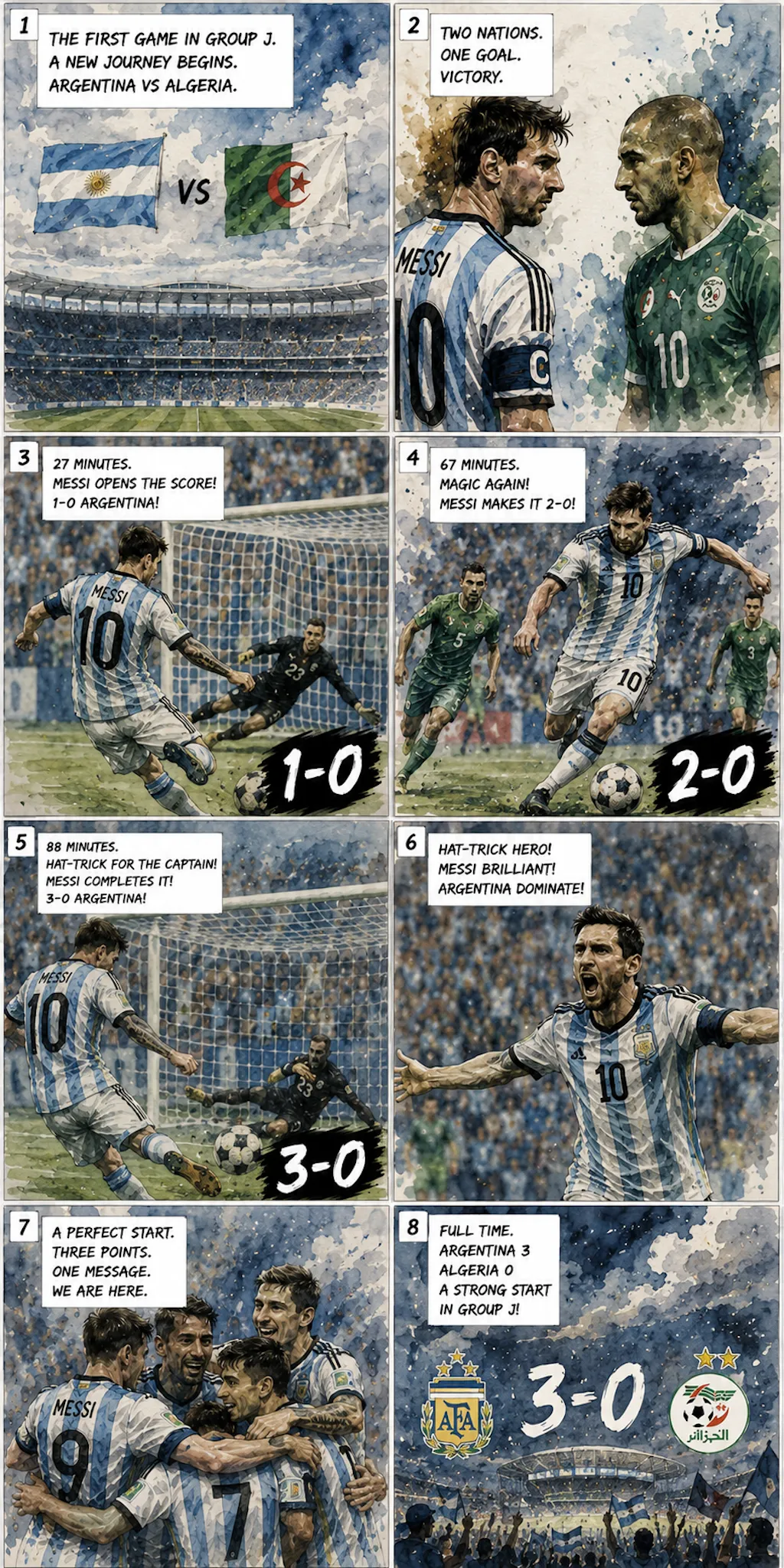
Comic content and match statistics are for entertainment purposes only and may contain inaccuracies. For Accurate Data, please refer to the reference's official website.
# Argentina 3-0 Algeria: Messi's Hat-Trick, the 4-3-3's Return, and a Tactical Masterclass at Arrowhead
The opening match of a World Cup for the defending champions carries a specific kind of tactical burden. Not merely the expectation of victory — that is a given — but the expectation that the victory should demonstrate something: a philosophy, a system, an identity that justifies the crown. Argentina's 3-0 dismantling of Algeria at Arrowhead Stadium in Kansas City did precisely that. It was not merely a win; it was a tactical statement, delivered with the clarity of a training-ground exercise and elevated to the sublime by the individual genius of a 38-year-old Lionel Messi.
The Argentine 4-3-3 that took the field in the Missouri heat was not identical to the shape that won the World Cup in 2022, but the principles were recognisable. Lionel Scaloni's system remains built around three core ideas: control of central midfield through numerical superiority, width provided by full-backs rather than wingers, and a fluid front three in which Messi is granted complete positional freedom. Against an Algeria side set up by Djamel Belmadi in a 5-4-1 mid-block, these principles would be tested — and, ultimately, vindicated.
## The 4-3-3 Against the 5-4-1: Space in the Half-Channels
The early exchanges established the tactical pattern that would define the match. Algeria's 5-4-1 was designed to deny Argentina access to the central zone — that crucial area between the opposition's midfield and defensive lines where Messi has spent his career dismantling opponents. The two Algerian holding midfielders, Nabil Bentaleb and Hicham Boudaoui, positioned themselves in front of the back five with remarkable discipline in the opening ten minutes, effectively sealing off the pocket between the lines.
Argentina's response was to overload the half-channels. Alexis Mac Allister, nominally the left-sided central midfielder in Scaloni's 4-3-3, was instructed to drift into the left half-space — that area between the Algerian right centre-back and right wing-back — while Enzo Fernández held his position slightly deeper to provide the passing option from which these movements could be launched. The positioning was not random; it was designed to pull Boudaoui wide, creating a gap between the Algerian midfield lines through which Messi could receive.
The pattern produced two early offside goals — Messi in the 5th minute, Algeria's Farès Chaïbi in the 8th — and both were instructive. Argentina's disallowed goal came from precisely the movement described: Mac Allister in the left half-channel, a threaded pass to Messi, a finish that was ruled offside by a matter of inches. Algeria's disallowed goal, by contrast, came from a transition moment: a long ball over the Argentine high line, Chaïbi's pace exploiting the space behind Cristian Romero. The symmetry was revealing — both teams were attempting to exploit the same structural vulnerability, but only one had the system to do so consistently.
## Messi's First Goal: The Geometry of a Long-Range Finish
The opening goal, when it arrived in the 17th minute, was not the product of an elaborate passing sequence but of a moment of individual brilliance that was itself a product of the system. Argentina had been working the ball through the right half-channel — Rodrigo De Paul, the right-sided midfielder in the three, had been increasingly influential as the match progressed — when the ball was played infield to Messi, who had dropped into a pocket of space approximately 25 metres from goal.
Algeria's defensive shape was, at this moment, theoretically correct. Bentaleb was positioned between Messi and the goal. Boudaoui was providing cover. The back five were set. But Messi's first touch pushed the ball to his left — away from Bentaleb's pressure — and his second, taken with almost no backlift, sent the ball arrowing into the top-right corner past Luca Zidane. The shot was struck from 22 metres. The Expected Goals value of such an effort, in normal circumstances, would be below 0.05. But Messi is not a normal circumstance.
The goal was Messi's 14th at World Cups, drawing him level with Gerd Müller. But the number, as always with Messi, is less interesting than the geometry. The angle at which the ball left his left boot — approximately 18 degrees from the vertical plane — and the power generated from a standing start with minimal backlift are the kinds of details that biomechanists will study long after the 2026 World Cup has faded from memory.
## The First Half: Territory Without Penetration
The period between Messi's opener and half-time was a study in territorial dominance without penetration — a pattern familiar to anyone who has watched Argentina under Scaloni. Argentina enjoyed 63% possession in the first half and completed 297 passes to Algeria's 158. But the shot map told a different story: Argentina registered four shots, two on target; Algeria registered three shots, one on target.
The reason was Algeria's defensive organisation. Belmadi's 5-4-1 compressed into a 5-4-1 low block whenever Argentina entered the attacking third, and the distance between the Algerian defensive line and the midfield line — approximately 12 metres — left almost no space for Messi or Lautaro Martínez to operate. Argentina's full-backs, Gonzalo Montiel and Facundo Medina, were seeing plenty of the ball but delivering crosses of insufficient quality to trouble the Algerian back three.
The half-time statistics painted the picture of a match that Argentina were controlling without dominating. Expected Goals: Argentina 0.48, Algeria 0.22. The champions were ahead, but they had not been convincing.
## Scaloni's Adjustments and the Second-Half Onslaught
The second half introduced two significant tactical changes. First, Nahuel Molina replaced Montiel at right-back — a substitution that added attacking thrust to Argentina's right flank. Molina's first five touches were all in the Algerian half, and his overlapping runs immediately stretched the Algerian defensive block wider than it had been in the first half.
Second — and more subtly — Messi's positioning shifted. In the first half, he had been operating primarily in the right half-space, the area of the pitch where he has spent most of his career. In the second half, he began appearing in the left half-space as well, swapping positions with Nicolás González (who had replaced Thiago Almada) in a fluid interchange that Algeria's defensive structure could not track.
The consequence was the second goal, in the 60th minute. Molina's overlap on the right drew the Algerian left wing-back Rayan Aït-Nouri out of position, creating a gap between Aït-Nouri and the left-sided centre-back. Mac Allister exploited this gap with a run into the penalty area. His shot was parried by Zidane — a fine reaction save — but the rebound fell to Messi, who had drifted into precisely the space that the defensive disorganisation had created. The finish was simple, a side-foot into an empty net, but the simplicity was the point: Messi's movement had created the conditions for the chance before Mac Allister had even received the ball.
The goal was Messi's 15th at World Cups, equalling Ronaldo Nazário for second on the all-time list. But again, the number obscures the tactical story. Argentina had scored because they had stretched Algeria's defensive block beyond its capacity to maintain structural integrity. The goal was not merely a goal; it was the logical conclusion of Scaloni's tactical adjustments.
## The Hat-Trick: History Sealed
The third goal, in the 76th minute, was the masterpiece. Messi received the ball on the edge of the Algerian penalty area — this time from the left side of the pitch, having drifted wide during a period of sustained Argentine possession. The Algerian defensive shape was, by this point, visibly fatigued. The distance between the defensive line and the midfield line had expanded to approximately 18 metres — a gap that Messi, even at 38, can exploit in his sleep.
He did not need to run. A drop of the shoulder created half a yard of space. The left-footed finish, struck low and hard into the bottom-right corner, was the kind of shot that goalkeepers see coming and cannot reach. 3-0 Argentina. Messi's 16th World Cup goal — equalling Miroslav Klose's all-time record. His 120th for Argentina. His first World Cup hat-trick. On his 200th appearance for the national team.
Scaloni substituted Messi in the 80th minute, and the standing ovation that followed — from Argentine supporters, from Algerian supporters, from the neutral Americans who had come to Arrowhead to witness history — was the kind of spontaneous expression of collective appreciation that transcends the tribal divisions of sport.
## What It Means
The result puts Argentina atop Group J with three points and a plus-three goal difference. The defending champions have announced their intentions with a performance that combined tactical discipline with individual brilliance in proportions that should concern every other contender in this tournament.
The 4-3-3 system, with its emphasis on half-channel overloads and full-back progression, functioned precisely as Scaloni intended — even if the first half demonstrated its vulnerabilities against a compact mid-block. The introduction of Molina at right-back and the positional fluidity of the second-half front three suggest that Argentina have tactical solutions beyond the starting XI. That is the mark of a serious title contender.
For Algeria, the result was sobering but not catastrophic. The 5-4-1 mid-block worked well for thirty-five minutes — the period between Messi's first offside goal and his legitimate opener — and Belmadi will take encouragement from the defensive organisation that limited Argentina to 0.48 xG in the first half. The problem, as it so often is against teams of Argentina's calibre, was sustaining that organisation for ninety minutes against an opponent that can bring Nahuel Molina, Nicolás González, and Julián Álvarez off the bench.
The tactical story of this match was Argentina's capacity to create chances through half-channel combinations. The human story was Messi, at 38, producing a World Cup hat-trick that equalled the all-time goals record. The two stories are not separate. Messi's goals were not acts of isolated genius but the products of a system designed to create the conditions in which his genius can flourish. The system delivered. The genius delivered. The scoreboard — Argentina 3, Algeria 0 — recorded the conclusion.