

Ghana 1-0 Panama: Yirenkyi Last-Gasp Winner in Toronto
Ghana 1-0 Panama. Caleb Yirenkyi scored in the 95th minute to give Ghana a dramatic victory at BMO Field in Toronto. Substitute Brandon Thomas-Asante created the winner, sliding a low cross that Yirenkyi tapped home from close range. Panama dominated possession but could not find a breakthrough.
Published: June 18, 2026
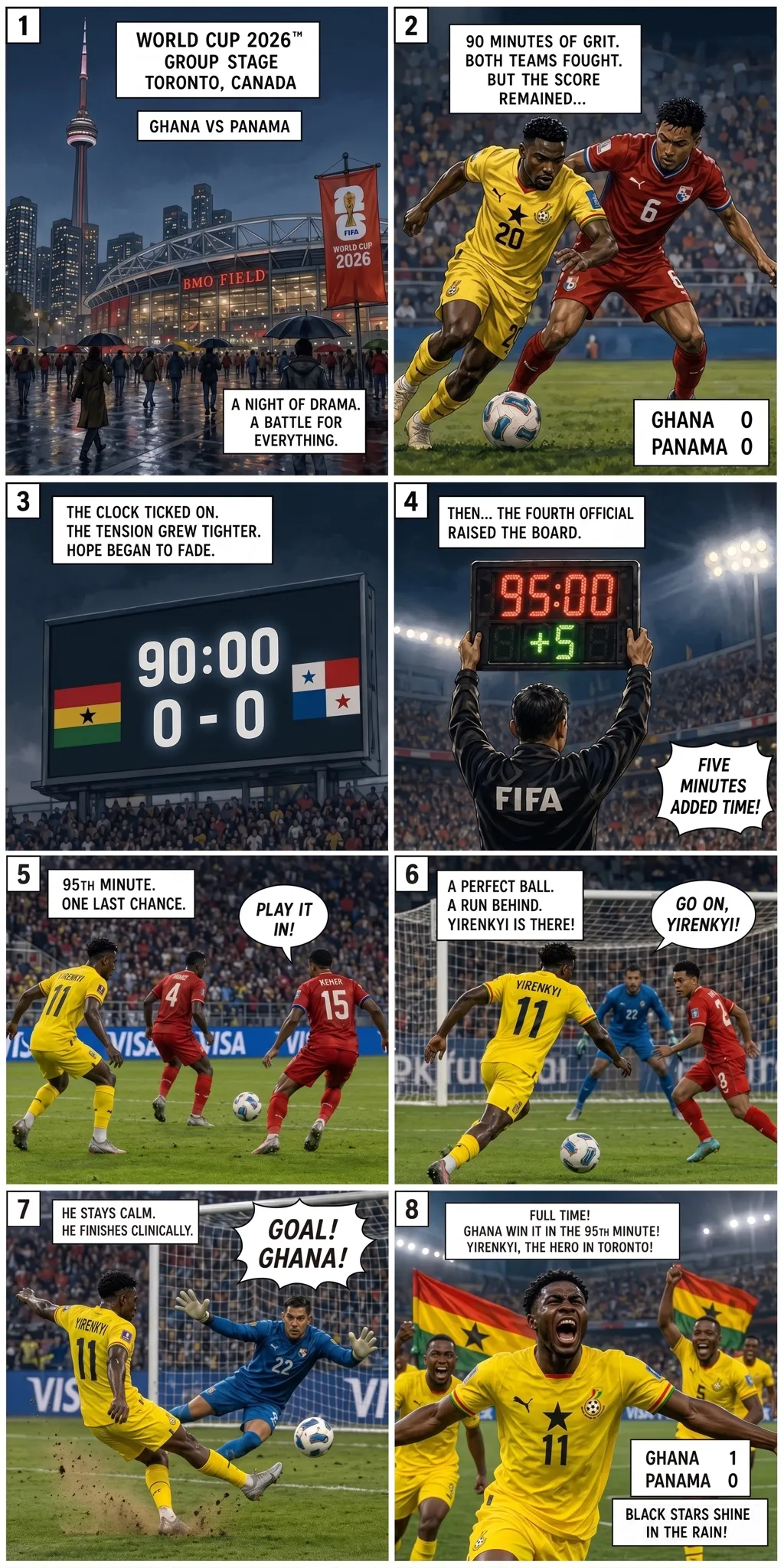
Comic content and match statistics are for entertainment purposes only and may contain inaccuracies. For Accurate Data, please refer to the reference's official website.
# Ghana 1-0 Panama: Yirenkyi's Last Breath, Toronto's Rain, and a Victory Stolen from the Jaws of Nothing
BMO Field, Toronto. A stadium built on the shore of Lake Ontario, where the wind comes off the water with the kind of bite that makes you forget it's June. The rain had been falling since the morning — not the tropical downpour that drowns out conversation, but the persistent, drizzly kind that seeps into your bones and makes everything feel heavier than it actually is. By the time the final whistle blew, the rain had stopped. But nobody in the Ghanaian section had noticed. They were too busy celebrating a goal scored in the fifth minute of stoppage time, the kind of goal that turns a forgettable 0-0 into a memory that will be recounted in Accra and Kumasi for generations.
Let me tell you about the goal, because it deserves telling. But first, let me tell you about the ninety minutes that preceded it — because without them, the goal means nothing.
Ghana came into this tournament carrying the weight of a continent's expectations. Not necessarily because anyone expected them to win the World Cup — let's be serious — but because they represent something. They are the Black Stars, the team of Abedi Pele and Michael Essien, of Asamoah Gyan and the Suárez handball that still gets talked about in bars from Cape Coast to Tamale sixteen years later. They are, in the African football imagination, the team that always threatens to do something special but so often finds a way to fall just short. The absence of Thomas Partey — denied entry to Canada for reasons that belong in a courtroom rather than a match report — had cast a shadow over their preparations that no amount of tactical planning could fully dispel.
Panama, for their part, arrived at BMO Field with nothing to lose and everything to prove. The Canaleros, making their second World Cup appearance after a debut in 2018 that had produced three defeats and a tournament to forget, had been the better side for long stretches of the first half. They pressed with intelligence. They kept the ball with a composure that belied their status as Group L's lowest-ranked team. They looked, for forty-five minutes, like the team that wanted it more.
The first half was not a classic. Let's not pretend it was. Panama had twelve shots to Ghana's seven across the ninety minutes. They controlled sixty-two percent of the possession. The statistics will tell you that Panama were the better side, and the statistics would not be lying. Cecilio Waterman tested Lawrence Ati-Zigi within the first two minutes. Jiovany Ramos sent a shot over the crossbar that he should have done better with. A penalty appeal in the thirty-fourth minute — waved away by the Swedish referee Glenn Nyberg — sent the Panamanian bench into a fury that took several minutes to subside. The rain kept falling. The clock kept ticking. And somewhere in the Ghanaian defence, a quiet rearguard action was taking shape.
Alexander Djiku, the Fenerbahçe centre-back whose name is not yet known in every household but ought to be, was immense. Mohammed Salisu, his partner at the heart of the defence, blocked, intercepted, and cleared with the grim determination of a man who had decided that no Panamanian footballer was going to score on his watch. Behind them, Ati-Zigi — the St. Gallen goalkeeper whose journey to this World Cup had taken him through the Ghanaian lower divisions and the Swiss Super League — made the saves he needed to make. None of them were spectacular. All of them were necessary.
The second half was more of the same, which is to say it was a match that seemed destined to end 0-0. Ghana had chances — Mohammed Kudus, the West Ham midfielder whose close control is the kind of thing that makes coaches purr, danced through two defenders in the sixty-eighth minute only to see his shot blocked by the outstretched leg of Jiovany Ramos. Panama had theirs — a free-kick from twenty-two metres that curled just wide of Ati-Zigi's left post. The match entered stoppage time with the scoreboard still reading 0-0, and the 42,942 souls inside BMO Field — plus the millions watching around the world — had largely resigned themselves to a result that would have been fair but forgettable.
Then came the ninety-fifth minute.
Football has a way of producing moments that transcend the matches in which they occur. The goal that Caleb Yirenkyi scored in the fifth minute of stoppage time was not a work of art. It was not a strike of technical brilliance or a moment of individual genius. It was simpler than that, and somehow more beautiful for its simplicity. Brandon Thomas-Asante — the Coventry City forward who had entered the match as a substitute, whose journey to this World Cup had taken him through the lower divisions of English football, who was playing in his first World Cup match — received the ball on the left flank and did the one thing that every coach tells every winger to do: he ran. He ran at the Panamanian defence, which by this point was understandably tired, and he delivered a low cross into the six-yard box. Yirenkyi — the 24-year-old midfielder who had been booked in the sixteenth minute, who had spent the rest of the match walking the tightrope between commitment and catastrophe — arrived at the back post and tapped the ball into an empty net from close range.
The ball crossed the line. The Ghanaian bench emptied. The Panamanian players fell to the ground. And somewhere in Toronto, in the stands behind the goal where the Ghanaian supporters had been singing since the first minute, a sound erupted that contained within it every year of waiting, every near-miss, every moment of doubt that had preceded this one.
The goal was Ghana's first of the 2026 World Cup. It was Yirenkyi's first at this level. It was the latest winning goal scored in the tournament so far — a record that may stand for days or may stand for weeks, but will stand forever in the memory of those who witnessed it. The match ended moments later. Ghana 1, Panama 0.
For Panama, the result was cruel. They had been the better side for significant periods. They had controlled possession, created chances, and generally looked like a team that belonged at this level. But football, as the great Italian football writer Gianni Brera once observed, is not a sport of justice. It is a sport of goals. And Ghana scored the only one that mattered.
For Ghana, the result was three points and a place atop Group L alongside England, who had beaten Croatia 4-2 earlier in the day. The Black Stars face England next in Boston — a match that will carry its own historical weight, its own set of narratives, its own possibilities. But that is for another day. Tonight, in Toronto, the story belongs to Caleb Yirenkyi and Brandon Thomas-Asante, to Alexander Djiku and Lawrence Ati-Zigi, to the substitutes who changed the game and the supporters who never stopped believing that the game could be changed.
The rain had stopped. The Ghanaian players walked toward their supporters and received an ovation that was entirely deserved. I folded my notebook and walked out into the Toronto night. The coffee I'd been nursing had gone cold hours ago. It didn't matter. Some things, as they say in the coffee shops of Accra, are worth the wait.