

Uzbekistan 1-3 Colombia: Diaz, Mina, Shomurodov, and a Debut to Remember
Colombia 3-1 Uzbekistan. Luis Diaz opened the scoring before Yerry Mina headed a second. Eldor Shomurodov scored Uzbekistan's first-ever World Cup goal to make it 2-1, before Rafael Santos Borre sealed the win. Uzbekistan's World Cup debut was brave but Colombia's quality told.
Published: June 18, 2026
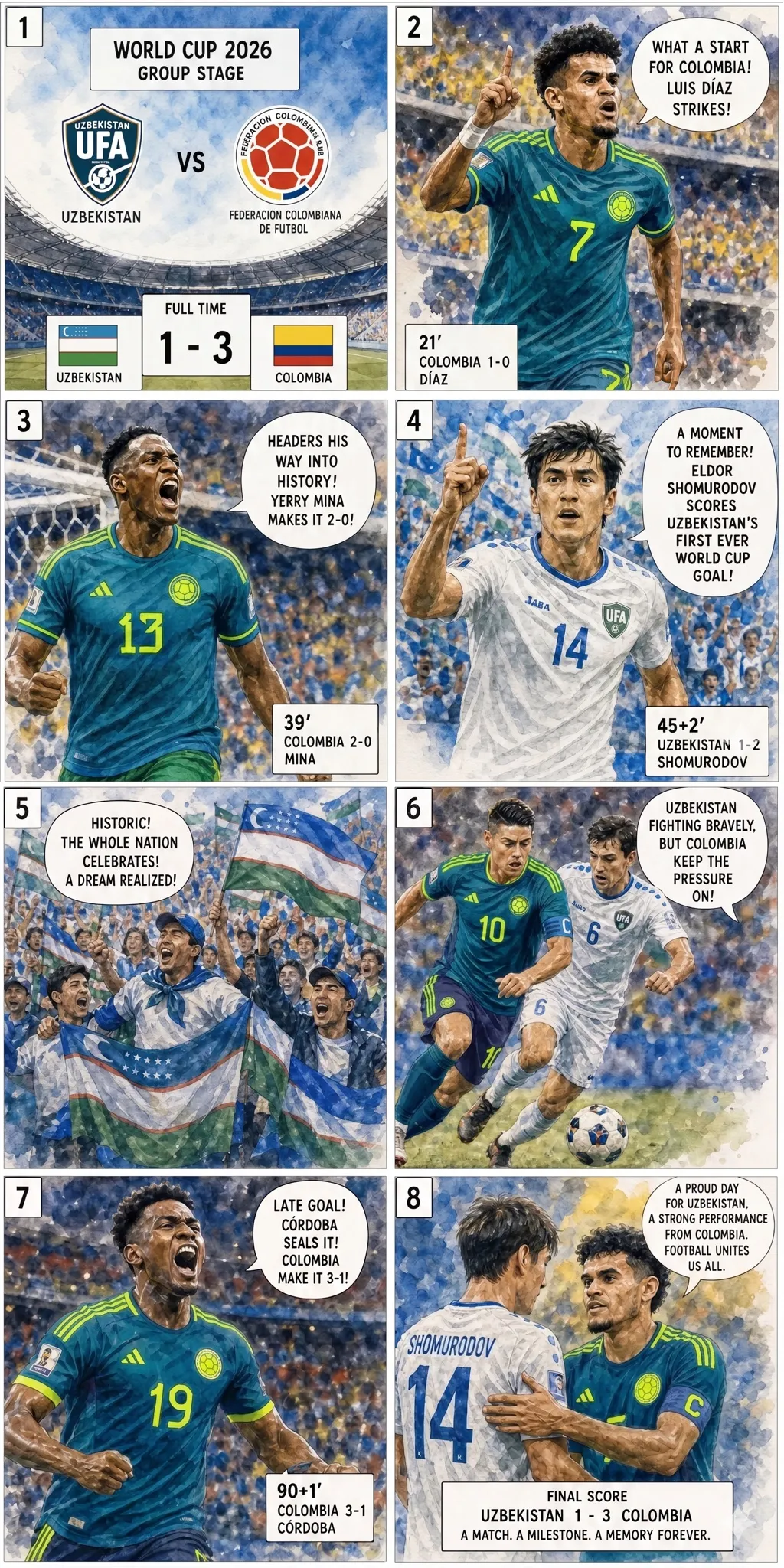
Comic content and match statistics are for entertainment purposes only and may contain inaccuracies. For Accurate Data, please refer to the reference's official website.
# Uzbekistan 1-3 Colombia: Díaz's Masterclass, Shomurodov's Pride, and the Longest Journey
Estadio Azteca, Mexico City. A coliseum that has seen Pelé and Maradona lift the World Cup, that has witnessed the Hand of God and the Goal of the Century, that holds 87,000 souls within its concrete bowl and somehow makes every one of them feel like they are sitting on the edge of a volcano. On a rain-soaked Wednesday night, it played host to a match that nobody in the football aristocracy had circled on their calendar — and that, in the end, was precisely what made it beautiful. Uzbekistan, making their World Cup debut in their first-ever appearance at this level, against Colombia, the perennial dark horses who had travelled to Mexico City with a squad that looked, on paper, far too strong for a team playing their first match on this stage. The score at the final whistle read Colombia 3, Uzbekistan 1. It was a scoreline that told only a fraction of the story.
Let me tell you about the match, because it deserves telling.
The opening exchanges established a pattern that would define the first half. Colombia, with their 4-2-3-1 system orchestrated by the ever-elegant James Rodríguez — still producing at thirty-four, still playing passes that seem to have been drawn with a protractor — controlled the ball with the quiet arrogance of a team that expected to win. Their possession figures hovered around sixty percent. Their passing triangles in midfield, anchored by the double pivot of Jefferson Lerma and Kevin Castaño, were crisp and purposeful. But Uzbekistan, to their immense credit, did not fold. They defended in a compact 5-4-1 that occasionally became a 5-3-2 when Eldor Shomurodov, the Roma striker whose name is known in every café from Tashkent to Samarkand, dropped deep to link play. The system was not sophisticated, but it was disciplined, and for thirty-one minutes it held.
The first goal, when it arrived in the thirty-second minute, was Luis Díaz at his most Luis Díaz. The Liverpool winger — and let us be clear, he is so much more than a winger — collected the ball on the left flank, cut inside past the Uzbek right-back with a drop of the shoulder that sent the defender sliding toward the corner flag, and struck a shot from the edge of the penalty area. The ball took a slight deflection — enough to wrong-foot Utkir Yusupov in the Uzbek goal, not enough to diminish the quality of the strike — and nestled in the bottom corner. Díaz ran toward the corner flag with his arms outstretched, and the Colombian supporters behind the goal erupted with a sound that could have been heard in Barranquilla.
The goal was Díaz's third in World Cup football. It felt, even in the moment, like a statement. Colombia were here. Colombia were serious.
The second Colombian goal arrived in the fifty-second minute, and it arrived via a route that has become almost boringly familiar to anyone who has watched this team over the past decade. A corner from James Rodríguez — the ball delivered with that distinctive whip that makes goalkeepers second-guess their positioning — found the head of Yerry Mina, the Cagliari centre-back whose aerial prowess at set pieces is one of football's least-guarded secrets. Mina rose between two Uzbek defenders and powered a header past Yusupov. 2-0 Colombia. The goal was Mina's fourth in World Cup competition. All four have been headers. All four have come from set pieces. At some point, opponents might consider marking him.
But the third act of this match belonged to Uzbekistan — and it lasted, in its purest form, for exactly twenty-four minutes.
In the fifty-sixth minute, four minutes after Mina's goal, Uzbekistan pulled one back in a manner that will be replayed in Tashkent for as long as people in Tashkent replay football matches. A long diagonal ball from the right flank found Khojiakbar Alijonov, the Pakhtakor winger whose pace had been Uzbekistan's most reliable attacking outlet throughout the first half. Alijonov beat his marker on the outside — a moment of genuine quality that deserved a better outcome than it initially received — and delivered a low cross into the penalty area. What happened next was one of those moments that the World Cup, at its best, is uniquely capable of producing. Eldor Shomurodov — the captain, the talisman, the man who had carried Uzbek football's hopes on his shoulders for the better part of a decade — arrived at the near post and redirected the ball past Camilo Vargas with a finish that was half improvisation and half instinct.
Shomurodov did not celebrate wildly. He turned, pumped his fist once — a single, contained gesture that carried more weight than a thousand knee-slides — and ran back toward the halfway line. He understood, perhaps better than anyone else on the pitch, that Uzbekistan were still trailing. But the goal itself was a piece of history. The first World Cup goal in Uzbekistan's history. The first time a player from that Central Asian nation of thirty-five million people had scored on football's grandest stage. The goal was not merely a goal. It was an arrival.
For the next twenty-four minutes — from the fifty-sixth to the eightieth — Uzbekistan pressed for an equaliser with the desperate energy of a team that understood the opportunity before them. Alijonov continued to cause problems on the flank. Shomurodov, emboldened by his goal, began dropping deeper and driving at the Colombian defence with the ball at his feet. The Uzbek supporters — a travelling contingent of perhaps three thousand who had crossed an ocean and a continent to be here — had not stopped singing since Shomurodov's goal. For twenty-four minutes, 1-2 felt like the most dangerous scoreline in football.
Colombia's third goal, when it arrived in the seventy-eighth minute, was a release. A sweeping counter-attack that began with a Colombian interception on the edge of their own penalty area and ended, nine seconds later, with Rafael Santos Borré — the River Plate forward who had entered as a substitute ten minutes earlier — sliding the ball past Yusupov from twelve yards. The goal restored the two-goal cushion. It settled the match. It allowed the Colombian supporters to finally exhale.
When the final whistle blew, Shomurodov exchanged shirts with Díaz — a gesture that felt meaningful, the established global superstar acknowledging the debutant captain who had just scored his nation's first World Cup goal. The Uzbek players walked toward their supporters and received an ovation that was entirely deserved. They had scored at their first World Cup. They had pushed one of South America's most talented teams to the limit for eighty minutes. They had announced themselves, unmistakably, as a team that belongs at this level.
Colombia join the top of Group K with three points. Néstor Lorenzo, their Argentine manager, will be pleased with the result and quietly concerned about the twenty-four-minute period in which his team lost control of a match they had been dominating. Uzbekistan face Portugal next in Houston. On this evidence, they will not be intimidated.
The espresso I'd been nursing in the press box had gone cold hours ago. It didn't matter. A new nation had scored at the World Cup. Some things, as they say in the coffee houses of Tashkent, are worth the wait.