

Canada 6-0 Qatar: Davies, David, and a Rout in Vancouver
Canada 6-0 Qatar. Jonathan David scored twice, Alphonso Davies and Stephen Eustaquio added stunning goals as Canada ran riot at BC Place. Qatar finished with nine men after Tarek Salman and Abdelkarim Hassan were sent off. The result puts Canada top of Group B.
Published: June 19, 2026
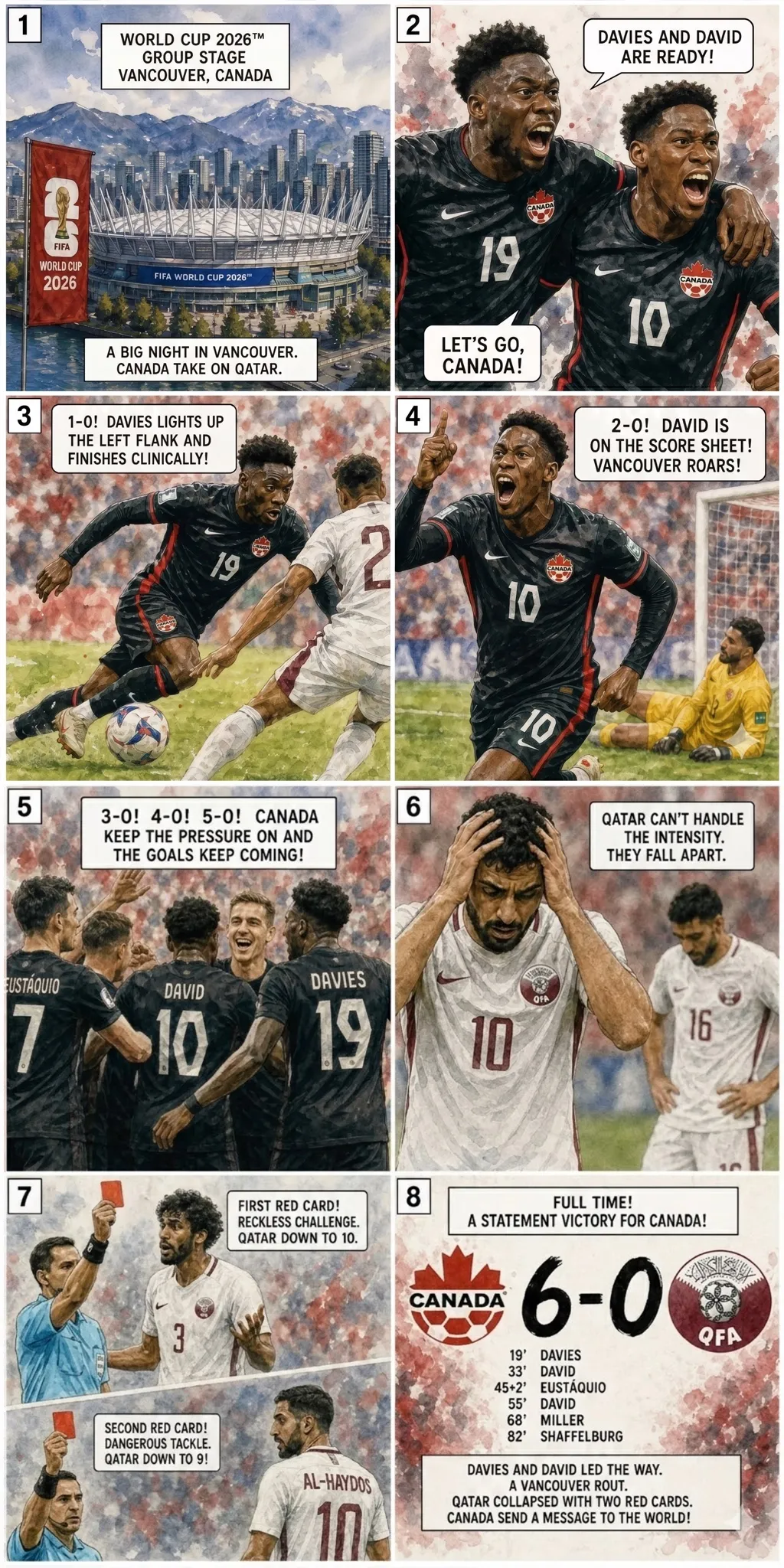
Comic content and match statistics are for entertainment purposes only and may contain inaccuracies. For Accurate Data, please refer to the reference's official website.
# Canada 6-0 Qatar: Davies's Masterclass, Qatar's Collapse, and a Result That Echoes Through Group B
BC Place, Vancouver. A stadium built on the edge of the Pacific, where the rain falls with the particular persistence of a city that has made peace with dampness. Canada, the co-hosts of this World Cup, arrived at their second group match carrying the weight of a tournament that had not yet properly begun for them. A 1-1 draw with Bosnia and Herzegovina on opening night had been functional rather than inspiring — the kind of result that keeps you alive without convincing anyone that you are truly dangerous. Qatar, the Asian champions, arrived carrying their own burden: a 1-1 draw with Switzerland that had been celebrated in Doha as a moral victory and analysed by everyone else as a missed opportunity. The mathematics of Group B were simple before kick-off. They were devastatingly simple after it. Canada 6, Qatar 0.
This was not merely a victory. It was a statement delivered with the force of a freight train and the precision of a military operation. Canada scored six goals. They could have scored ten. Qatar finished the match with nine men, two red cards, and the particular silence that follows a public humiliation. The scoreline will be remembered for years. The manner of it will be discussed for longer.
The opening exchanges established a pattern that would define the match before it was ten minutes old. Canada's 4-3-3 — the system that Jesse Marsch has been refining since his appointment, the system built on aggressive pressing, vertical passing, and the overlapping runs of Alphonso Davies — was overwhelming Qatar's 5-3-2 before the Qataris had worked out which Canadian player to mark. The first goal, when it arrived in the seventh minute, was a product of exactly the kind of overload that Marsch's system is designed to create. Davies, the Bayern Munich left-back who plays as something closer to a left-winger for his national team, received the ball on the overlap and delivered a cross that Jonathan David — the Lille striker whose movement in the penalty area belongs to a higher plane of spatial awareness — headed past Meshaal Barsham. 1-0. The goal was David's second of the tournament. It was his thirty-second for Canada. It felt, even at that early stage, like the beginning of something rather than the end.
The second goal arrived in the sixteenth minute. Cyle Larin, the Real Valladolid forward whose predatory instincts have been the foundation of Canadian attacking play for the better part of a decade, latched onto a through-ball from Stephen Eustáquio and finished with the composure of a man who has scored goals in four different countries and sees no reason to stop now. 2-0. The third goal arrived in the twenty-eighth minute. Davies again — this time cutting inside from the left and striking a shot from twenty-two metres that curved past Barsham with the kind of trajectory that makes physicists reconsider their assumptions. The ball struck the inside of the post on its way in, a detail that only added to the aesthetic quality of the moment. 3-0. The match was twenty-eight minutes old. It was already over.
The statistical portrait of the first half was devastating. Canada had sixty-eight percent possession. They had taken fourteen shots, eight of which were on target. Qatar had taken one shot. It was off target. The Canadian supporters behind the goal — a sea of red and white that had transformed BC Place into the nation's largest living room — were not so much celebrating as marvelling. This was not a contest. It was a coronation.
The second half introduced two significant developments, neither of which improved Qatar's situation. In the fifty-second minute, Tarek Salman — the thirty-five-year-old Al-Sadd defender whose international career has spanned more than a decade — was shown a straight red card for a tackle on David that was, depending on your perspective, either mistimed or malevolent. The referee's decision was immediate. VAR confirmed it. Qatar were reduced to ten men with thirty-eight minutes still to play, which is the footballing equivalent of being asked to stop a flood with a teaspoon.
The fourth goal arrived four minutes after the red card. Eustáquio — the Porto midfielder whose range of passing and positional intelligence had been quietly orchestrating the entire Canadian performance — curled a free-kick into the top corner from twenty-five metres. The strike was technically immaculate. It was also, by this point, almost unnecessary. 4-0.
The fifth goal — David's second, Canada's fifth, the goal that made it a rout by any historical definition — came in the sixty-seventh minute. A low cross from Tajon Buchanan, the Inter Milan winger whose pace had been torturing the Qatari left flank since the opening whistle, found David at the back post. The finish was simple. The celebration was appropriately muted. Even the Canadian supporters, who had been in full voice for over an hour, were beginning to conserve their energy for the matches that lie ahead.
The sixth goal, when it arrived in the eighty-first minute, was almost cruel. Buchanan, who had been the best player on the pitch in the second half, cut inside and struck a shot that deflected off a Qatari defender and looped over Barsham in a parabola of misfortune. The goal was Buchanan's first of the tournament. It was Canada's sixth of the evening. Qatar received their second red card — for Abdelkarim Hassan, dismissed for a second bookable offence — moments later. The match ended with Qatar reduced to nine men and Canada reduced to the particular exhaustion that follows a victory so comprehensive that celebration feels almost redundant.
The result sends Canada to the top of Group B with four points and a plus-six goal difference. They face Switzerland next — a match that will likely determine the group winner. Qatar, by contrast, are effectively eliminated. They have one point from two matches and a minus-six goal difference that will require a sequence of results so unlikely that even the most optimistic Qatari supporter would hesitate to articulate it.
Jesse Marsch, in his post-match press conference, used the word "professional" four times. He was right. This was a professional performance against an opponent that had been systematically dismantled. But the story of this match was not merely about Canada's excellence. It was about the distance between where this Canadian team was a decade ago — eliminated in the semi-finals of the 2015 Gold Cup, unable to qualify for the 2014 World Cup, a nation whose footballing infrastructure was still being constructed — and where they are now. They are co-hosts. They are group leaders. They are, on this evidence, capable of reaching the knockout stages with something approaching authority. The rain kept falling in Vancouver. Nobody inside BC Place noticed.