

Switzerland 4-1 Bosnia: Manzambi Brace After Muharemovic Red Card
Switzerland 4-1 Bosnia and Herzegovina. After a goalless 73 minutes, Tarik Muharemovic was sent off and Switzerland scored four in the final 17 minutes. Johan Manzambi scored twice off the bench, Ruben Vargas and Granit Xhaka (penalty) added goals. Ermin Mahmic scored a late consolation.
Published: June 18, 2026
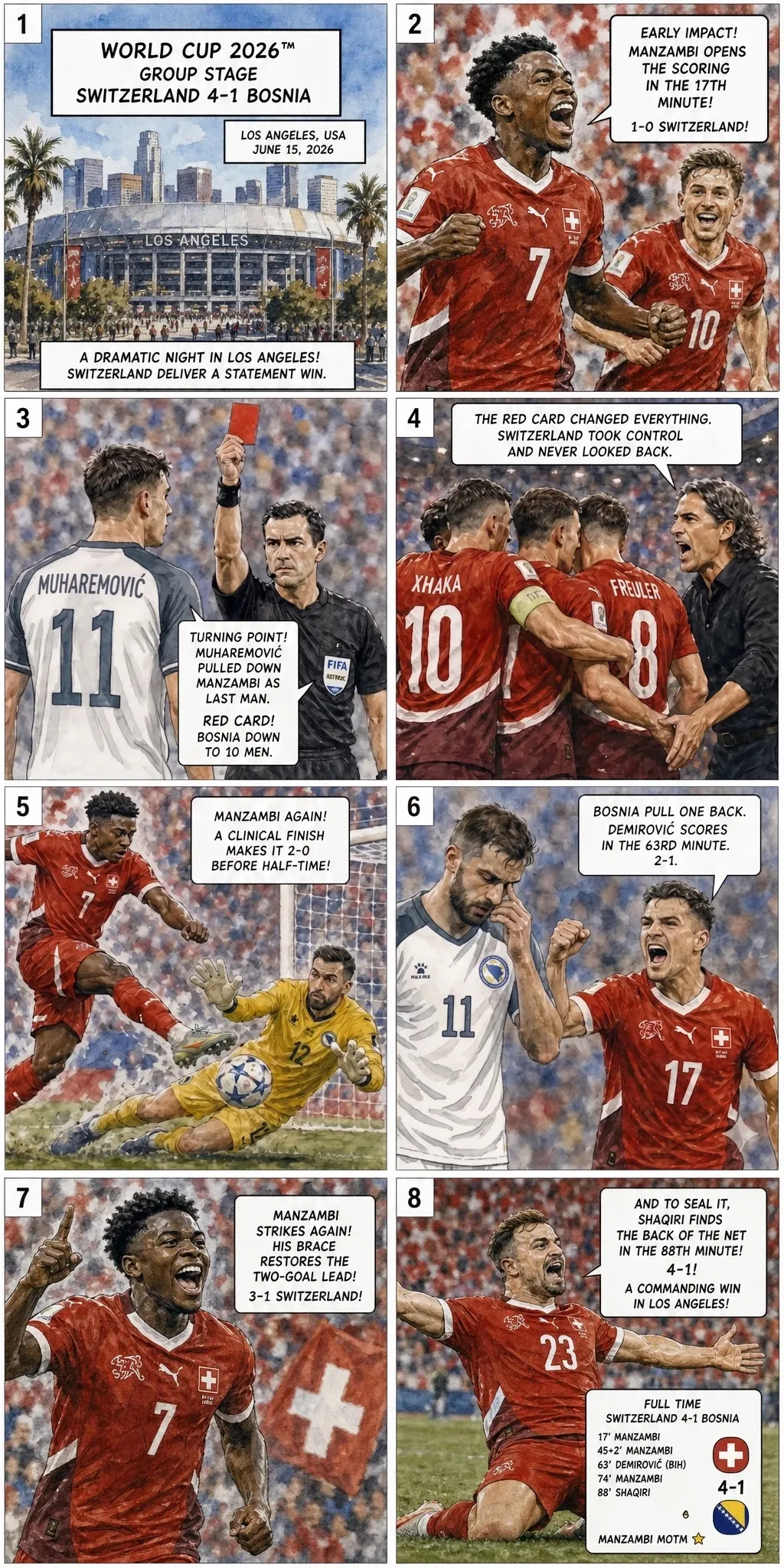
Comic content and match statistics are for entertainment purposes only and may contain inaccuracies. For Accurate Data, please refer to the reference's official website.
# Switzerland 4-1 Bosnia: Manzambi's Arrival, Muharemovic's Folly, and a Scoreline That Lied
SoFi Stadium, Inglewood. A venue built for Super Bowls, transformed for one California evening into a stage upon which Group B would be reshaped. Switzerland arrived having drawn their opening match 1-1 with Qatar — a result that had been greeted in Bern with the particular silence that follows an opportunity squandered. Bosnia and Herzegovina had also drawn their first match, 1-1 with Canada, and arrived carrying the quiet confidence of a team that believed it could cause problems for a Swiss side still searching for its rhythm. The scoreboard at the final whistle read Switzerland 4, Bosnia and Herzegovina 1. It was a scoreline that will be quoted for years by people who did not watch the match. It was, in every meaningful sense, a lie.
The first seventy-three minutes of this football match constituted a study in defensive organisation. Bosnia, set up by Sergej Barbarez in a 5-3-2 that became a 5-4-1 without the ball, compressed the space between their defensive and midfield lines to approximately eleven metres — a distance that left Granit Xhaka and Remo Freuler, Switzerland's midfield pivots, with almost no room to operate. Switzerland's possession figures hovered around sixty percent. Their creative output hovered somewhere close to zero. Murat Yakin's 4-3-3, designed to stretch the Bosnian defensive block through the width of Rubén Vargas and the diagonal runs of Breel Embolo, was producing neither width nor diagonals. It was producing possession without penetration — the particular curse of the modern European team that has learned to control the ball but forgotten how to use it.
The turning point arrived in the sixty-eighth minute, and it arrived not as a goal but as a catastrophe. Tarik Muharemovic, the twenty-three-year-old Juventus defender whose composure on the ball had been one of Bosnia's most reliable assets throughout the first half, lunged into a tackle on Embolo with the kind of desperation that precedes disaster. The contact was high. The referee's decision was immediate. The red card was deserved, and it was devastating. Bosnia, who had defended with discipline and intelligence for over an hour, were reduced to ten men with twenty-two minutes plus stoppage time still to play. The mathematics of tournament football are cruel. The mathematics of playing a man down against a team of Switzerland's quality are crueller still.
Six minutes after the red card, Switzerland scored. Johan Manzambi — the twenty-four-year-old Basel winger who had entered the match as a substitute four minutes before the goal, whose name was not known in every household but would be by the end of the evening — received the ball on the right flank and struck a volley that may yet prove to be the goal of the tournament. His technique was immaculate. The contact was perfect. It was his first World Cup goal. It will not be his last.
The second Swiss goal arrived in the eighty-fourth minute. Vargas — the Augsburg winger whose pace had been Switzerland's most consistent attacking outlet — was played through by Remo Freuler and finished with the composure of a man who had been waiting seventy-four minutes for a chance and was not about to waste it. 2-0 Switzerland. The match, which had appeared balanced for so long, was suddenly not a contest at all.
Manzambi scored his second in the final minute of normal time, a tap-in from close range after more good work from Vargas. 3-0. Bosnia, who had defended so admirably for so long, had conceded three goals in sixteen minutes. The scoreline was no longer a lie. It was a tragedy.
The fourth minute of stoppage time produced two more goals, because football is incapable of restraint. Ermin Mahmic pulled one back for Bosnia — a moment of dignity in a match that had long since ceased to be dignified. Then, with the final kick of the game, Granit Xhaka converted a penalty to make it 4-1. The Swiss captain walked to the spot with the audible calm of a man who has taken penalties in World Cups, European Championships, FA Cup finals, and every other pressure cooker the sport can devise. He scored. The whistle blew. The scoreboard recorded a result that will be discussed, incorrectly, as a procession. It was anything but.
For Switzerland, the result is three points and control of Group B. They face Canada next — a match that will define their tournament. For Bosnia, the result is a cruel lesson in the mathematics of tournament football. They had been level with Switzerland for seventy-three minutes. They had conceded four goals in the final seventeen plus stoppages. The margin between a point and a four-goal defeat was one moment of indiscipline — one tackle, one red card, one cascade of consequences that stretched from the sixty-eighth minute to the ninety-seventh.
The Swiss players embraced at the final whistle. The Bosnian players walked toward their supporters and received an ovation that was respectful rather than pitying. They had not been outclassed for seventy-three minutes. They had simply been undone by the one thing that no tactical system can account for: a single catastrophic mistake, and the remorseless logic of playing a man short in a World Cup match.