

USA 2-0 Australia: Freeman Sends Co-Hosts Through as Seattle Witnesses History
Alex Freeman scored the decisive header in the 44th minute after a VAR review overturned an initial offside call. An earlier own goal by Cameron Burgess gave the US a dream start. Christian Pulisic missed the match with a calf injury. USA clinched knockout stage spot with six points from two matches — first time winning first two World Cup games since 1930.
Published: June 19, 2026
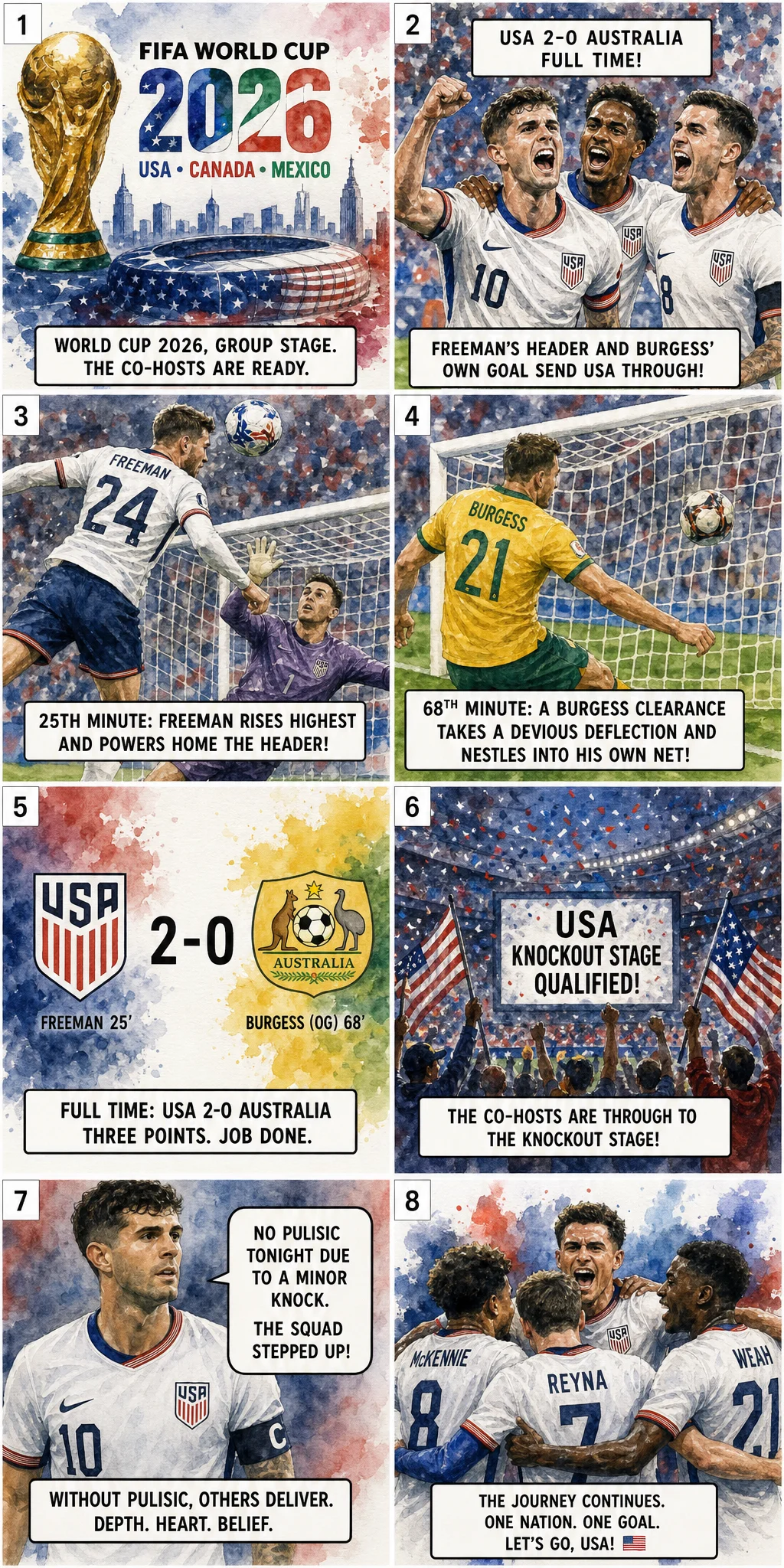
Comic content and match statistics are for entertainment purposes only and may contain inaccuracies. For Accurate Data, please refer to the reference's official website.
# USA 2-0 Australia: Freeman's Header, an Own Goal, and the Night Seattle Became a Soccer City
A few hours before kick-off at Lumen Field, I walked past a coffee shop on Occidental Avenue where a barista with a Stars and Stripes bandana was pulling espresso shots with one hand and arguing about the 4-3-3 with the other. "Balogun has to start," he said, sliding a macchiato across the counter. "Without Pulisic, he's the one." Outside, the streets of Pioneer Square were filling with red, white, and blue — not the colours of a Fourth of July parade, but of a World Cup host nation starting to believe.
This is the Seattle I had been told about but never quite believed. A city whose football history has been written more in the stands of an MLS club — the Sounders, with their 40,000-strong tifos and their Cascadia derbies — than in the annals of World Cup lore. But on a cool June evening, with the Olympic Mountains invisible behind a familiar Pacific Northwest mist, Seattle was about to witness something that had not happened to an American men's team at a World Cup since 1930.
Let that number sit for a moment. 1930. Uruguay. The first World Cup ever played. The United States won their first two matches in that tournament — against Belgium and Paraguay, if you're keeping score — and then never did it again. Not in 1994, when they hosted and made the round of 16. Not in 2002, when they reached the quarter-finals. Not in any of the eleven World Cups in between. Ninety-six years of waiting for a start this good.
The score at the final whistle was USA 2, Australia 0. It was a scoreline that will be remembered as comfortable. It was anything but.
The first goal arrived in the eleventh minute, and it arrived in a manner that no Australian will want to watch again. Folarin Balogun — the New York-born, London-raised striker whose decision to represent the United States rather than England had been the subject of approximately four thousand social media arguments — received the ball on the left flank and drove toward the byline with the directness that has become his signature. His cross was low, driven, and aimed toward the near post. Cameron Burgess, the Australian centre-back who plays his club football for Ipswich Town in England's Championship, stretched to intercept. The ball deflected off his outstretched leg and looped past Mathew Ryan, the Australian goalkeeper who had probably already calculated that the cross was his to collect. 1-0 USA. Own goal. A moment of misfortune that will follow Burgess for a long time — the kind of moment that football, in its particular cruelty, specialises in producing.
In the press box, an Australian journalist next to me put his head in his hands. I have seen that gesture before. It is the universal language of a deflection going wrong. It needs no translation.
The second goal came in the forty-fourth minute, and unlike the first, it was a thing of beauty — the kind of goal that makes you forget the own goal that preceded it. Sergiño Dest, the right-back whose career has taken him from Ajax to Barcelona to AC Milan to PSV Eindhoven — a journey that would make for a very good podcast episode — received the ball on the overlap and struck a shot that was less a shot and more a question posed to the Australian defence. The ball deflected, looped, hung in the air. Alex Freeman, the twenty-three-year-old defender who plays for the Seattle Sounders — yes, the local boy, in his hometown stadium — rose to meet it. His header found the back of the net. The flag went up. Offside. The crowd exhaled.
Then VAR intervened.
There is something about VAR in a World Cup that turns a stadium into a courtroom. Twenty thousand people hold their breath while a referee somewhere consults a screen that no one else can see. The seconds stretch. Fans check their phones, as though Twitter might have the answer before the referee does. In the stands, an American supporter next to me — a man who had painted his entire face in the pattern of the American flag, which is a commitment to a cause that I respect — kept saying "it's a goal, it's a goal" with the rhythm of a prayer.
The referee gave the goal. The stadium erupted. Freeman, arms outstretched, ran toward the corner flag with the expression of a man who had just discovered that his childhood dream was not a dream after all. 2-0. The first half had forty-four minutes on the clock. The match was already effectively over.
I should mention Christian Pulisic. Not because he played — he didn't. A calf injury, sustained in training two days before the match, kept the American captain on the sidelines. His absence was the subplot that had dominated the build-up: how does the United States play without the man who has been their talisman for the better part of a decade? The answer, delivered with a certain quiet confidence by Berhalter's team, was: pretty well, actually. Balogun stepped up. Weston McKennie, the Juventus midfielder whose engine appears to have been manufactured by a different company than everyone else's, covered every blade of grass. Tyler Adams sat in front of the back four and did what Tyler Adams does — intercepted, disrupted, recycled possession with the economy of a man who has no interest in doing anything other than what is necessary.
The second half was a controlled exercise. The United States, safe in their two-goal lead, managed the game with a professionalism that felt almost European — and I mean that as a compliment. They kept the ball. They frustrated Australia's attempts to build through midfield. They did not score a third, but they did not need to. The most significant statistic from the second half was the one that appeared on the scoreboard after ninety-four minutes: shots on target by Australia, zero. The United States recorded their first clean sheet in ten matches. For a team whose defensive vulnerabilities have been the subject of considerable anxious commentary, this was a statement disguised as a statistic.
The Australians walked off with the particular dignity of a team that had been beaten by a better opponent on the night. Graham Arnold, their coach, stood on the touchline for a long moment after the final whistle, staring at the pitch with the expression of a man calculating what needs to change before the next match. Australia had arrived in Seattle having won their opening game. They will leave still with a path to the knockout stages — but that path is now narrower, steeper, and requires results that were not in the original plan.
For the United States, the mathematics are simple and beautiful: six points from two matches, qualification for the Round of 32 secured, a final group game against the group's other opponent to determine who tops the group. They are the second team to qualify for the knockout stages — after Canada, their co-hosts, which is a sentence that would have sounded absurd fifteen years ago and now feels entirely natural.
I walked out of Lumen Field into the Seattle night. The mist had lifted. The streets of Pioneer Square were alive with the particular sound of a city that has just watched its team win a World Cup match — a sound that is equal parts joy, relief, and the slightly disbelieving energy of supporters who are not quite used to feeling this way. A group of fans were singing "We Are the Champions" outside a bar on First Avenue. They were off-key. They were magnificent.
Ninety-six years is a long time to wait for a start this good. The United States are not just hosting this World Cup. They are, on this evidence, playing in it.