

Scotland 0-1 Morocco: Fastest goal shatters Scottish hopes
FOXBOROUGH, Mass. — The match clock at Gillette Stadium had not yet completed its second revolution when Ismael Saibari turned the 2026 World Cup on its head for Morocco, scoring the fastest goal of…
Published: June 20, 2026
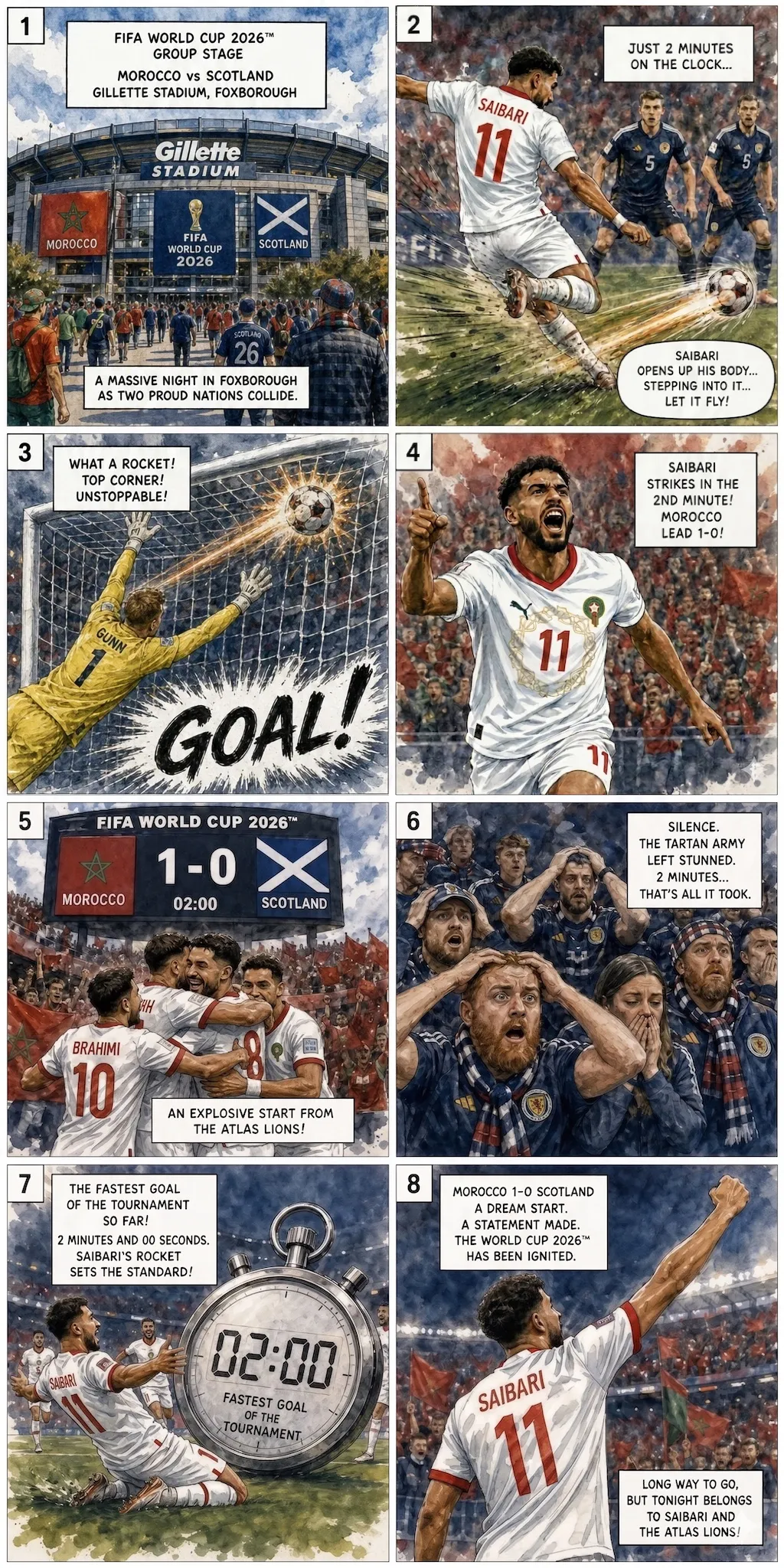
Comic content and match statistics are for entertainment purposes only and may contain inaccuracies. For Accurate Data, please refer to the reference's official website.
# Scotland 0-1 Morocco: Fastest goal shatters Scottish hopes
FOXBOROUGH, Mass. — The match clock at Gillette Stadium had not yet completed its second revolution when Ismael Saibari turned the 2026 World Cup on its head for Morocco, scoring the fastest goal of the tournament after just 71 seconds and condemning Scotland to a 1-0 defeat that leaves their knockout-stage hopes hanging by a thread. In front of 64,146 fans in the Massachusetts humidity, Morocco’s early strike—a right-footed thunderbolt from Saibari into the top-left corner, assisted by Brahim Diaz—proved decisive as the Atlas Lions dominated possession and suffocated any Scottish attacking ambition. The result moved Morocco to four points in Group C, placing them in a commanding position to advance, while Steve Clarke’s side, still stuck on one point from two matches, now face a must-win final group game against the group leaders.
The opening minute was a blur of chaos and precision. Scotland kicked off, but within seconds, a misplaced pass from Scott McTominay in midfield was pounced upon by Diaz, who drove forward with intent. The Real Madrid playmaker slipped a perfectly weighted pass into the path of Saibari, who had ghosted between two Scottish defenders. The PSV Eindhoven midfielder took one touch to set himself, then unleashed a ferocious right-footed drive that arrowed past Angus Gunn’s despairing dive and into the top-left corner. The net rippled before many in the crowd had even settled into their seats. It was Saibari’s second goal in as many World Cup matches, following his strike against Croatia in Morocco’s opening draw, and it immediately set the tone for a match that Scotland would spend the remaining 88 minutes chasing.
The early concession was a hammer blow for a Scottish side that had arrived in New England buoyed by a gritty, if uninspiring, 1-1 draw with Belgium in their tournament opener. Clarke had spoken in the build-up about the need for discipline and composure, but the goal exposed a defensive fragility that had been masked by the result against the Red Devils. Liam Cooper and Jack Hendry, the central defensive pairing, were caught flat-footed as Diaz received the ball in the half-space, and neither could recover to close down Saibari’s shot. Gunn, who had been solid against Belgium, had no chance with the strike—it was placed with such venom and precision that it would have beaten any goalkeeper in the world.
Morocco, sensing blood, did not relent after the goal. Under the guidance of Walid Regragui, they settled into a rhythm of patient possession that suffocated Scotland’s attempts to build any sustained pressure. The statistics would later confirm what was obvious from the stands: Morocco dominated with approximately 62 percent of the ball, a figure that felt even higher given the scarcity of Scottish possession in dangerous areas. Their midfield trio of Sofyan Amrabat, Azzedine Ounahi, and Saibari controlled the tempo, recycling the ball with ease and forcing Scotland’s midfield—McTominay, Callum McGregor, and John McGinn—to retreat deeper and deeper into their own half.
Scotland’s attacking struggles were stark. They failed to register a single shot on target across the 90 minutes, a damning indictment of their inability to break down a well-organized Moroccan defense. The closest they came to testing goalkeeper Yassine Bounou was a speculative long-range effort from Andy Robertson that sailed harmlessly over the bar, and a deflected cross from Ryan Christie that looped just wide of the post. Bounou, a veteran of Morocco’s historic 2022 run, was effectively a spectator for long periods, his clean sheet secured by the work of the outfield players in front of him rather than any heroics of his own.
The frustration boiled over for Scotland in two moments of controversy, both involving penalty appeals that were waved away by referee Mario Escobar. The first came in the 34th minute, when McGinn went down in the box under a challenge from Noussair Mazraoui. McGinn, driving into the area from the right flank, appeared to have his shirt tugged as he attempted to cut inside. He threw his arms up in appeal, but Escobar, well-positioned, saw no infringement and waved play on. Replays showed minimal contact, and the decision, while debated in the Scottish dugout, was not a clear error.
The second appeal, in the 67th minute, carried more weight. McTominay, rising to meet a corner from Robertson, saw his header deflect off the arm of Romain Saïss. The ball struck the veteran defender’s arm as it was raised above his head, and Scotland’s players surrounded Escobar, demanding a penalty. The referee consulted his assistant but again waved play on, deeming the arm to be in a natural position given the leap. VAR, led by Alejandro Hernández, reviewed the incident but did not recommend a review, leaving Clarke apoplectic on the sideline. “It’s a clear handball,” the Scotland manager shouted toward the fourth official, but the decision stood.
Without the penalty, Scotland’s attacking impotence was laid bare. Clarke had started with a 3-4-2-1 formation, hoping to match Morocco’s midfield numbers, but the plan unravelled as the game progressed. Che Adams, the lone striker, cut an isolated figure, feeding off scraps and often dropping deep just to touch the ball. McGinn and Christie, deployed as the attacking midfielders behind him, found themselves pinned back by Morocco’s relentless pressing, unable to link play effectively. The introduction of Lyndon Dykes and Ryan Fraser in the second half added energy but not incision; Dykes, a physical presence, won a few aerial duels but could not direct any headers on goal, while Fraser’s pace was nullified by Morocco’s deep defensive block.
Morocco, for their part, were content to manage the game after the early goal. They did not press for a second with reckless abandon, instead prioritizing control and conservation of energy in the oppressive heat. Diaz was a constant threat on the counter-attack, his dribbling and vision causing problems for Robertson and Aaron Hickey down the Scottish left. On one occasion, in the 52nd minute, Diaz danced past two defenders and unleashed a shot that Gunn parried away, the first of only two saves the Scotland goalkeeper was forced to make. The other, a routine stop from a Saibari free-kick, was a mere formality.
The midfield battle was the defining narrative of the match. Amrabat, the heartbeat of Morocco’s system, completed more passes than any Scottish player managed touches in the final third. His ability to break up play and distribute quickly left Scotland chasing shadows. Ounahi, meanwhile, drifted between the lines, pulling McGregor and McTominay out of position and creating space for Saibari to exploit. Saibari, already a hero for his goal, was tireless in his pressing, forcing errors from Scotland’s defenders when they attempted to play out from the back. His performance was a masterclass in the modern midfield role: scoring, pressing, and dictating tempo.
Scotland’s best spell came in the final 15 minutes, when desperation forced them forward with more urgency. Robertson, typically a threat from left-back, bombed forward repeatedly, delivering crosses that were met by Moroccan heads. A corner in the 81st minute saw Grant Hanley rise highest, but his glancing header flew wide of the far post. Another, in the 87th minute, caused a scramble in the box, with Bounou fumbling the ball before Saïss cleared off the line. The Scottish bench erupted, believing the ball had crossed the line, but replays showed Saïss’s clearance was inches from the goal line. It was as close as Scotland came.
The final whistle was met with contrasting scenes. Morocco’s players embraced on the pitch, aware that four points from two matches—with a final group game against Belgium—puts them firmly in control of their destiny. A draw in that match would likely secure their place in the knockout stage, and given their defensive solidity and ability to strike early, they will fancy their chances. For Scotland, the math is brutal. With one point from two matches, they must beat Belgium in their final group game and hope other results fall their way. The defeat in Foxborough was not just a loss; it was a tactical dismantling, a reminder of the gap in quality between a team that reached the World Cup semifinals three years ago and one that is still searching for its first knockout-round appearance since 1998.
Clarke’s post-match press conference was a study in controlled frustration. He praised his team’s effort but acknowledged the lack of cutting edge. “We had two penalty shouts, we had moments, but we didn’t test their goalkeeper enough,” he said. “When you give a team like Morocco an early lead, they’re very comfortable. They have players who can keep the ball for long periods. We needed to be more clinical in the final third, and we weren’t.” The statistics backed him up: zero shots on target, 38 percent possession, and a single goal conceded from a moment of individual brilliance. In a tournament where small margins decide games, Scotland had been beaten by a single, devastating strike.
The broader context of Group C now hangs over Scotland like a shadow. Belgium, who drew 1-1 with Morocco in the opening round, sit on two points after their own match against Scotland. The group is wide open, but Scotland’s goal difference—now minus-one after this defeat—could prove crucial. They need not just a win against Belgium, but a convincing one, while also hoping Morocco and Belgium’s match produces a result that favors them. It is a precarious position, one that requires both a performance and a slice of luck that has been absent so far.
For Morocco, the narrative is one of quiet efficiency. They are not the flashiest team in the tournament, but they are disciplined, organized, and capable of moments of magic. Saibari’s goal was the fastest of the 2026 World Cup, a record that will be remembered long after the tournament ends. But more importantly, it was a goal that showcased their ability to strike early and then control the game. Regragui’s side have conceded just once in two matches, and their defensive structure, anchored by Saïss and Nayef Aguerd, has been imperious. They will not dominate headlines like Brazil or France, but they are building a case as a team that could go deep.
The atmosphere at Gillette Stadium was electric throughout, the 64,146 crowd a mix of Scottish expats, Moroccan supporters, and neutral American fans drawn by the World Cup’s allure. The Moroccan contingent, waving flags and beating drums, created a wall of sound that grew louder after Saibari’s goal. Scotland’s fans, brave and vocal despite the result, sang “Flower of Scotland” deep into the second half, a defiant soundtrack to their team’s struggles. But by the final whistle, the noise had subsided into a low hum of disappointment.
This was a match that will be dissected by Scottish analysts for years. The early goal, the penalty appeals, the lack of shots on target—each element tells a story of a team that competed but fell short. Morocco, meanwhile, will move on to their final group game with confidence, knowing that their blend of experience and youth, of defensive solidity and attacking flair, is well-suited to the pressures of tournament football. For Scotland, the road ahead is narrow and steep. They must now beat Belgium, and perhaps rewrite their own history, to keep their World Cup dream alive.