

New Zealand 1-3 Egypt: Egypt's first World Cup win
VANCOUVER — The roar that greeted Finn Surman’s 15th-minute opener at BC Place was the sound of a nation daring to dream, but by the time the final whistle echoed through the 52,497 sellout crowd, it…
Published: June 22, 2026
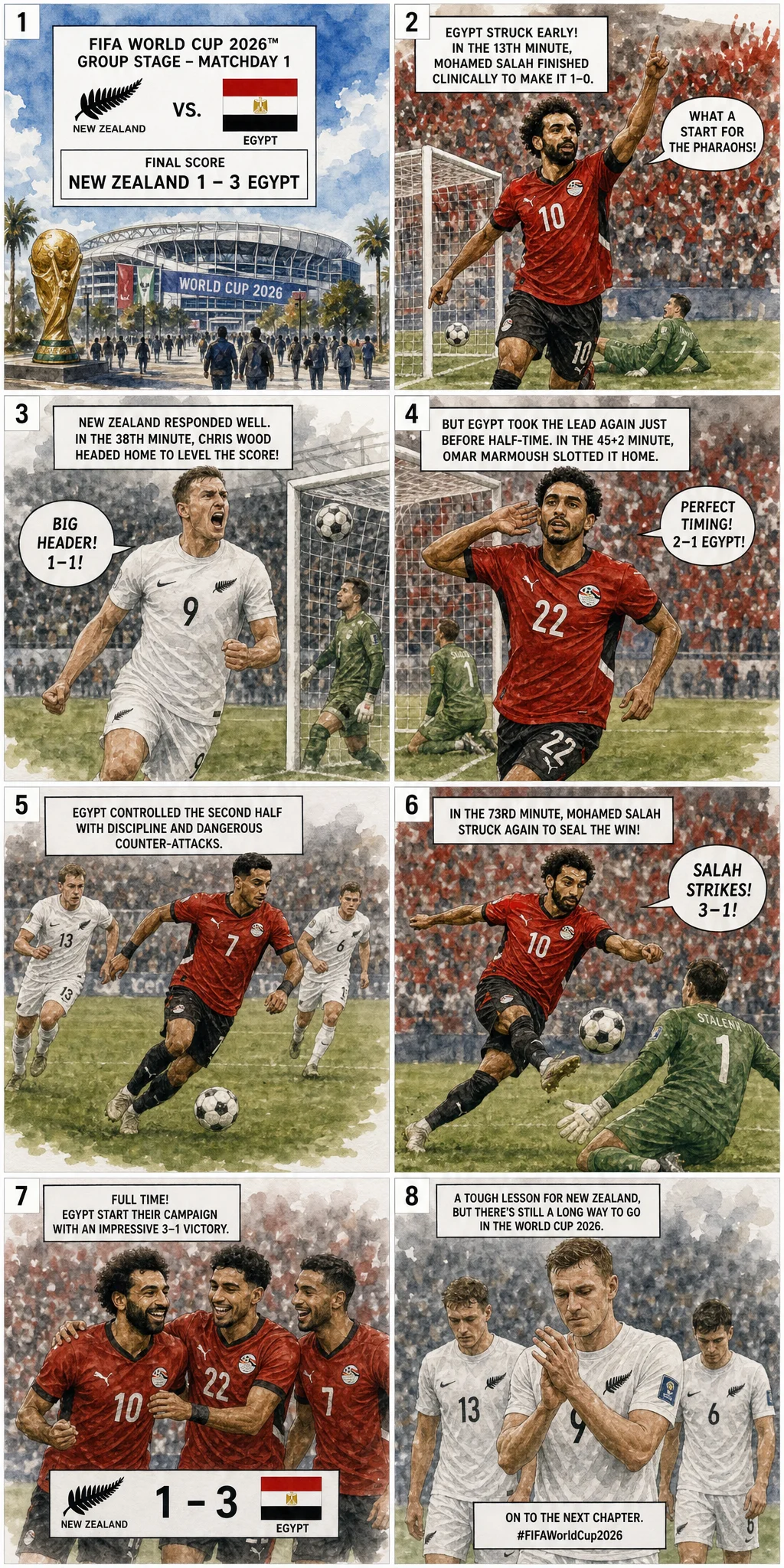
Comic content and match statistics are for entertainment purposes only and may contain inaccuracies. For Accurate Data, please refer to the reference's official website.
# New Zealand 1-3 Egypt: Egypt's first World Cup win
VANCOUVER — The roar that greeted Finn Surman’s 15th-minute opener at BC Place was the sound of a nation daring to dream, but by the time the final whistle echoed through the 52,497 sellout crowd, it was Egypt who had written their name into history. In a match that swung on moments of individual brilliance and collective composure, Egypt secured their first-ever World Cup victory, scoring three goals in a single tournament match for the first time, and leaving New Zealand’s knockout hopes hanging by the slenderest of threads. The 3-1 scoreline, forged by strikes from Mostafa Zico, Mohamed Salah, and Trezeguet, was a testament to Egypt’s resilience after a sluggish start, and a cruel lesson for an All Whites side that had everything to play for but could not hold the line.
The opening quarter of an hour belonged entirely to New Zealand. They pressed high, disrupted Egypt’s build-up play, and forced errors from a backline that looked jittery under the Vancouver floodlights. The breakthrough came from a set piece, that great equalizer for underdogs. Tim Payne, stationed on the right flank, delivered a corner with whip and pace that bent toward the near post. Finn Surman, a towering presence in the heart of the New Zealand defense, peeled off his marker with a well-timed run. The ball met his forehead with perfect connection, and he powered it downward and past the despairing dive of the Egyptian goalkeeper. The net bulged, the crowd erupted, and for a moment, the dream of a first World Cup win for New Zealand felt tangible. Surman’s celebration was brief, a clenched fist and a glance to the heavens, as his teammates mobbed him. It was a goal born of organization and intent, a set-piece routine executed with precision against a team that had yet to find its rhythm.
Egypt, for all their individual talent, looked shaken. Their passing was sloppy, their movement disjointed. Mohamed Salah, the talisman and captain, drifted into deep positions to collect the ball, but found himself isolated against a compact New Zealand block. The All Whites, buoyed by the goal, grew in confidence. They funneled play wide, looking to exploit the pace of their wingers, and forced a series of corners that kept the Egyptian defense under siege. But as the first half wore on, the pattern shifted. Egypt began to assert control in midfield, with Trezeguet and Zico dropping deeper to link play. They started to stretch New Zealand’s shape, probing the gaps between the full-backs and center-backs. The equalizer, when it came just before the hour mark, was a reward for that patience.
The 58th minute brought the moment that changed the game’s trajectory. Mohamed Hany, the Egyptian right-back who had been quiet in the first half, found space on the overlap. His cross was floated with precision, curling toward the far post where Mostafa Zico had timed his run to perfection. The forward, unmarked and with a predator’s instinct, met the ball with a firm header from close range. It was a finish that required accuracy over power, and Zico delivered, guiding the ball inside the near post as the New Zealand goalkeeper could only watch. The stadium, which had been a cauldron of support for the underdogs, fell into a tense hush. Egypt’s bench erupted, and the players celebrated with a renewed sense of purpose. The goal was a release valve, a reminder of the technical quality that had made Egypt a dark horse in this tournament.
The match now hung in the balance, and for the next nine minutes, it was a chess match. New Zealand responded with urgency, pushing their full-backs higher and attempting to regain the initiative. But Egypt’s defense, now settled, absorbed the pressure with discipline. The turning point arrived in the 67th minute, and it bore the unmistakable signature of Mohamed Salah. The Liverpool star, who had been relatively contained, sparked to life in a flash of brilliance. Collecting the ball on the right flank, he played a sharp back-heel one-two with Zico, a move that split the New Zealand defense open. The return pass found Salah in space on the edge of the box, and he did not hesitate. With a sweeping, curling finish, he bent the ball with his left foot into the far corner, beyond the reach of the diving goalkeeper. It was a goal of pure technique and cold efficiency, a reminder of why he is one of the most feared attackers in the world. The Egyptian fans, a vocal minority in the sellout crowd, roared their approval. Salah’s celebration was understated, a simple raise of the arm, as if this was merely business as usual. But for Egypt, it was a seismic moment: their first lead in a World Cup match in over 30 years.
New Zealand, to their credit, did not fold. They pushed forward with renewed desperation, throwing men into attack and forcing Egypt to defend deep. The All Whites’ best chances came from long-range efforts and half-cleared crosses, but the Egyptian goalkeeper, who had looked shaky early, now commanded his area with authority. The game became stretched, with both sides committing numbers forward. It was in this open phase that Egypt delivered the decisive blow. In the 82nd minute, Salah, still the orchestrator, stepped up to take a corner from the left. His delivery was a looping, inswinging ball that invited a runner at the near post. Trezeguet, the winger who had worked tirelessly all night, read the flight perfectly. He threw himself forward, meeting the ball with a diving header that redirected it with venom into the net. The goal was a statement of intent, a clinical finish that killed the contest. Trezeguet’s celebration was raw, a slide on his knees as his teammates piled on top of him. Egypt had scored three goals in a World Cup match for the first time in their history, a milestone that underscored their attacking potential.
Three minutes later, in the 85th minute, the stadium rose to its feet for a different reason. Mohamed Salah was substituted off, replaced to a standing ovation from both sets of fans. It was a gesture of respect for a player who had not only scored but had orchestrated the comeback. Salah walked off slowly, clapping to the crowd, his work done. The ovation was a rare moment of unity in a match that had been fiercely contested. For New Zealand, the final five minutes plus stoppage time were a fruitless exercise in chasing the game. They pushed bodies forward, but Egypt’s defense, now marshaled with confidence, held firm. The final whistle confirmed the 3-1 scoreline, and the Egyptian players collapsed in a heap of joy. Their first World Cup victory, after decades of near-misses and heartbreak, was finally theirs.
For New Zealand, the mathematics are now brutally simple. The defeat leaves them with one point from two matches, and they must beat Belgium in their final group game to keep their knockout hopes alive. It is a monumental task, but not an impossible one. The All Whites showed in the first half that they can trouble elite opposition, but the lesson from Vancouver is that they cannot afford to switch off. The defensive lapses that allowed Egypt back into the game were punished ruthlessly. The set-piece goal that gave them the lead was a high point, but the inability to build on it, to find a second goal when Egypt were vulnerable, proved fatal. Their tournament now hinges on a single 90-minute performance against one of the tournament favorites.
Egypt, meanwhile, can look forward with genuine optimism. This victory, built on a foundation of resilience and individual brilliance, is a statement of intent. The trio of Zico, Salah, and Trezeguet combined for all three goals, a front line that now has proven chemistry and a taste for the big stage. The defensive wobbles of the first half will need to be addressed, but the character shown in the second half, the ability to wrest control of the game after falling behind, is the hallmark of a team that believes in itself. For a nation that has waited so long for a World Cup win, the scenes at BC Place were cathartic. The traveling fans, outnumbered but not outshouted, sang long after the final whistle.
The match was a study in contrasts: New Zealand’s early promise versus Egypt’s late dominance, a set-piece goal versus three flowing moves. It was a game that turned on two moments of magic from Salah and a diving header from Trezeguet, but it was also a game that Egypt won through sheer persistence. For the neutrals in the sellout crowd of 52,497, it was a compelling spectacle. For New Zealand, it was a painful reminder that in World Cup football, moments of brilliance can be fleeting, and history is written by those who seize it. For Egypt, it was a night to remember, a first victory that will be etched in the annals of their footballing history. The road ahead is long, but for now, they have earned the right to dream.