

Uruguay 2-2 Cabo Verde: Historic goalkeepers duel ends in draw
MIAMI — Under the closed roof of Hard Rock Stadium, the first World Cup match in history to feature two goalkeepers over the age of 40 delivered a piece of history that defied all pre-tournament…
Published: June 22, 2026
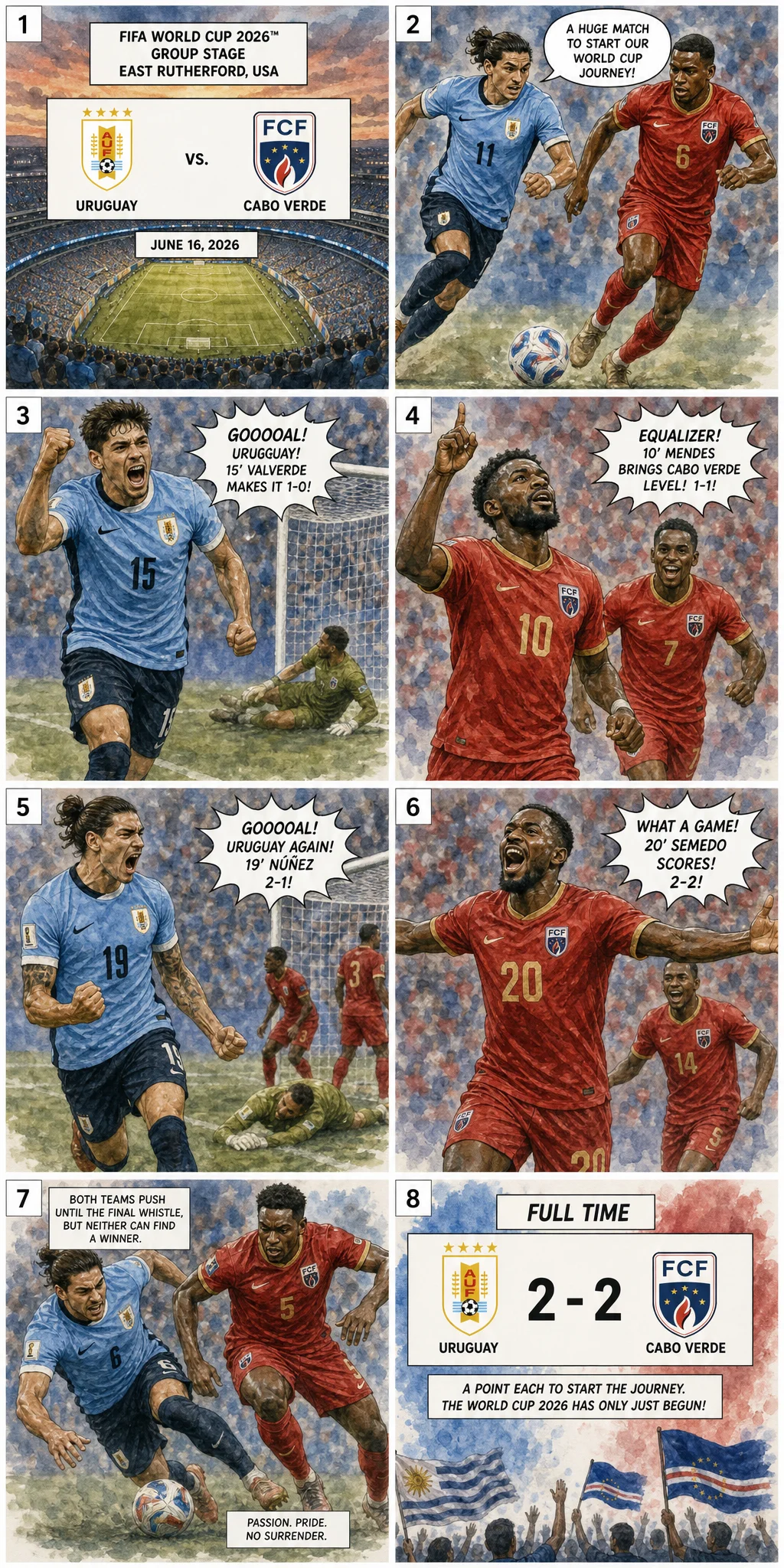
Comic content and match statistics are for entertainment purposes only and may contain inaccuracies. For Accurate Data, please refer to the reference's official website.
# Uruguay 2-2 Cabo Verde: Historic goalkeepers duel ends in draw
MIAMI — Under the closed roof of Hard Rock Stadium, the first World Cup match in history to feature two goalkeepers over the age of 40 delivered a piece of history that defied all pre-tournament logic. Fernando Muslera, Uruguay’s 39-year-old stalwart who will turn 40 this June, and Cape Verde’s 42-year-old Vozinha, the oldest player at the 2026 tournament, stood at opposite ends of a pitch that bore witness to a 2-2 draw that felt far more significant than the final scoreline suggested. For Cape Verde, a tiny archipelago nation making its second World Cup appearance, this was not merely a point stolen from a two-time world champion. It was a statement of arrival, punctuated by the thunderbolt of Kevin Pina’s 30-meter free kick that gave the Blue Sharks their first-ever World Cup goal and set the stage for a match that oscillated between the sublime and the chaotic.
The opening quarter-hour carried the familiar tension of a group-stage encounter where reputation met ambition. Uruguay, expected to dominate possession and territory, found themselves frustrated by a Cape Verde side that had already held Spain to a goalless draw in their tournament opener. That result in Orlando had sent a quiet ripple through Group H, suggesting that the islanders were no longer simply happy to be here. They pressed high, compressed space in midfield, and dared Uruguay’s aging spine to break them down. Federico Valverde tried to orchestrate from deep, but Cape Verde’s midfield trio, anchored by the tireless Pina, refused to yield ground. The pattern felt familiar: Uruguay probing, Cape Verde absorbing, the crowd in Miami growing restless.
Then came the 21st minute, and the moment that will be replayed in Praia, Mindelo, and every corner of the diaspora for generations. A foul conceded some 32 meters from goal, dead center, presented a set-piece opportunity that seemed too far for anything direct. Muslera organized his wall, barking instructions, but Pina had other ideas. The 28-year-old midfielder, who plies his trade in Portugal’s Primeira Liga with Farense, stepped up and struck the ball with a venomous, dipping trajectory that curled over the wall, evaded Muslera’s desperate dive, and nestled into the top corner. The stadium erupted in disbelief. Cape Verde’s first World Cup goal was not a scrappy tap-in or a fortunate deflection; it was a strike of genuine, world-class quality. Pina sprinted to the corner flag, mobbed by teammates who understood the magnitude of the moment. On the touchline, Cape Verde’s coach, Bubista, allowed himself a clenched fist before quickly returning to his tactical instructions.
Uruguay’s response was immediate in intent but labored in execution. Darwin Núñez, isolated and frustrated, cut a lonely figure against Cape Verde’s compact back four. Facundo Pellistri tried to inject pace on the right, but Vozinha, the veteran goalkeeper who had kept a clean sheet against Spain, commanded his area with a calm authority that belied his 42 years. The first half ticked toward its conclusion with Uruguay growing increasingly desperate, their attacks lacking the incisiveness that had defined their golden generations. Then, in the 44th minute, the breakthrough arrived from an unlikely source.
A corner from the left, swung in with precision, found Rodrigo Bentancur at the near post. The Tottenham midfielder’s header was powerful, aimed low, and seemed destined for the back of the net. But Vozinha, showing reflexes that defied his age, got a strong hand to it, parrying the ball onto the post. The rebound fell invitingly, and there was Maximiliano Araujo, the left-back who had pushed high, to head the ball into the empty net from close range. It was a scrappy goal, born of persistence rather than artistry, but it leveled the score at 1-1 and restored a semblance of order for La Celeste. The timing could not have been more critical, as the first half entered six minutes of stoppage time, a number that would prove decisive.
Deep into that added time, with Cape Verde perhaps already mentally in the dressing room, Uruguay struck again. Araujo, now operating almost as a winger, found space down the left and delivered a looping, headed assist into the box. The ball hung in the air, inviting a finish, and Agustin Canobbio, the Flamengo forward who had been introduced as a substitute earlier in the half, reacted quickest. He stole in ahead of his marker, stabbed the ball past Vozinha from close range, and sent the Uruguayan bench into a frenzy. 2-1, just before the whistle. The Hard Rock Stadium crowd, heavily tilted toward the South American contingent, roared its approval. It felt like a sucker punch, a cruel twist for a Cape Verde side that had held its own for 51 minutes of football.
The halftime interval allowed both managers to recalibrate. Uruguay’s Marcelo Bielsa, ever the tactician, would have demanded more control, less reliance on set pieces and late surges. But the second half told a different story, one of fragility and fatal errors. Cape Verde emerged with renewed belief, their tails up despite the deficit. They had already proven they could score; now they needed to prove they could recover. Pina, already the hero, continued to pull strings in midfield, while forwards Helio Varela and Jamiro Monteiro stretched Uruguay’s defense with runs in behind.
The equalizer, when it came in the 61st minute, was a gift wrapped in defensive negligence. Uruguay attempted to play out from the back, a hallmark of Bielsa’s philosophy, but the execution was disastrous. A loose pass from José María Giménez, intended for Muslera, was intercepted by Varela, the Cape Verde winger who plays in Turkey for Istanbul Basaksehir. Varela, with the goal at his mercy, showed composure beyond his years. He rounded the advancing Muslera, who had no choice but to commit, and tapped the ball into an empty net. 2-2. The silence from the Uruguayan sections was deafening, broken only by the jubilant chants of the Cape Verdean supporters, who had traveled in numbers far greater than their nation’s population might suggest.
From that point onward, the match descended into a tense, open-ended affair. Uruguay pushed for a winner, their pride stung by the manner of the equalizer. Bielsa threw on attacking options, shifting to a more direct approach that bypassed the midfield. Núñez had a header saved by Vozinha, who produced another fine stop in the 78th minute, diving low to his left. The veteran goalkeeper’s performance, like Muslera’s, was a testament to longevity, but the narrative had shifted. This was no longer about age; it was about resilience.
In the 84th minute, Uruguay thought they had snatched all three points. A corner was flicked on, and the ball appeared to cross the line after a scramble. The Uruguayan players celebrated, the bench spilled onto the pitch, and the stadium held its breath. But the referee, after consultation with VAR, ruled that the ball had not fully crossed the line. Replays showed a marginal call, the kind that defines tournaments. Uruguay’s late goal was disallowed, and the decision stood. For Cape Verde, it was a reprieve; for Uruguay, a bitter pill to swallow, especially given their history of VAR controversies in this competition.
The final whistle arrived after five minutes of stoppage time, with both sides exhausted but unbowed. The 2-2 draw left Group H wide open, with Spain still to play their second match. For Cape Verde, this was another scalp, another statement. They had held Spain, they had scored their first World Cup goal, and they had come from behind to draw with Uruguay. Kevin Pina, the scorer of that historic free kick, was named FIFA Man of the Match, a deserved recognition for a performance that blended technical brilliance with relentless work rate. He had not only etched his name into Cape Verdean football folklore but had also announced himself on the global stage.
For Uruguay, the questions will linger. A team with World Cup pedigree, boasting players from Europe’s elite leagues, has now drawn two matches in a tournament where they were expected to advance comfortably. Bielsa’s system, so effective in qualifying, has shown cracks under the pressure of tournament football. The defensive error that gifted Cape Verde the equalizer will be scrutinized, as will the reliance on set pieces for goals. Muslera, despite his experience, could do little about either goal, but the narrative of two over-40 goalkeepers sharing a pitch will be a footnote in a match that had far more substance.
Hard Rock Stadium, typically a venue for Miami Dolphins football and concerts, had hosted a World Cup match that encapsulated everything beautiful and brutal about the sport. There was history in Pina’s free kick, drama in the late disallowed goal, and a sense that Cape Verde, a nation of just over 500,000 people, is no longer content to be a footnote in world football. They have arrived, not with a whimper, but with a thunderbolt from 30 meters. Uruguay, meanwhile, must regroup, knowing that their path to the knockout stages now requires a result against Spain that, on this evidence, is far from guaranteed. The draw in Miami was a result that satisfied no one fully, but it left everyone talking. And in a World Cup, that is often the most enduring legacy of all.