

Portugal 5-0 Uzbekistan: Ronaldo Brace Rewrites Record Books
HOUSTON — At NRG Stadium on Tuesday afternoon, Portugal delivered the kind of statement that had been conspicuously absent from their World Cup opener, dismantling Uzbekistan 5-0 in a Group K clash…
Published: June 23, 2026
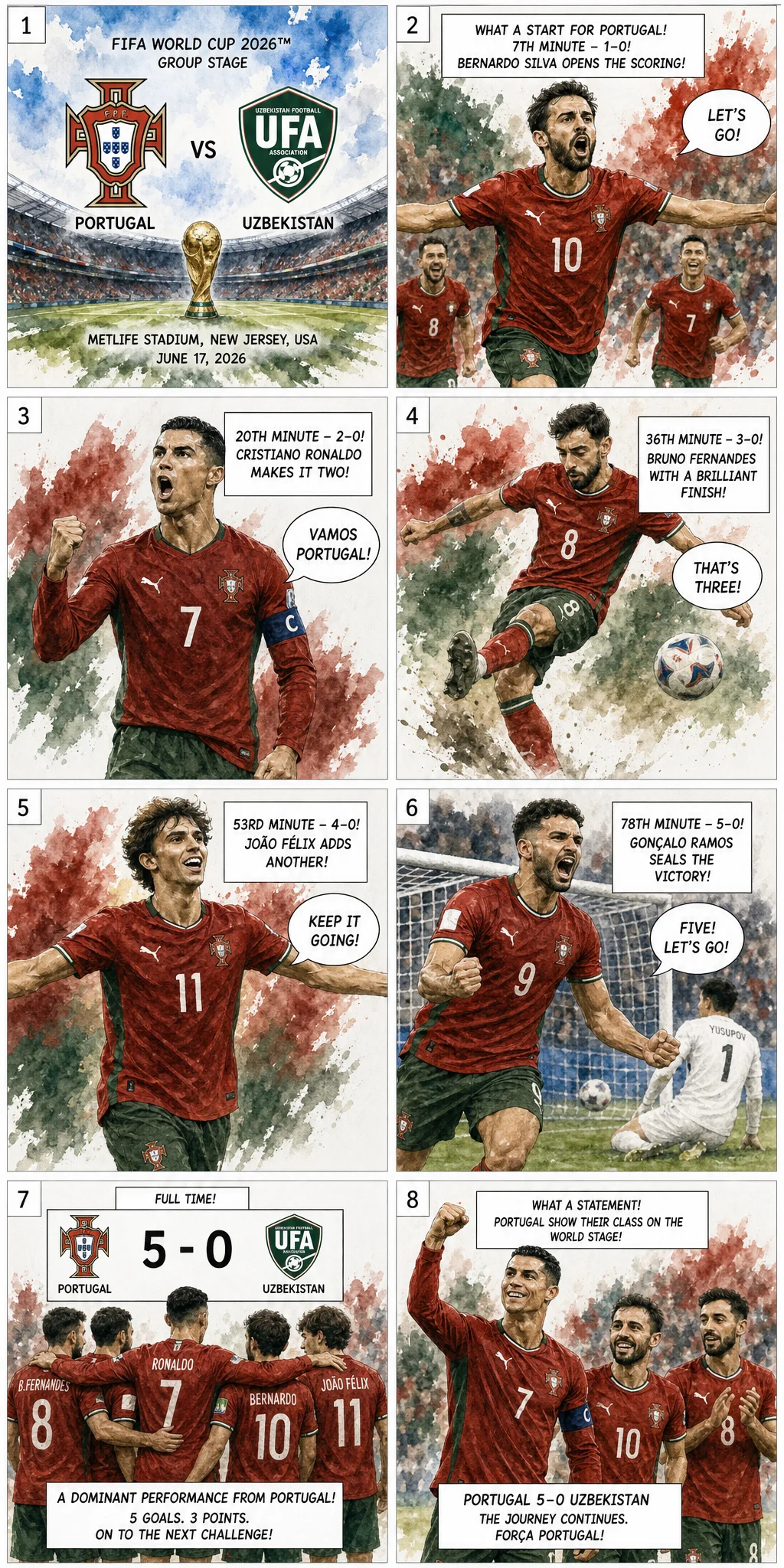
Comic content and match statistics are for entertainment purposes only and may contain inaccuracies. For Accurate Data, please refer to the reference's official website.
# Portugal 5-0 Uzbekistan: Ronaldo Brace Rewrites Record Books
HOUSTON — At NRG Stadium on Tuesday afternoon, Portugal delivered the kind of statement that had been conspicuously absent from their World Cup opener, dismantling Uzbekistan 5-0 in a Group K clash that was as emphatic as it was historically significant. The scoreline, built on a first-half brace from Cristiano Ronaldo and capped by a late Rafael Leao thunderbolt, not only secured Portugal’s first win of the tournament but also propelled them to the top of the group standings. For the thousands of Portuguese fans who filled the retractable-roof venue, the performance was a cathartic release after the disappointment of Matchday One, and for Ronaldo, it was a night that rewrote the record books.
The match kicked off at 1 p.m. ET under the closed roof of the Houston stadium, with Portugal needing a response after a lackluster opening performance had left them with just a single point. Uzbekistan, buoyed by their own competitive start, sat deep and organized, hoping to frustrate a Portuguese side that had struggled to break down disciplined defenses in recent tournaments. For the first quarter of an hour, the plan worked. Uzbekistan goalkeeper Abduvohid Nematov was largely untroubled as Portugal probed without incision, their passing patterns predictable and their movement static. The crowd, a sea of red and green, grew restless.
Then came the moment that changed everything. Early in the first half, with the exact minute lost to the chaos of a rapidly unfolding sequence, Cristiano Ronaldo broke the deadlock. The goal was vintage Ronaldo: a sharp run off the shoulder of the last defender, a precise finish that gave Nematov no chance. The ball nestled into the net, and the stadium erupted. It was the 39-year-old’s first goal of the 2026 tournament, but more importantly, it was a goal that carried immense weight beyond the scoreline. With that strike, Ronaldo became the first player in men’s World Cup history to score at six different editions of the tournament, a feat that spanned from 2006 in Germany to this sweltering afternoon in Texas. The record, previously shared with Lionel Messi and a handful of others who had scored at five tournaments, now belonged to him alone. The Portuguese bench rose as one, and Ronaldo, typically stoic, allowed himself a brief, clenched-fist celebration before jogging back to the center circle.
The goal unlocked the game. Uzbekistan, forced to push forward in search of an equalizer, left gaps that Portugal’s wide players were only too happy to exploit. Just minutes after the opener, Ronaldo struck again. This time, the move was less about individual brilliance and more about collective ruthlessness. A quickly taken throw-in, a deft flick, and suddenly Ronaldo was through on goal. His finish was emphatic, a low drive that beat Nematov at his near post. The brace, his second of the tournament, put Portugal 2-0 ahead and effectively killed the contest before halftime. The Uzbek defense, which had looked composed in the opening exchanges, now appeared disoriented, caught between their desire to press and their fear of being caught on the counter.
Portugal, sensing blood, did not relent. With the halftime whistle approaching, they added a third goal that left the Uzbek players trudging off the field in disbelief. Nuno Mendes, the left-back who had been marauding forward all half, stepped up to a free kick from the edge of the area. The wall was set, Nematov positioned himself, but Mendes’ delivery was inch-perfect. The ball curled over the wall, dipped viciously, and crashed into the net. It was a goal of stunning technical quality, and it gave Portugal a 3-0 lead at the interval. The halftime scoreline, as reported by some sources, was 2-0, but others recorded it as 3-0; regardless of the precise tally at the break, the game was effectively over. Portugal had scored three times in a devastating first-half spell, and Uzbekistan had no answer.
The second half was a formality, but it was not without incident. Portugal, now in cruise control, continued to dominate possession and create chances. The Uzbek resistance had crumbled, and their goalkeeper, Nematov, was about to endure a moment of personal misfortune that would compound his team’s misery. In the 60th minute, a Portuguese attack surged forward. A cross from the right, intended for Ronaldo, was cleared only as far as the edge of the box. The subsequent shot, a speculative effort from distance, took a deflection off a defender and looped toward goal. Nematov, scrambling to adjust, could only watch as the ball struck his outstretched leg and trickled over the line. It was an own goal, officially credited to the Uzbek goalkeeper, and it made the score 4-0. The Portuguese players offered muted celebrations, aware of the cruel nature of the goal, but the stadium announcer confirmed the tally: Portugal 4, Uzbekistan 0.
The final act of the match belonged to Rafael Leao. With three minutes of normal time remaining, the AC Milan winger picked up the ball on the left flank, cut inside onto his right foot, and unleashed a ferocious strike that arrowed into the top-left corner of the net. The shot was unstoppable, a pure exhibition of power and placement that left Nematov rooted to his spot. Leao’s goal, in the 87th minute, completed the scoring at 5-0. It was a fitting end to a performance that had started slowly but had built into a crescendo of attacking football. Leao, who had come off the bench to inject fresh energy, celebrated with a roar, his frustration from the opening match now a distant memory.
For Portugal, the result was transformative. After a disappointing Matchday One that had left them needing a result, they now sat atop Group K with three points and a superior goal difference. The 5-0 win, comprehensive and emphatic, sent a message to the rest of the tournament: this Portugal side, led by an ageless Ronaldo, was not to be written off. The team’s ability to score from a variety of situations—open play, set pieces, and even an own goal—demonstrated a versatility that had been missing in their first outing. The midfield, which had been criticized for its lack of creativity, found rhythm in the second half, and the defense, untroubled for most of the match, recorded a clean sheet that would boost confidence.
Uzbekistan, on the other hand, faced a sobering reality. They had entered the match with hopes of springing an upset, but they were outclassed in every department. Their defensive organization, which had held firm for the opening 20 minutes, disintegrated after Ronaldo’s first goal. The own goal from Nematov was a bitter pill to swallow, but the truth was that the scoreline could have been worse. Portugal hit the woodwork twice in the second half, and only a series of last-ditch blocks prevented a sixth or seventh goal. The Uzbek midfield, overrun and outmuscled, failed to provide any meaningful service to their lone striker, who cut an isolated figure for 90 minutes.
The match also highlighted the enduring brilliance of Ronaldo. At 39, playing in his sixth World Cup, he remains the focal point of this Portuguese team. His brace took his World Cup goal tally to a record that continues to grow, and his movement off the ball, even in the late stages of the game, was a masterclass in positional awareness. The record of scoring at six different World Cups is unlikely to be broken anytime soon, and it cements his legacy as one of the greatest players the game has ever seen. Yet, as he walked off the pitch after being substituted in the 80th minute to a standing ovation, there was a sense that this performance was about more than individual glory. It was about Portugal’s collective ambition.
The atmosphere inside NRG Stadium, which had been subdued during the opening stages, became a carnival as the goals flew in. The Portuguese fans, outnumbering their Uzbek counterparts by a significant margin, chanted Ronaldo’s name and waved flags adorned with the national crest. The stadium, a venue more accustomed to hosting NFL games and rodeos, had been transformed into a cauldron of football passion. The roof, closed to keep out the Houston heat, amplified the noise, creating an intensity that seemed to lift the Portuguese players. For the neutral observer, it was a reminder of what the World Cup can be: a stage for history, for drama, and for moments of pure, unadulterated joy.
As the final whistle blew, the Portuguese players gathered in a huddle near the center circle. The 5-0 win was their first of the tournament, but the manner of the victory suggested that this team was finding its form at the right time. The road ahead remains challenging, with tougher opponents lurking in the knockout stages, but for one afternoon in Houston, Portugal looked like a team capable of going all the way. Ronaldo’s record, Mendes’ free kick, and Leao’s stunning strike will be replayed and remembered, but the most important takeaway was the three points and the top spot in Group K. For Portugal, the 2026 World Cup had truly begun.