

Panama 0-1 Croatia: Substitutes Strike Decisive Blow
BMO Field in Toronto was the stage for a night of stark mathematical reality and personal milestone on the final day of Group L at the 2026 FIFA World Cup, as Croatia edged Panama 1-0 to keep their…
Published: June 24, 2026
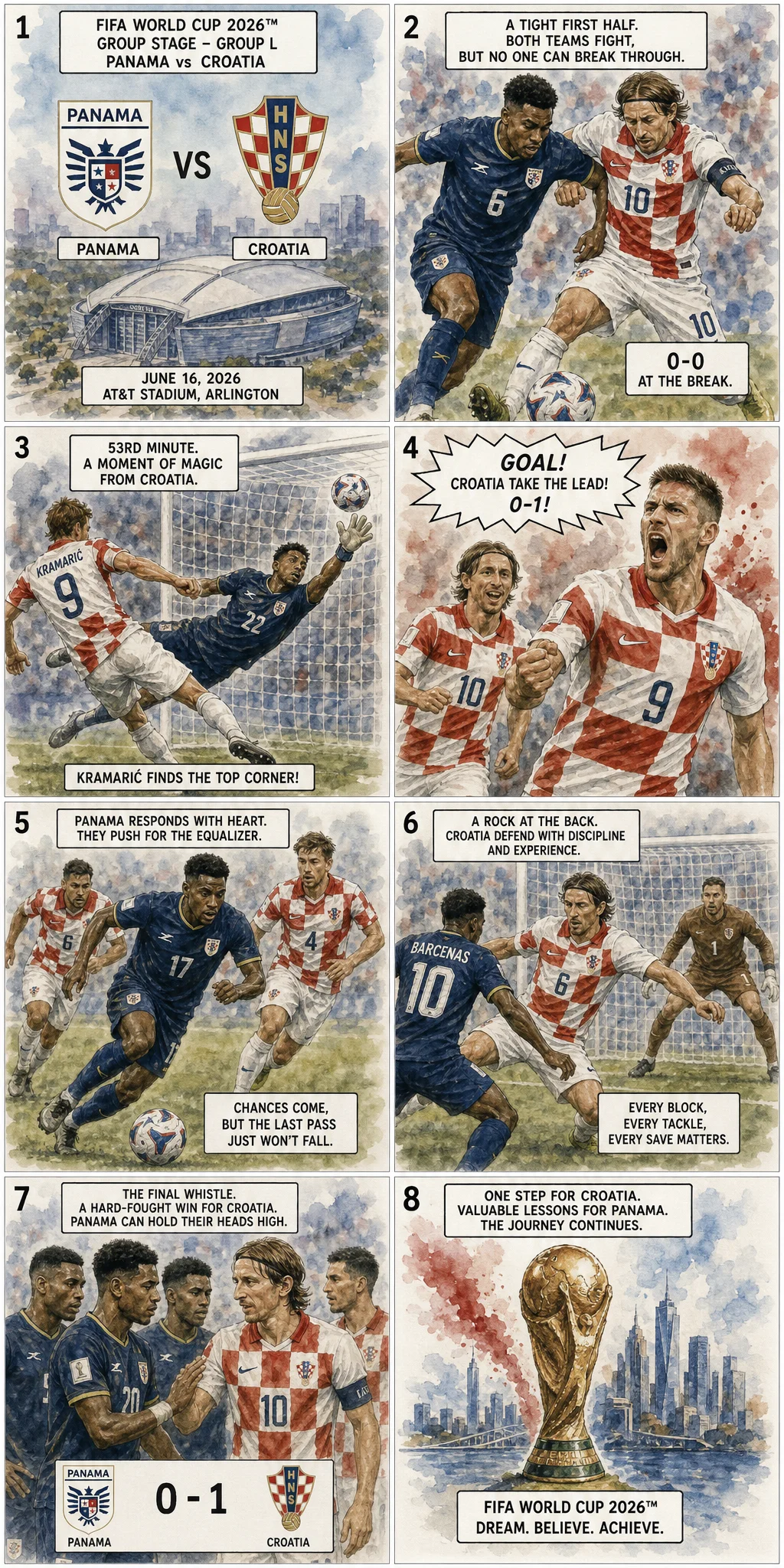
Comic content and match statistics are for entertainment purposes only and may contain inaccuracies. For Accurate Data, please refer to the reference's official website.
# Panama 0-1 Croatia: Substitutes Strike Decisive Blow
BMO Field in Toronto was the stage for a night of stark mathematical reality and personal milestone on the final day of Group L at the 2026 FIFA World Cup, as Croatia edged Panama 1-0 to keep their tournament hopes flickering while extinguishing the debutants’ campaign with a single, decisive second-half goal. For Croatia, the victory was a lifeline—a narrow, nervy triumph that lifted them to three points in the group standings, trailing England and Ghana, who each held four points after their own match. For Panama, the result confirmed their elimination from the World Cup, a cruel end to a spirited journey that had captured the imagination of neutrals but ultimately fell short against the weight of tournament experience and a moment of clinical finishing from a substitute.
The match began under the floodlights of the Toronto venue with an atmosphere thick with anticipation, both sides acutely aware of the stakes. Panama, needing a win to keep their knockout-stage ambitions alive, approached the game with the energy of a team unburdened by history but burdened by the mathematics of the group. Croatia, meanwhile, carried the weight of a nation accustomed to deep runs in major tournaments, yet they had stumbled to a single point from their opening two matches. The first half unfolded as a tense, tactical affair, with neither side willing to commit fully to attack for fear of exposing themselves to a counter-punch that could prove fatal.
Croatia’s midfield, marshaled by the evergreen Luka Modrić, sought to impose control through possession and patience. Modrić, making his 200th appearance for the national team in a milestone that underscored his remarkable longevity and influence, dictated the rhythm from deep positions, attempting to unlock Panama’s compact defensive block with lateral passes and subtle shifts of play. The Croatian captain, now 40 years old, moved with the economy of a player who has seen every defensive shape imaginable, but Panama’s organization was disciplined, their lines tight and their pressing triggers well-timed. For all of Croatia’s territorial dominance in the opening 45 minutes, they struggled to carve out clear-cut chances. The statistics would later reflect a match of extraordinary defensive stinginess: Panama created just one shot across the entire 90 minutes, with an expected goals (xG) of 0.06, while Croatia registered only two shots, one of which found the target, for an xG of 0.05. The numbers painted a picture of a game defined not by flowing attacking play but by a single moment of precision.
That moment arrived in the 54th minute, and it came from a source that had been introduced to change the game’s trajectory. Ante Budimir, the second-half substitute, had been on the pitch for only a short time when he found himself in the right place at the right time. The goal originated from the right flank, where Josip Stanisic, the Croatian full-back, had pushed forward to support an attack. Stanisic delivered a cross into the penalty area, a delivery that curved toward the far post with enough pace and height to evade the Panama defenders who had tracked runners in the central channels. Budimir, reading the flight of the ball with the instinct of a poacher, arrived unmarked at the far post. His finish was simple—a tap-in, a clinical redirect that left Panama goalkeeper Orlando Mosquera with no chance to react. The ball nestled into the net, and BMO Field erupted with a mixture of Croatian relief and Panama despair.
The goal was a gut punch for Panama, who had defended with discipline and organization for the first 53 minutes. Their game plan had been clear: absorb pressure, frustrate Croatia’s playmakers, and look to spring forward on the counter-attack. They had executed that plan effectively, limiting Croatia to half-chances and speculative efforts from distance. But one lapse in concentration, one moment where a runner was not tracked to the far post, undid all of their hard work. The goal also highlighted the value of Croatia’s depth; Budimir, introduced from the bench, provided a different dimension to their attack, a physical presence and a poacher’s instinct that had been missing in the first half.
Panama’s response was immediate and full of intent. They pushed forward with renewed urgency, forcing Croatia to defend deeper than they had for much of the match. The Central American side, playing in their first World Cup, showed no signs of accepting their fate quietly. They pressed higher, committed more men forward, and looked to exploit any space left by a Croatian side that now prioritized protecting their slender lead. Yet for all their endeavor, Panama struggled to create meaningful opportunities. Their sole shot of the match had come much earlier, in the 23rd minute, and it had nearly produced a moment of magic that would have rewritten the narrative entirely.
That chance fell to José Luis Rodríguez, Panama’s midfield dynamo, who rose highest to meet a corner kick with a powerful header. The connection was clean, the direction aimed toward the bottom corner, and it appeared destined to give Panama a lead that would have sent shockwaves through the group. But Dominik Livaković, Croatia’s goalkeeper, produced a save of the highest quality. He reacted instinctively, tipping the ball onto the woodwork—the crossbar or post, the reports confirmed—and deflecting it away from danger. It was a moment that could have swung the match, a save that preserved parity and, in hindsight, proved pivotal. Livaković’s intervention kept the score level, allowing Croatia to regroup and eventually find the winner through Budimir.
As the second half wore on, Panama’s desperation grew. Their attacks became more direct, more frantic, but Croatia’s defense, anchored by a veteran backline, held firm. The Croatian midfield, with Modrić still pulling the strings, managed the game’s tempo expertly, slowing play when necessary and breaking up Panama’s rhythm with tactical fouls and smart positioning. Panama’s elimination was confirmed long before the final whistle; the mathematics of the group meant that even a draw would have been insufficient, and the loss sealed their fate. For a team that had captured the hearts of their nation with their qualification and their spirited performances, the end was a quiet one—a defeat that extinguished their World Cup dream but left a legacy of resilience.
For Croatia, the victory was a reprieve, but it came with caveats. Their performance was far from convincing; they had created only two shots across the entire match, a statistic that would concern coach Zlatko Dalić as he prepared for the knockout stages. The reliance on a single moment from a substitute, the lack of sustained attacking threat, and the narrow margin of victory all pointed to deeper issues in a squad that had reached the semifinals in 2022. Yet the three points were all that mattered in the immediate aftermath. They moved into third place in Group L, level on points with the leaders but trailing on goal difference, with the knowledge that their fate now depended on results elsewhere. The milestone of Modrić’s 200th cap was celebrated with a win, a fitting tribute to a player who has defined an era of Croatian football, but the performance was a reminder that even legends cannot defy time indefinitely.
The final whistle at BMO Field brought contrasting emotions. Panama’s players collapsed to the turf, their World Cup journey over. They had arrived in Toronto with hope, having earned their place on the global stage through years of development and determination. They leave with the knowledge that they pushed a World Cup powerhouse to the brink, that they created a chance that nearly changed everything, and that they were undone not by a lack of effort but by a single moment of Croatian quality. For Croatia, the celebration was muted, professional. They had done what they needed to do—win—but the performance left questions unanswered. As they walked off the pitch, the image of Modrić, his 200th cap secured, his team still alive, encapsulated the night: a legend’s milestone, a substitute’s goal, and a team that survived, if only just.