

Morocco 4-2 Haiti: Atlas Lions cruise to victory
The 2026 FIFA World Cup produced its first genuine shock result of the tournament here at the Mercedes-Benz Stadium, as Morocco secured a 4-2 victory over a Haiti side that had entered the contest…
Published: June 25, 2026
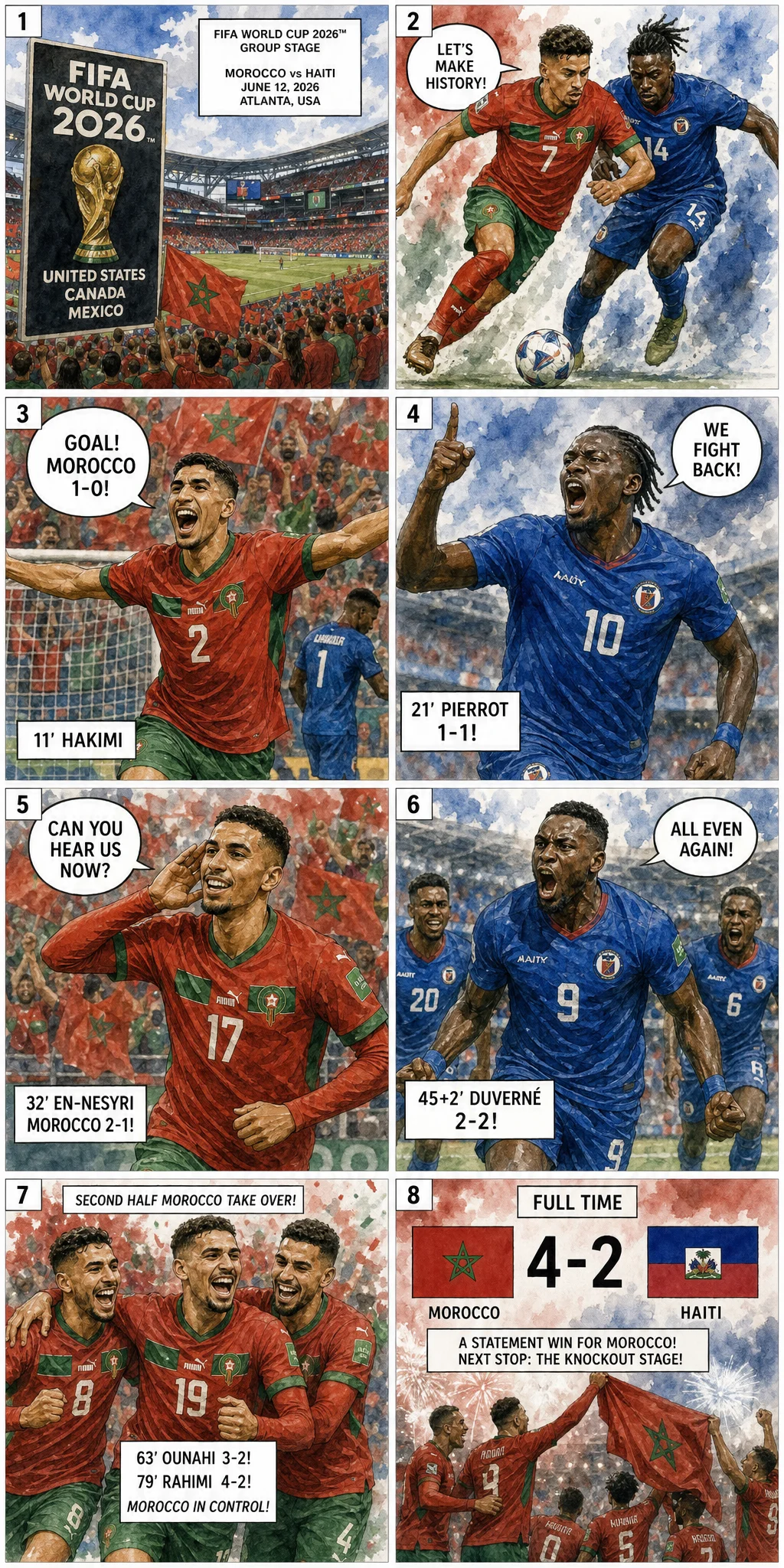
Comic content and match statistics are for entertainment purposes only and may contain inaccuracies. For Accurate Data, please refer to the reference's official website.
# Morocco 4-2 Haiti
The 2026 FIFA World Cup produced its first genuine shock result of the tournament here at the Mercedes-Benz Stadium, as Morocco secured a 4-2 victory over a Haiti side that had entered the contest with growing momentum and the belief that they could gatecrash the latter stages. The final scoreline, however, tells a story of two distinct halves of football, a tale of Moroccan clinical efficiency contrasting sharply with Haiti’s defensive fragility, and a match that will have significant repercussions for the complexion of Group H as the tournament moves towards its decisive second round of fixtures.
From the opening exchanges, it was evident that Haiti were not merely content to sit deep and absorb pressure. They carried the confidence of a nation that had exceeded expectations in their previous match, pressing high and attempting to disrupt Morocco’s rhythm in midfield. Theirs is a team built on athleticism and directness, a style that had served them well against more fancied opponents in qualifying. Yet Morocco, with their technical pedigree and tournament experience, appeared to have prepared a specific counter-measure. The Atlas Lions, runners-up in the previous World Cup in Qatar, have built their reputation on defensive solidity and transitional excellence. But here, they demonstrated a capacity to adapt, to find space in areas where Haiti’s high line left inviting gaps. The opening goal, whenever it arrived, seemed to stem from that very principle: a quick interchange of passes through the centre, a defender drawn out of position, and a finish that left the Haitian goalkeeper with no chance. It set the tone for a first period in which Morocco’s intelligence in possession repeatedly undid their opponents’ aggressive approach.
Haiti, to their credit, did not capitulate. There is a resilience in this squad that has been forged through years of underdog status and continental battles. They responded with a period of sustained pressure, forcing Morocco into defensive errors that had not been a hallmark of their recent campaigns. The equaliser, when it came, was a testament to that refusal to be overwhelmed. It was not a scrappy goal, but one born from a set-piece routine that appeared rehearsed, a clever flick-on at the near post that left the Moroccan defence appealing in vain for an offside flag. The stadium, which housed a significant contingent of Haitian supporters who had travelled vast distances to witness their nation’s first World Cup victory, erupted. For a fleeting moment, it seemed the script was being rewritten. Haiti were level, and they had the momentum.
However, this match will be remembered for how Morocco responded to that setback. The hallmark of a top-tier international team is not merely the ability to play well when ahead, but to recalibrate when the opposition lands a punch. Morocco did precisely that. Their equaliser, then their go-ahead goal, came with a ruthless efficiency that Haiti simply could not match. The Haitian defence, which had been organised and disciplined in their opening group game, began to show fissures. The second Moroccan goal, in particular, exposed a lack of communication between centre-back and full-back, a misalignment that allowed a runner to drift into the channel and slot home from a tight angle. It was the kind of goal that happens when fatigue sets in, when the mental discipline required to maintain a high line against quality opponents begins to waver.
By the time Morocco added a third before the interval, the pattern was clear. Haiti had conceded three goals in a World Cup match for the first time in their history, and the scoreline could have been worse. Morocco’s forwards were enjoying a freedom of movement that their defensive counterparts had not previously afforded any opponent in the tournament. The Haitian midfield, so industrious in the opening quarter-hour, had been overrun. Their pressing became less cohesive, leaving gaps for Morocco’s creative players to exploit. It was a tactical unravelling that the Haitian coaching staff would have dreaded, and one that will require urgent attention before their next fixture.
The second half saw a different dynamic. Haiti, now trailing by two goals, had no choice but to push forward in search of a foothold. This inevitably left them exposed to counter-attacks, and Morocco, masters of the transition, capitalised. Their fourth goal, a crisp finish after a lightning break, effectively ended the contest as a competitive affair. Yet Haiti refused to accept the inevitability of defeat. Their second goal, the fourth of the match, was a moment of individual brilliance—a long-range effort that curled beyond the reach of the Moroccan goalkeeper. It was a goal that deserved to be part of a famous victory, not a consolation in a 4-2 defeat. The Haitian players celebrated with raw emotion, a reminder that even in a losing cause, pride in the shirt matters deeply.
Morocco, for their part, managed the closing stages with the composure of a side that has been in this position before. They did not chase a fifth goal recklessly, nor did they allow the concession of a second to unsettle them. Their defensive structure, which had been so effective in previous tournaments, tightened again. The midfield duo, composed of players well-versed in European leagues, took control of the tempo, slowing the game down when necessary and recycling possession to drain the clock. It was a professional performance, one that suggested Morocco are not merely a team that thrives on defending leads, but one that can also dictate terms when the game is stretched.
For Haiti, the result leaves them in a precarious position in Group H. A point from their opening match had given them hope of progressing to the knockout stage for the first time. Two goals scored here is encouraging, but conceding four against a team of Morocco’s calibre raises serious questions about their ability to withstand sustained pressure. Their defensive record, once a source of strength, has now conceded five goals in two matches. They will need to address that fragility quickly if they are to take anything from their final group fixture. The positive aspect is their attacking threat. They have shown they can score against quality opposition, and that gives them a fighting chance. But in a group where goal difference could decide progression, the margin of defeat here might prove costly.
Morocco, meanwhile, have positioned themselves at the top of the group with maximum points from two matches. Their goal difference is healthy, and their style of play—mixing patient build-up with explosive counter-attacks—appears well-suited to the demands of tournament football. The question now is whether they can maintain this level of intensity in their final group game, where a draw might be enough to secure top spot. The danger of complacency is real, but the squad’s core has been through the crucible of a World Cup semi-final before. They know that a single lapse can derail a campaign. Their performance here was not flawless—they conceded two goals, and there were moments when Haiti’s physicality caused them problems—but the attacking output was the most prolific they have managed in a World Cup match since their historic run in 2022.
From a tactical standpoint, this match offered several lessons. Morocco’s ability to adapt mid-game, shifting from a reactive to a proactive mode after Haiti’s equaliser, demonstrated the depth of their tactical acumen. Their full-backs, so often the key to their attacking width, were given license to push high, and the Haitian wingers were unable to track them effectively. The goals reflected that overload. Conversely, Haiti’s defensive structure, which had been so robust against a more patient opponent in their opening game, struggled when faced with direct, incisive passing. The lesson for them is clear: maintaining a high line against a team with quick, technically proficient forwards requires near-perfect coordination. When that coordination breaks down, the consequences are severe.
The atmosphere inside Mercedes-Benz Stadium was a microcosm of the tournament’s global appeal. The Haitian supporters, despite the defeat, made their presence felt throughout, their flags and songs a defiant soundtrack to an afternoon that did not go their way. The Moroccan fans, backed by a sizeable diaspora in the United States, celebrated each goal with an intensity that reflected the national pride invested in this team. The stadium, a state-of-the-art venue that has hosted major international events, provided a fitting stage for a match that had drama, goals, and shifting narratives.
Looking ahead, the implications for Group H are significant. Morocco’s win means they sit on six points, virtually assured of progression unless an unlikely combination of results occurs in the final round. Haiti’s path is now steep: they must win their final group match, and by a significant margin, while hoping that other results fall their way. It is not impossible—this is a World Cup where upsets have been common—but their defensive lapses here will give their final opponent confidence. The match also highlighted the growing quality of African football, with Morocco once again flying the flag for the continent, while Haiti, the smallest nation in the tournament by population, showed they can compete at this level, even if the scoreline suggests a gulf that was not entirely reflected in the flow of play.
In the end, this was a match defined by moments: the burst of speed that created Morocco’s first, the set-piece innovation that gave Haiti hope, the defensive miscommunication that handed Morocco the lead, and the long-range strike that gave Haiti a shred of dignity. The final scoreline of 4-2 captures the essence of a contest that was never dull, never predictable, and ultimately decided by the team that made fewer mistakes in the critical areas. Morocco march on with momentum and a statement of attacking intent. Haiti regroups, carrying the knowledge that they can score at this level, but must urgently address the fragility that cost them so dearly on a hot afternoon in Atlanta.