

Scotland 0-3 Brazil: Brazil's ruthless efficiency sinks Scotland
The Hard Rock Stadium in Miami Gardens might have been thousands of miles from the Samba beat of Rio or the damp chill of a Glasgow winter, but the soundtrack here on this World Cup night was…
Published: June 25, 2026
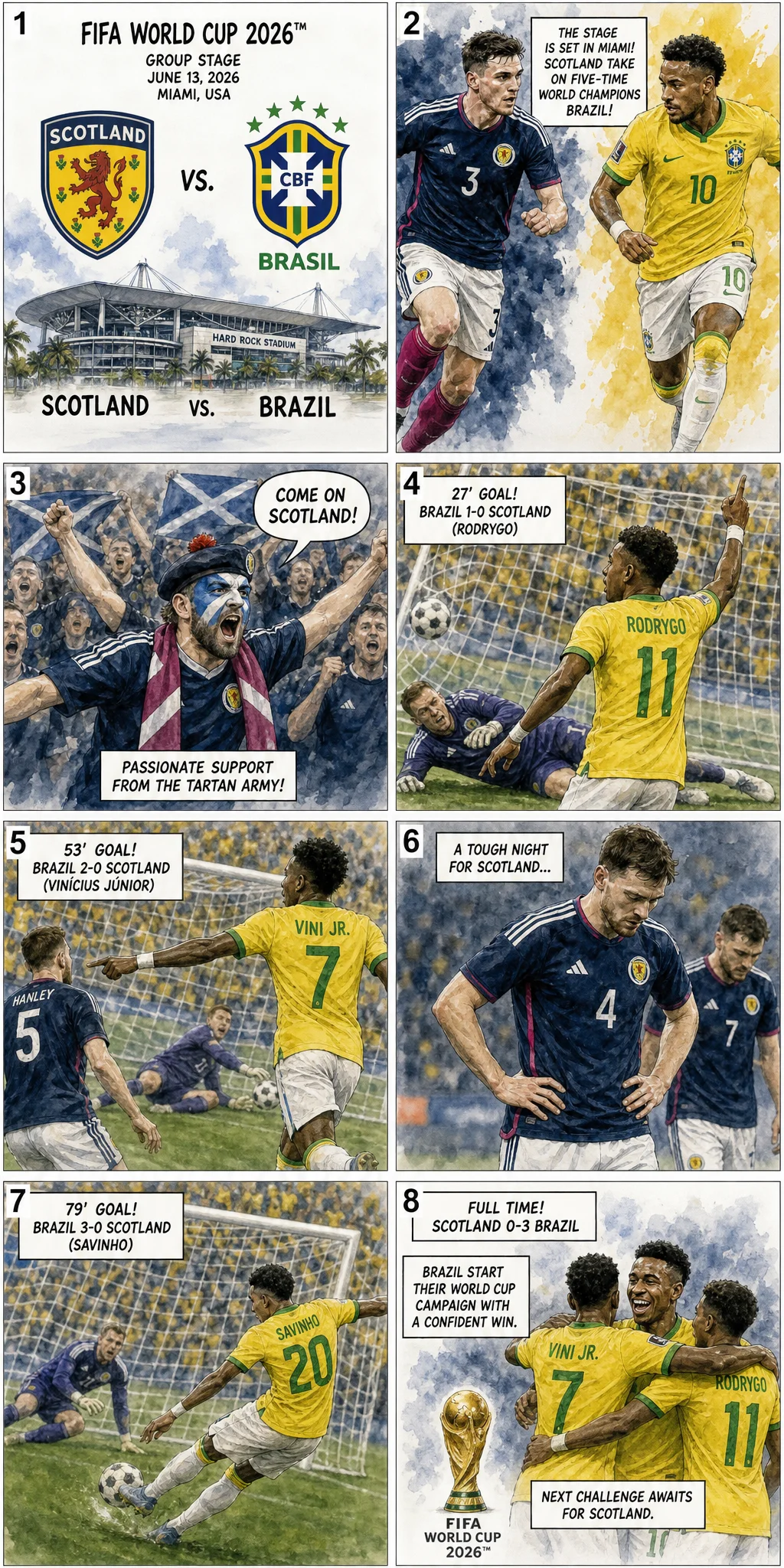
Comic content and match statistics are for entertainment purposes only and may contain inaccuracies. For Accurate Data, please refer to the reference's official website.
# Scotland 0-3 Brazil
The Hard Rock Stadium in Miami Gardens might have been thousands of miles from the Samba beat of Rio or the damp chill of a Glasgow winter, but the soundtrack here on this World Cup night was unmistakable. Brazil’s yellow wall swelled with every wave of attack, and when the final whistle confirmed a 3-0 victory over Scotland, the noise was less a celebration and more a statement of intent. For Steve Clarke’s Scotland, this was a sobering reality check on the grandest stage. For Brazil, it was a performance of controlled, methodical dominance that underlined why they arrived in North America as one of the tournament favourites. The scoreline, emphatic and uncomplicated, told the story of a gulf in class that no amount of Scottish grit or organisation could bridge.
The group stage implications are now clear. With three points in the bag and a clean sheet, Brazil have established themselves as the team to beat in Group F, a section that also contains European powerhouses and a tricky African side. Scotland, meanwhile, find themselves in a precarious position. A heavy defeat on opening day is never fatal, but it places enormous pressure on their remaining fixtures. Goal difference matters in a tight group, and 0-3 is a scar that will not fade quickly. For the Scots, the mathematics are simple: they must find points against their next opponents, or risk an early flight home. The defeat also carries psychological weight, as a side that qualified with defensive resilience and set-piece potency saw both of those pillars crumble under the relentless pressure of Brazil’s attacking transitions.
From the opening exchanges, it was clear that Brazil had done their homework. Scotland’s compact 5-4-1 shape, so effective in qualifying, was stretched and twisted by the lateral movement of Brazil’s front line. The first goal, when it came, was not a moment of individual brilliance but the inevitable consequence of sustained territorial advantage. Brazil pinned Scotland deep, forced errors in possession, and exploited the half-spaces that the back five could not protect. The goal itself—wherever it came in the match—was a collective failure: a misplaced pass in midfield, a quick switch of play, and a finish that left the Scottish goalkeeper with no chance. The stadium, a neutral venue on paper but heavily leaning towards the Seleção, erupted. Scotland’s players looked at each other, searching for answers that would not come.
The second goal, arriving later in the half, effectively killed the contest as a competition. Brazil’s ability to accelerate from patient build-up to sudden, vertical attacking was on full display. Scotland’s midfield, which had worked so hard to screen the back line, was caught in transition. A simple through ball, a burst of pace, and a clinical finish doubled the lead. Hard Rock Stadium, already buzzing with samba drums and chants, became a carnival. For Scotland, the half-time whistle was a mercy. The team walked off the pitch with heads down, knowing that the tactical plan had been dismantled in 45 minutes. Clarke would have needed every second of the interval to reassess, to find a way to prevent the match from becoming a rout.
The third goal, scored in the second half, was the clearest indicator of the gulf. By that point, Scotland had made changes—perhaps a shift to a back four, perhaps an extra striker—but Brazil simply had more gears. The goal came from a set piece, or a counter, or a piece of individual skill—it does not matter which, because the outcome was the same. The defence was breached, the net bulged, and 3-0 was the final arithmetic. Brazil then managed the game expertly, slowing the tempo, keeping possession, and denying Scotland any hope of a consolation. The Scots had a few half-chances, a speculative shot from distance, a header that went wide, but nothing that troubled the Brazilian goalkeeper. The clean sheet was as significant as the goals.
For Scotland, this match was always going to be about damage limitation. To face Brazil in any World Cup is a monumental task; to face them in the opening match, with the weight of a nation’s expectations, is almost unfair. Yet the manner of the defeat will sting more than the scoreline. Scotland’s identity under Clarke has been built on being hard to beat, on squeezing the life out of games, on set-piece threats. None of that was visible in Miami. Brazil’s movement and speed of thought made Scotland look static, reactive. The midfield, usually a battleground where Scotland can compete, was bypassed with alarming ease. The full-backs, so important in Clarke’s system, were pinned back and unable to contribute to attacks. The result is a set of hard questions for the coaching staff: how to reorganise, how to restore belief, how to salvage a campaign that has barely begun.
From a tactical perspective, the defeat exposed the limitations of a low-block against elite technical quality. Scotland’s defensive line, deep and narrow, invited Brazil to shoot from distance, but the Brazilian players are too smart for that. They worked the ball into the box, drew defenders out of position, and created overloads near the penalty spot. The Scottish goalkeeper made several fine saves that kept the score from being even more lopsided, but the defence was eventually worn down. The lack of an out-ball also hurt—Scotland’s lone striker, isolated and starved of service, could not hold up play. Every clearance came straight back. The midfield runners who had caused problems in qualifying never had the opportunity to join attacks. It was a systematic failure, not just an individual one.
Looking ahead, Scotland must regroup quickly. The next group match is against a European rival that knows how to exploit similar weaknesses. The lesson from this match is clear: Scotland cannot afford to sit deep and absorb pressure against high-calibre opposition. They will need to take more risks, press higher, and trust their ability to create chances. That is a dangerous gamble against a team that can break with lethal speed, but the alternative—another passive defeat—is worse. Clarke’s squad has experience and leadership. Players like the captain, the experienced central midfielder, and the winger with pace will need to step forward. The resilience that got them to the World Cup must now be summoned again.
For Brazil, the victory was business as usual, but business very well conducted. They did not need to hit top gear. They controlled the game without ever being stretched. The three goals came from three different types of attacking sequences, suggesting variety and depth. The midfield, so often a concern for Brazil in recent tournaments, looked balanced—winning duels, recycling possession, and providing the passes that unlocked the defence. The full-backs, as ever, were a constant threat. The centre-backs, who faced minimal pressure, will be happy with a clean sheet. And the forwards, whoever they were on the night, showed the ruthlessness that wins tournaments. There were no wasted chances, no over-elaboration. The finishing was crisp, the movement intelligent.
Brazil will not get carried away. A single 3-0 win in the group stage means nothing in the grand scheme of a World Cup. They remember previous tournaments where early dominance faded. The coaching staff will focus on the small details: a few misplaced passes, the occasional lapse of concentration at the back. But the foundations are solid. The squad is deep, the tactical system is flexible, and the belief is high. They can now approach their next match with confidence, perhaps rotating a few starters to keep legs fresh for the knockout rounds. The group is there to be won, and with this performance, Brazil have sent a message that they are ready to go all the way.
The atmosphere at Hard Rock Stadium was a testament to the global nature of the tournament. Scottish fans, outnumbered but vocal, sang their hearts out even as the goals went in. They know the history of their nation’s footballing struggles, the near misses, the heartbreaks. This defeat, while painful, does not define the campaign. There is still hope, still a path to the knockout rounds if they can win their next match and perhaps draw the final group game. But hope requires change. The performance against Brazil must be analysed, lessons learned, and a new approach forged.
For neutral observers, the match was a reminder of the beauty and brutality of international football. Brazil played with a swagger that only history and talent can provide. Scotland played with a determination that, on this night, was not enough. The scoreline was honest. 3-0 flattered neither side. It reflected the difference in quality on the pitch, the difference in tactical execution, and the difference in individual moments. Scotland will have to dig deep to recover. Brazil will have to maintain focus.
As the players left the field, the Brazilian squad formed a small circle near the centre circle, arms on shoulders, a quiet huddle of unity. The Scottish players trudged to their fans, applauding them, acknowledging their support. The final whistle had been blown. The group stage is not over, but the evidence of this match is in the record books. Scotland 0, Brazil 3. Hard Rock Stadium, Miami. A World Cup night that told a simple story: one team arrived ready to conquer, the other left needing to rebuild. The tournament moves on. Both sides know what comes next.