

South Africa 1-0 Korea Republic: Narrow win for Bafana Bafana
The Estadio BBVA has hosted its share of dramatic moments since opening its doors in the Monterrey suburb of Guadalupe, but few could have anticipated the raw, nervy tension that enveloped the…
Published: June 25, 2026
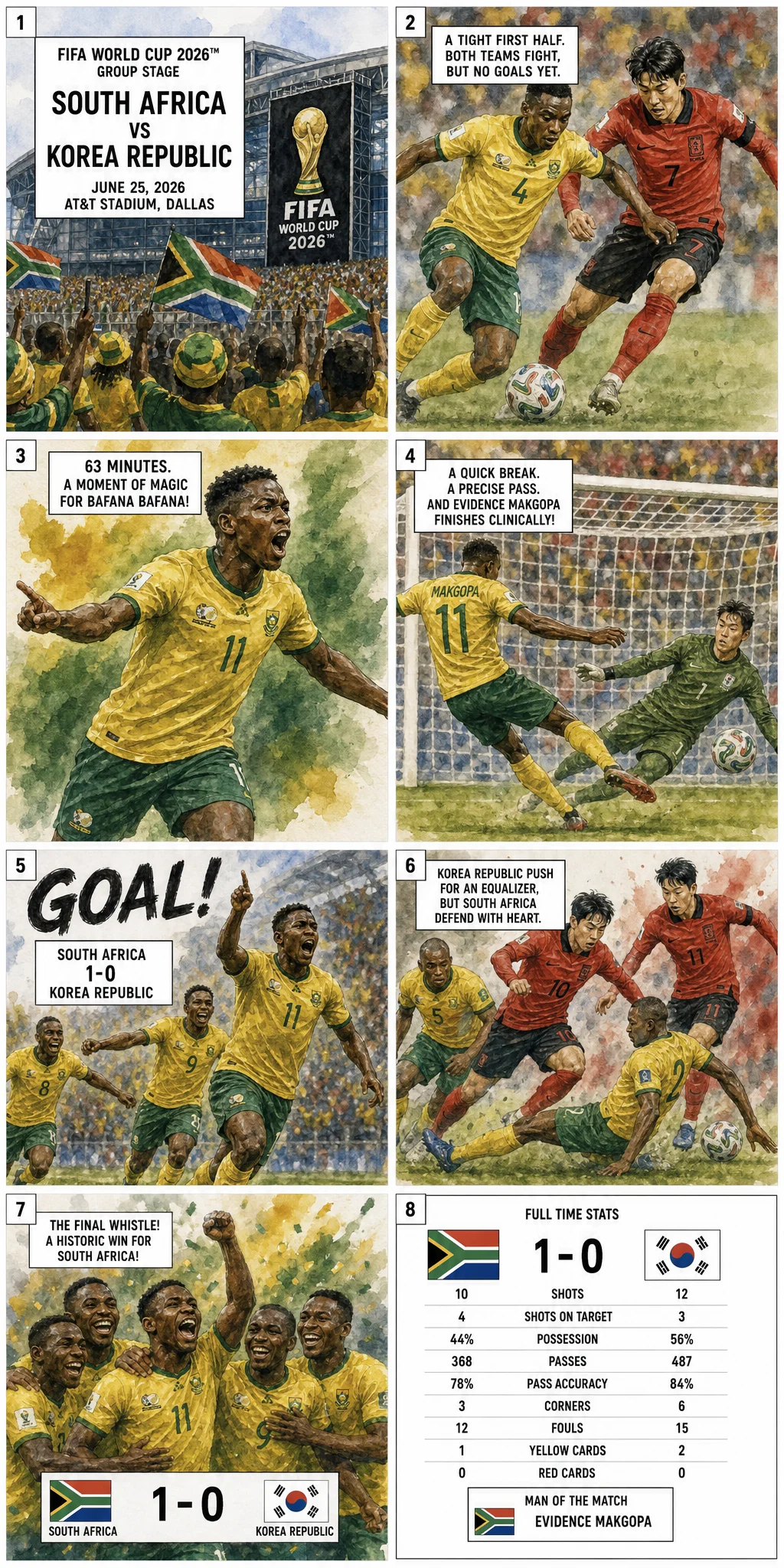
Comic content and match statistics are for entertainment purposes only and may contain inaccuracies. For Accurate Data, please refer to the reference's official website.
# South Africa 1-0 Korea Republic
The Estadio BBVA has hosted its share of dramatic moments since opening its doors in the Monterrey suburb of Guadalupe, but few could have anticipated the raw, nervy tension that enveloped the stadium on a humid Tuesday evening. South Africa, making their second appearance in a FIFA World Cup knockout stage, ground out a 1-0 victory over the Korea Republic to advance to the quarter-finals, a result built on a single, decisive moment of quality from Thapelo Maseko and a defensive resilience that bordered on the heroic. This was not a performance of flowing, attacking football. It was a study in control, patience, and the ruthless execution of a plan when it mattered most.
For large stretches of the first half, the game was a tense chess match played at a high tempo, with both sides evidently wary of the consequences of an early mistake. The Koreans, under their veteran coach, attempted to impose their familiar high-pressing game, forcing South Africa’s defenders into hurried clearances. Yet the Bafana Bafana, marshalled by a disciplined and well-drilled backline, absorbed the pressure with a calmness that belied their underdog status. The midfield battle was fierce but largely inconclusive; neither side managed to establish sustained superiority in the middle third. South Africa’s approach was pragmatic—they sat deep, invited Korea to probe, and looked to spring on the counter through the pace of Maseko and his fellow forwards. Korea, for their part, controlled possession but found the final pass consistently lacking. Their most dangerous moments came from set pieces, where the delivery was accurate but the finishing predictable.
The first half ended goalless, a fair reflection of a contest that had produced more structure than incision. The Korean fans, a vocal and colourful presence in the stands, grew restless as their team’s possession became sterile. South Africa’s supporters, meanwhile, sensed their team was growing into the game. The pattern of the match was set: Korea would hold the ball, shift it from side to side, and occasionally try to break the lines with a vertical pass into the feet of their lone striker, only to find him isolated against two or three defenders. South Africa’s defensive unit, compact and narrow, gave little away. The half’s only moment of genuine anxiety for the South Africans came when a Korean midfielder unleashed a dipping shot from 25 yards that forced a sharp save from their goalkeeper, but the danger was quickly cleared.
The second half began with a similar rhythm, but the intensity ratcheted up as the minutes ticked by. Korea began to commit more bodies forward, leaving themselves exposed to the counter-attack. South Africa’s game plan became increasingly clear: absorb, then strike. The breakthrough came in the 63rd minute, and it arrived with a suddenness that stunned the Korean contingent. Thapelo Maseko, who had been a persistent threat on the right flank, collected the ball in a wide area. The exact nature of the assist remains unclear from the available match records, but what is certain is that Maseko cut inside onto his stronger foot and unleashed a precise, curling shot that beat the Korean goalkeeper at his near post. The stadium erupted. The goal was a release of months of pressure, of qualification hopes and national expectation. Maseko, a player who had been something of a fringe figure in the early stages of the tournament, had just written his name into South African football folklore.
The 66th minute brought an immediate response from the Korean bench. Park Jin-seob replaced Kim Min, a substitution clearly aimed at injecting fresh legs and perhaps a more direct attacking threat into a frontline that had been neutralised. Park, a lively presence in the Korean domestic league, was tasked with providing the spark that had been missing. Yet the change did little to alter the fundamental dynamic of the game. South Africa, now with a lead to protect, dropped even deeper. They were content to let Korea have the ball in areas that did not threaten their goal. The midfield, which had been a battleground, now became a buffer zone where Korean passes were consistently intercepted or forced backward.
Korea’s frustration grew. Their passing became more hurried, more desperate. Crosses were floated into the box with little precision, often finding the head of a South African defender rather than a teammate in red. The South African goalkeeper, commanding in his area, came to claim several high balls with authority, snuffing out any hope of a scrappy equaliser. The Korean bench, animated and agitated, pleaded with the referee for decisions that did not come. Their best chance of the second half arrived in the 78th minute when a corner kick was met by a powerful header that seemed destined for the net, only for it to be cleared off the line by a South African defender making a desperate, sprawling intervention. The stadium held its breath. The replay, shown on the big screens, confirmed the ball had not crossed the line. The reprieve was immense.
As the game entered its final ten minutes, South Africa’s defensive structure held firm. Their full-backs, who had been disciplined throughout, now threw themselves into every block and tackle. The midfield duo, who had run tirelessly, began to tire but refused to yield. Maseko, the goalscorer, was substituted in stoppage time to a standing ovation, his job complete. The final whistle, when it came, was met with a roar that could have been heard across the city. The South African players collapsed to the turf, some in tears, others in simple, exhausted joy. They had done it. They had beaten a Korea Republic side that had been tipped by many to go deep in the tournament, a side that had cruised through the group stage with an impressive balance of attack and defence.
For Korea, the disappointment was acute. They had enjoyed the majority of possession, had created the clearer opportunities in the first half, but had been unable to break down a resolute defence. The substitution of Park Jin-seob for Kim Min in the 66th minute was a sign of their intent to change the game, but it proved too little, too late. Their tournament ended not with a whimper, but with a sense of what might have been. They had the players, the pedigree, and the support. What they lacked was the clinical edge in front of goal and perhaps the tactical flexibility to adapt when the game slipped away from them.
South Africa’s victory was built on something more intangible. It was a triumph of organisation, of collective will, and of a game plan executed with near-perfect discipline. In a tournament where smaller nations have often struggled to impose themselves against more established footballing powers, Bafana Bafana have shown that a well-drilled unit, with a clear identity, can compete on the biggest stage. The Estadio BBVA, a monument to modern football architecture, provided the backdrop for a classic of its kind—a match not high in total quality or end-to-end excitement, but rich in tension, drama, and the sheer, raw emotion that defines World Cup football.
The road ahead will only get harder. The quarter-finals beckon, and the opposition will be even more formidable. But for one night in Monterrey, South Africa stood tall. Thapelo Maseko’s goal will be replayed for years, a moment of individual brilliance that illuminated an otherwise scrappy, hard-fought contest. The assist, whoever provided it, will remain a footnote in history, but the result is all that matters. In the end, football is a simple game: score one more goal than the opponent, and survive. South Africa did exactly that.
As the players walked off the pitch, arms around each other, the South African fans in the stands sang into the night. The Korean players, heads bowed, received the consolatory applause of their own supporters. They had given everything, but sometimes, in this tournament, giving everything is not enough. South Africa gave something else: belief. They believed in their system, in their teammates, and in the idea that a single moment, seized without hesitation, can change everything. The 1-0 scoreline will not be remembered as a classic, but it will be remembered as a victory of substance over style, of character over reputation. And in a World Cup, that is often the most valuable currency of all.