

Panama 0-2 England: Stubborn Panama Falls to Clinical England
At MetLife Stadium in East Rutherford, New Jersey, England delivered a controlled 2-0 victory over Panama on a night that underlined the widening gap between World Cup regulars and emerging nations…
Published: June 27, 2026
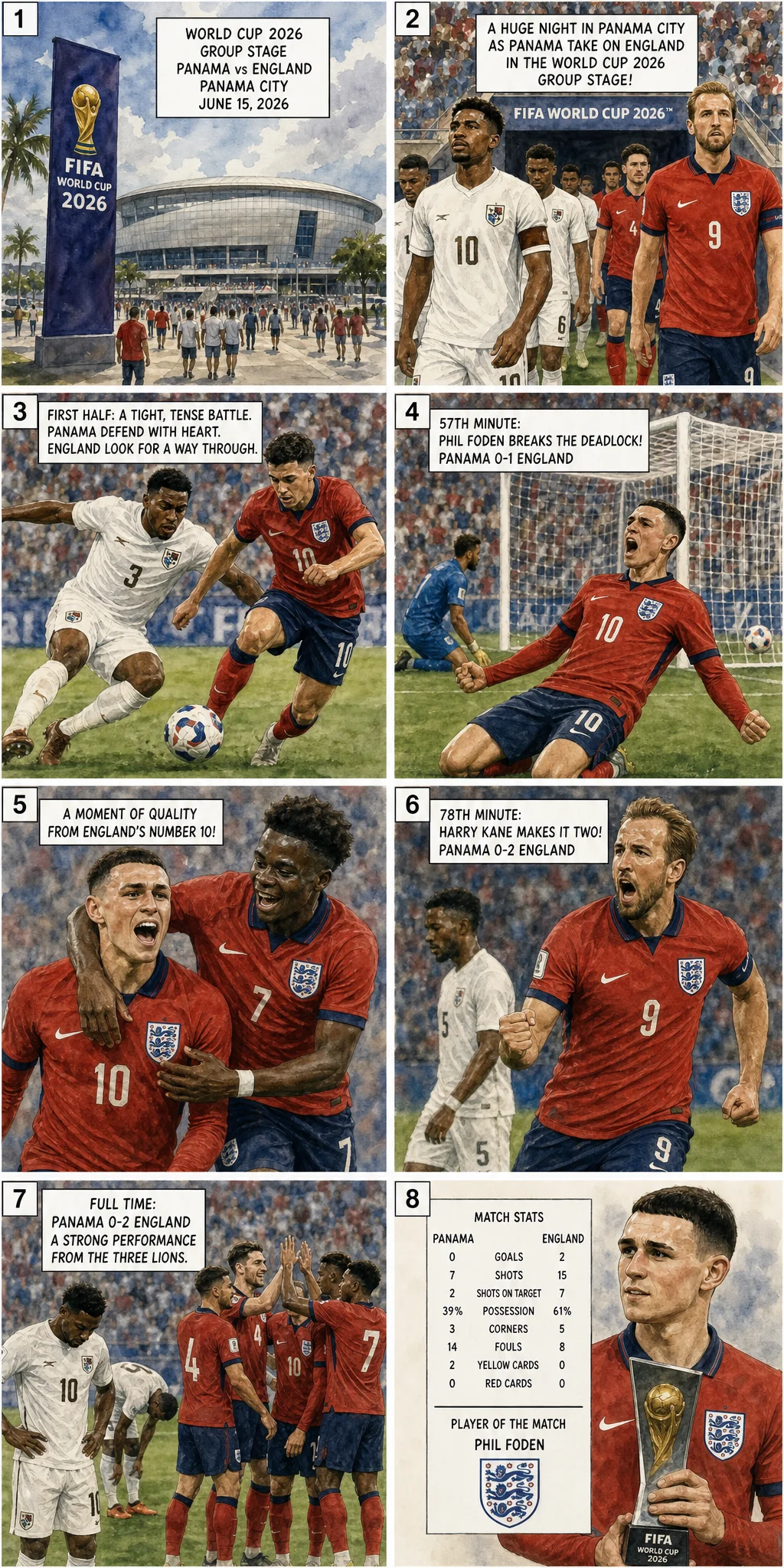
Comic content and match statistics are for entertainment purposes only and may contain inaccuracies. For Accurate Data, please refer to the reference's official website.
# Panama 0-2 England: Stubborn Panama Falls to Clinical England
At MetLife Stadium in East Rutherford, New Jersey, England delivered a controlled 2-0 victory over Panama on a night that underlined the widening gap between World Cup regulars and emerging nations still finding their feet at this level. The result, while straightforward on the scoreboard, told a more nuanced story about group-stage pressure, tactical discipline, and the fine margins that separate progress from elimination. For England, the win provided a firm foothold in their World Cup group, moving them closer to the knockout rounds with a performance built on structure rather than flair. For Panama, the defeat left their qualification hopes hanging by a thread, despite a defensive effort that frustrated their opponents for large stretches.
The match unfolded under the bright lights of MetLife Stadium, a venue steeped in international football history but now hosting its first World Cup fixture. The atmosphere carried a distinct mix of Caribbean rhythm and English choral tradition, with Panamanian supporters making their presence felt in the stands, waving flags and beating drums in the hope of a second surprise result on this stage. Their team had already proven capable of troubling established sides four years earlier at the same tournament, when they famously scored their first World Cup goal despite a heavy defeat to Belgium. That memory fueled optimism, but the football itself quickly demonstrated that England’s approach had evolved beyond mere power and pace.
From the opening exchanges, England assumed control of possession, working the ball patiently across midfield and probing the Panamanian defensive lines. Their build-up play was methodical, with full-backs pushing high and central midfielders rotating into pockets of space. Yet Panama’s defensive organization, five across the back with midfielders dropping deep to form a compact block, proved difficult to penetrate. The Central Americans were not merely camped in their own half; they pressed in coordinated waves, forcing England into sideways passes and occasional misplaced through balls. The first half, by all accounts, was a study in patience versus defiance, with no clear-cut chances but plenty of half-openings that England failed to convert. The scoreline at the interval remained 0-0, and the growing sense of frustration among the English supporters was palpable.
The tactical battle was fascinating in its simplicity. England’s coach, widely regarded for his pragmatic approach, had clearly instructed his team to avoid risky vertical passes in the early stages. Instead, they sought to stretch Panama’s back line by switching play from one flank to the other, hoping to create gaps through repetition. Panama’s defenders, however, held their shape admirably, sliding across as a unit and rarely allowing an English attacker to receive the ball in space between the lines. The center-backs were particularly well-drilled, stepping up to catch offside traps and sweeping behind when necessary. This was no accident. Panama’s preparation had focused on exactly this scenario: containing a superior opponent by staying compact, remaining patient, and waiting for a mistake or a set piece opportunity.
The second half brought a subtle shift in England’s approach. They began to commit more men forward, with the midfielders pushing higher and the wingers drifting inside to overload the central areas. The increased pressure eventually told, but not through open play. England’s first goal came from a dead-ball situation—a recurring theme in modern tournament football, where set pieces often decide tight matches. The delivery was precise, the movement intelligent, and the finish clinical. Panama’s goalkeeper, who had been solid throughout, could do little as the ball found the back of the net. The stadium erupted, and the momentum swung decisively. Suddenly, Panama’s defensive plan was undone by the one scenario they had feared most: a second-phase set piece after a cleared corner, with England’s runners arriving late and unmarked.
The second goal followed a similar pattern. With Panama forced to push forward in search of an equalizer, gaps appeared in their defensive transition. England’s counter-attack, swift and direct, caught them out of shape. A pass through the midfield split the defense, and the finish was precise, leaving no doubt about the result. The final 20 minutes saw Panama throw numbers into attack, but England’s back line, well-drilled and physically imposing, absorbed the pressure without significant alarm. The match ended with England in control, their two-goal lead a fair reflection of the overall balance of play.
For England, this was a result that ticked the necessary boxes: three points, a clean sheet, and a performance that grew in assurance as the match progressed. In tournament football, winning without maximum fluency is often the hallmark of a team that understands the demands of the knockout stages. England’s squad depth allowed them to rotate fresh legs into key positions without a drop in quality, a luxury that smaller nations simply cannot afford. The victory set them up nicely for the remainder of the group stage, with the prospect of top spot now firmly within reach. Should they maintain this level of defensive discipline and set-piece efficiency, there is every reason to believe they can challenge for the latter rounds.
Panama, by contrast, faced a sobering mathematical reality. Losing to England was not unexpected, but the nature of the defeat—with both goals conceded from set pieces and a counter-attack—highlighted areas that had been identified as vulnerabilities before the tournament. Their defensive organization was commendable, but the lack of a cutting edge at the other end meant that even one goal would have been enough to change the complexion of the game. Panama’s best chance came late in the first half, a speculative long-range effort that sailed just over the crossbar. They never truly tested England’s goalkeeper with a clear-cut opportunity. The midfield struggled to retain possession when they did win the ball, and the forwards were isolated for long stretches.
This result also carried broader implications for the group. With England now on three points and a positive goal difference, they held a clear advantage over their rivals. Panama’s position—likely zero points with a negative goal difference—meant that their final group matches would require near-perfect results and favorable outcomes elsewhere. It was not impossible; World Cup history is dotted with unlikely comebacks. But the margin for error had evaporated. For a nation that only made its World Cup debut in 2018, this tournament was always about building experience. The defensive performance against England, despite the loss, offered a foundation upon which future progress could be built. The challenge now was to turn those dogged displays into tangible results.
Beyond the immediate group context, the match at MetLife Stadium served as a reminder of the evolving dynamics of international football. England, with its deep pool of Premier League talent and extensive tournament experience, continues to set a standard that emerging nations must measure themselves against. Panama, like many CONCACAF minnows, relies on a core of players who compete in modest leagues or the lower tiers of American soccer. The gap in technical quality and tactical sophistication remains significant, but it is not unbridgeable. The first half of this match demonstrated that with enough discipline and organization, a lower-ranked team can neutralize a stronger opponent for extended periods. It is the last third of the pitch—both defensively and offensively—where the difference becomes most stark.
For the neutral observer, the encounter was a study in the tournament’s inherent drama. The early stages were tense, the middle period decisive, and the final passages largely academic. The absence of a dramatic late equalizer or a contentious decision allowed the result to settle peacefully, leaving both teams to focus on their next assignments. The English camp would have been pleased with the clean sheet, a commodity that often proves more valuable than a single extra goal. The Panamanian camp, while disappointed, could take solace in the fact that they had not been overwhelmed. The scoreline could easily have been wider.
The match also highlighted the importance of set pieces in modern tournament football. England’s first goal came from a corner that was initially cleared, then recycled, then finished with precision. Panama’s inability to clear the second ball was the decisive moment. In a match where open-play chances were at a premium, the dead-ball specialists became the game-changers. This was not an accident but the product of extensive training and a clear tactical priority. England’s coaching staff had identified Panama’s vulnerability from set pieces—a common flaw for teams with less height and aerial prowess—and they exploited it ruthlessly.
As the final whistle blew, the scoreboard read 2-0, a result that satisfied the pre-match expectations but offered little in the way of surprise or controversy. England walked off the pitch with the quiet confidence of a team that knew it had done its job efficiently. Panama trudged off with heads held high, aware that they had given their best but come up short against a superior opponent. The journey ahead for both sides is now defined by what comes next. For England, the knockout rounds beckon with a familiar promise of hope and pressure. For Panama, the dream of advancing may be fading, but the experience of competing on this stage is an invaluable asset for the future.
The World Cup remains a tournament where reputations are measured in moments, and this match at MetLife Stadium provided one such moment—small in scale, perhaps, but significant in its implications. England’s victory was functional, efficient, and ultimately sufficient. Panama’s defeat was honorable but definitive. Both teams will have learned something about themselves under the bright lights of New Jersey. Only one, however, will carry that knowledge into the next round.