

Colombia 0-0 Portugal: High-Quality Chances Go Unpunished
The first 0-0 draw of the 2026 World Cup arrived under the South Florida lights at Hard Rock Stadium, and it belonged entirely to Colombia—except for the one number that mattered most.
Published: June 28, 2026
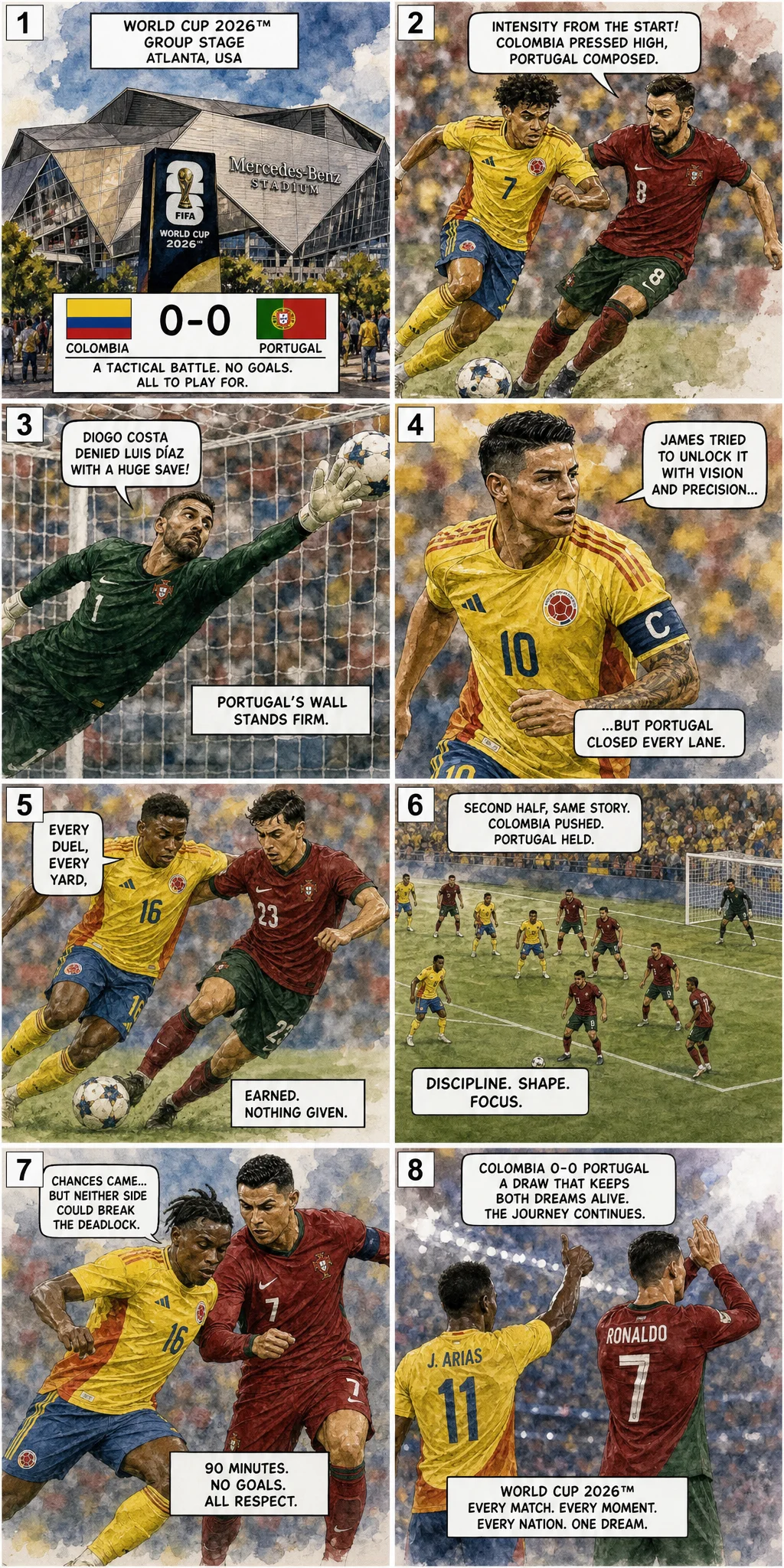
Comic content and match statistics are for entertainment purposes only and may contain inaccuracies. For Accurate Data, please refer to the reference's official website.
# Colombia 0-0 Portugal: High-Quality Chances Go Unpunished
The first World Cup match to be played at Hard Rock Stadium in Miami ended in a stalemate that told a story of missed opportunities and defensive resolve, as Colombia and Portugal played out a 0-0 draw on 27 June 2026. In a Group K encounter that carried significant implications for the knockout-stage bracket, neither side could break the deadlock despite both creating clear chances. The result confirmed Colombia as group winners while Portugal had to settle for second place, but the match itself was defined by a handful of high-quality moments that ultimately went unpunished.
From the opening exchanges, it was evident that Portugal would look to dominate possession and dictate the tempo. Their midfield trio, anchored by the experienced Ruben Neves and Bruno Fernandes, sought to find pockets of space between Colombia’s compact defensive lines. Colombia, meanwhile, set up in a disciplined shape designed to absorb pressure and spring quickly on the counter, with James Rodríguez dropping deep to link play and Jhon Arias providing width on the right. The first real threat came from the most predictable source. Cristiano Ronaldo, playing his fifth World Cup at the age of 41, drifted into the left-central channel and received a pass that allowed him to turn and shoot. The effort was tame, rolling comfortably into the hands of Colombia goalkeeper Camilo Vargas, but the flag had already gone up for offside. It was a moment that encapsulated the frustrations of both player and team: a chance created through movement and anticipation, only for the timing to be a fraction off.
As the half wore on, the game became increasingly physical. Midfield battles spilled over into the final third, and referee decisions started to shape the rhythm. In one notable incident, Ronaldo was bundled over by a Colombian defender just outside the penalty area, but instead of receiving a free kick, the advantage was played. Portugal wasted the opportunity as the ball ran loose, and in the ensuing scramble, an aerial foul on James Rodríguez by Ruben Dias was called. At the time it felt like a microcosm of a disjointed spell: Portugal unable to convert promising positions into clear-cut chances, and Colombia’s defensive organisation growing in confidence with every successful clearance.
The best opportunity of the first half, however, belonged to Portugal. João Cancelo, overlapping from right-back, sent a hopeful cross into the box that bypassed the first wave of Colombian defenders. Bruno Fernandes, arriving late and unmarked, took a touch to control the ball before firing a point-blank shot on goal. It was the kind of attempt that, six inches to either side, would have rippled the net. But Vargas, Colombia’s veteran goalkeeper, reacted sharply, spreading himself to smother the effort with his chest. The save drew a roar from the Colombian supporters packed into the Hard Rock Stadium stands, and it kept the score level heading into halftime.
The second half followed a similar pattern. Portugal continued to hold the ball but struggled to break down a Colombia defence that was marshalled with discipline. When Portugal did breach the lines, the final pass often let them down, or Vargas was equal to the task. Colombia, by contrast, grew bolder as the game progressed. Their best chance arrived with a moment of individual brilliance from Jhon Arias. Picking up the ball on the right flank, he cut inside onto his left foot and unleashed a driven shot that beat Diogo Costa all ends up. The ball was heading for the top corner before Ruben Neves, sprinting back towards his own goal, managed to get his body in the way and clear the ball off the line. It was a remarkable piece of defensive recovery, the kind of intervention that changes the course of a tournament. For Colombia, it was a warning that they were capable of punishing Portugal on the counter, but also a reminder that fine margins can decide World Cup matches.
The final twenty minutes saw a shift in momentum as both teams recognised that a draw would be enough for Colombia to top the group, while Portugal needed a win to finish first. Portugal pushed more numbers forward, leaving gaps at the back that Colombia were happy to exploit. Yet neither side could find the decisive breakthrough. Ronaldo, increasingly isolated, had one more chance to make the difference when a free kick was awarded in a dangerous position. He struck it well, but Vargas was again equal to the effort, tipping the ball over the bar. At the other end, Colombia substitute (no specific name given) nearly caught Costa off his line, but the Portuguese goalkeeper recovered in time.
When the final whistle blew, the scoreboard read 0-0. For Colombia, it was a historic result in an unexpected way. The goalless draw was their first 0-0 in a World Cup match, a statistical milestone that reflected the defensive solidity they have built under their current coach. They will progress to the knockout stage as group winners, a position that allows them to avoid the tournament favourites from other groups in the early rounds. Portugal, by finishing second, face a more daunting path, but they will take confidence from the fact that they created the better chances and dominated large periods of the match.
The wider context of the group standings made the result feel more significant than a simple goalless stalemate. Colombia’s ability to hold their nerve against a side with Portugal’s pedigree, particularly given the attacking firepower of players like Ronaldo and Fernandes, will give them belief that they can match up against any opponent in the tournament. For Portugal, the frustration of failing to top the group will be tempered by the knowledge that they are through to the knockout stage, and that their performance in Miami was not without merit. The stats will show a game of few clear chances, but those that did materialise were high quality. The save by Vargas from Bruno Fernandes, the goal-line clearance by Ruben Neves, the tame effort from Ronaldo that was flagged offside — each moment carried weight.
The atmosphere at Hard Rock Stadium was electric throughout, a testament to the large Latin American community in South Florida and the travelling Portuguese supporters who made the journey across the Atlantic. The venue itself, hosting World Cup matches for the first time in 2026, offered a modern, hostile environment for visiting teams. The heat and humidity of a Miami evening added another layer of difficulty, particularly for a Portuguese side that had played its previous group games in more temperate conditions. Colombia, acclimatised to similar weather, used that familiarity to their advantage, controlling the tempo in the latter stages and ensuring that Portugal could not build up a head of steam.
Individual performances deserve mention. Camilo Vargas, in goal for Colombia, was outstanding. His save from Bruno Fernandes was the highlight, but his command of the penalty area and distribution were equally impressive. Ruben Neves, for Portugal, showed why he is valued as much for his defensive work as his passing ability; his goal-line clearance was the turning point of the second half. James Rodríguez, despite not being directly involved in the goalscoring chances, was instrumental in holding the ball up and drawing fouls, allowing Colombia to relieve pressure. Ronaldo, meanwhile, cut a frustrated figure at times, but his movement off the ball remained a constant threat even if the final product was lacking.
In the end, the 0-0 draw was a fitting outcome for a match that was tight, tense, and ultimately decided by the quality of defending rather than the lack of ambition. Colombia will be delighted with a point that secured top spot in Group K, and they can now look forward to a knockout tie against a second-place finisher from another group. Portugal, having finished second, will face a group winner in the round of 16, but they will feel that their performance deserved more. For now, both teams are still alive in the tournament. The path forward is set, and the memories of this goalless affair at Hard Rock Stadium will be overshadowed by whatever comes next. But for the observers who were present, it was a game that offered a reminder of how much can happen even when the scoreboard remains unchanged. The offside flag, the point-blank save, the clearance off the line – these are the moments that define World Cup matches, even when no goals are scored.