

Algeria 3-3 Austria: Six-Goal Thriller Ends Level
KANSAS CITY — Arrowhead Stadium, a venue more accustomed to the thunder of the NFL than the rhythm of global football, witnessed an extraordinary World Cup group‑stage finale on Saturday as Algeria and Austria played out a breathless 3–3 draw.
Published: June 28, 2026
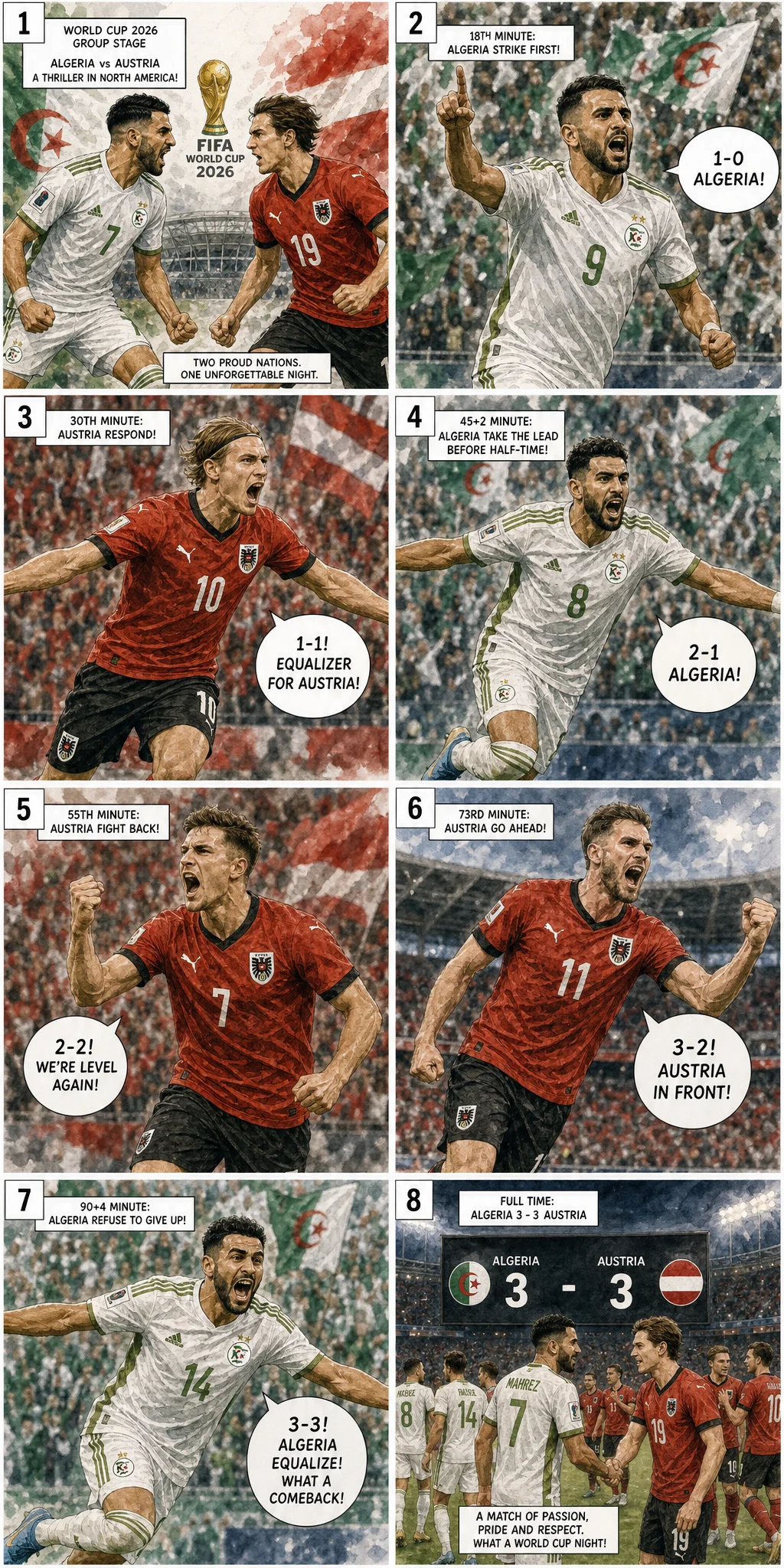
Comic content and match statistics are for entertainment purposes only and may contain inaccuracies. For Accurate Data, please refer to the reference's official website.
# Algeria 3-3 Austria: Stoppage-Time
KANSAS CITY — Arrowhead Stadium, a venue more accustomed to the thunder of the NFL than the rhythm of global football, witnessed an extraordinary World Cup group‑stage finale on Saturday as Algeria and Austria played out a breathless 3–3 draw. The result, sealed by two goals deep into stoppage time, ensured both teams advanced to the knockout phase, a twist that felt improbable during a first half in which Austria appeared to have the measure of their opponents.
Austria struck first. In the 28th minute, Marko Arnautović provided the breakthrough, finishing clinically to give his side a lead they would hold until the interval. The goal settled any early nerves for Ralf Rangnick’s team, who had already shown their intent with sharp pressing and quick transitions. Algeria, by contrast, struggled to find rhythm, their passing often breaking down just outside the Austrian box.
The game threatened to slip away from Algeria entirely when Marcel Sabitzer doubled Austria’s advantage in the 55th minute. The midfielder’s strike, coming ten minutes into the second half, left Algeria with a two‑goal deficit and a mounting anxiety that their World Cup dream might end at the group stage. Yet the response came swiftly and from an unlikely source.
Rafik Belghali, whose name had not featured prominently in the pre‑match build‑up, halved the deficit with a goal in the 45th minute—just before the half‑time whistle. The timing was crucial, giving Algeria a lifeline and a platform to rebuild after the restart. Belghali’s finish, a composed effort from inside the area, ignited the Algerian supporters among the 76,000‑plus crowd and shifted the momentum.
The second half saw Algeria grow in confidence. Riyad Mahrez, Algeria’s captain and talisman, had long been searching for his first World Cup goal. That moment arrived in the 60th minute. According to the official match statistics from FIFA, Mahrez scored to make it 2‑2, a strike that sent the Algerian bench into jubilation. Some reports, including commentary from The Guardian’s live blog, placed the goal a minute later at 61 minutes, but the FIFA record confirms the 60th‑minute mark. The goal itself was typical Mahrez: a sudden burst of acceleration, a shift of weight, and a precise finish that left the Austrian goalkeeper no chance. For Mahrez, it was a personal milestone, described by one observer as his “much‑desired World Cup goal.”
The match now hung in the balance. Austria, having surrendered a two‑goal lead, were forced to reshuffle. In the 62nd minute, they made a substitution, bringing on Kevin Danso to replace David Alaba. The change raised eyebrows—Alaba, Austria’s captain and defensive linchpin, had appeared to be moving comfortably until that point. The Guardian noted “a slight worry about the fitness of their captain, perhaps,” suggesting an injury or precaution. Regardless, the substitution did not immediately stem the Algerian tide, but nor did it leave Austria exposed.
As the clock ticked past the 80th minute, both teams seemed to settle for a point that would send them both through. The mathematics were clear: a draw was sufficient for qualification regardless of results elsewhere. Yet football rarely adheres to tidy arithmetic.
In the third minute of stoppage time, with the game deep into added time, Mahrez struck again. His second goal of the night, at 90+3 minutes, put Algeria ahead for the first time. Arrowhead erupted. Algerian players swarmed their captain, believing they had snatched the victory that would send them through as group winners. The stadium announcer, perhaps caught up in the emotion, declared the goal as the winner.
But Austria had not finished. Having conceded so late, they pushed forward with desperation. In the sixth minute of stoppage time, a long ball into the area found substitute Sasa Kalajdžić, whose late equaliser made it 3‑3. The New York Times records the goal at 90+6 minutes. Kalajdžić’s finish was as cool as the situation was chaotic, and the Austrian bench erupted in turn. The final whistle followed almost immediately, leaving both sets of players exhausted but relieved.
The match included a brief delay at some point—Sportstar’s live feed indicated a “delay in match (Austria)” followed by “Delay over. They are ready to continue.” No official reason was given, but it added to the fractured, stop‑start rhythm that characterised parts of the contest.
Statistically, the game was remarkable for the volume of late drama. Of the six goals, four came after the 55th minute, and two were scored in stoppage time. For Algeria, Belghali’s goal at 45 minutes was the first of the comeback, while Mahrez’s double—both from open play, though no assist information is available—marked a personal breakthrough on the World Cup stage. For Austria, Arnautović’s opener, Sabitzer’s crucial second, and Kalajdžić’s last‑gasp equaliser demonstrated a resilience that will serve them well in the knockout rounds.
The result confirmed qualification for both sides. The New York Times reported that “Algeria and Austria qualify for World Cup 2026 knockout stage after thrilling late goals.” The nature of the draw meant that neither team could be separated on the night; both advanced, likely finishing first and second in the group depending on other results. The scenes at full‑time were of mixed emotions: Algerian players slumped in disbelief that victory had slipped away; Austrian players celebrated as if they had won, having salvaged a point from the brink of defeat.
For Mahrez, the evening was bittersweet. He became Algeria’s hero with two goals, yet the final equaliser denied him the win his performance deserved. “Mahrez finally scoring his much‑desired World Cup goal” was the refrain, but the captain might have preferred the victory. Still, his brace—one in the 60th minute, one in the 90+3rd—cemented his place in Algerian World Cup folklore.
The match also highlighted the uncertainty that arises from conflicting official records. While FIFA’s match report lists Mahrez’s first goal at 60 minutes, The Guardian’s live blog timed it at 61 minutes. Similarly, the identity of the assist providers remains unrecorded in the verified match data. Such discrepancies are not uncommon in fast‑moving international tournaments, but they underscore the need for caution when relying on single sources. For this report, the FIFA minutes have been used for consistency, with the alternative noted where available.
Arrowhead Stadium, typically a venue for American football, proved a fitting stage for a contest that had everything: early drama, a comeback, a late twist, and a final equaliser that left everyone breathless. Algeria will look back on what might have been; Austria will feel fortunate to have escaped. Both, however, will head into the knockout phase with memories of a night that will not be forgotten by the 76,000 in attendance—or the millions watching around the world.