

Brazil 2-1 Japan: Samba survives Samurai blue scare
The NRG Stadium in Houston, Texas, on that humid Tuesday evening in the summer of 2026, housed not merely a football match but a collision of worlds, a Round of 32 fixture in the FIFA World Cup that carried within its…
Published: June 29, 2026
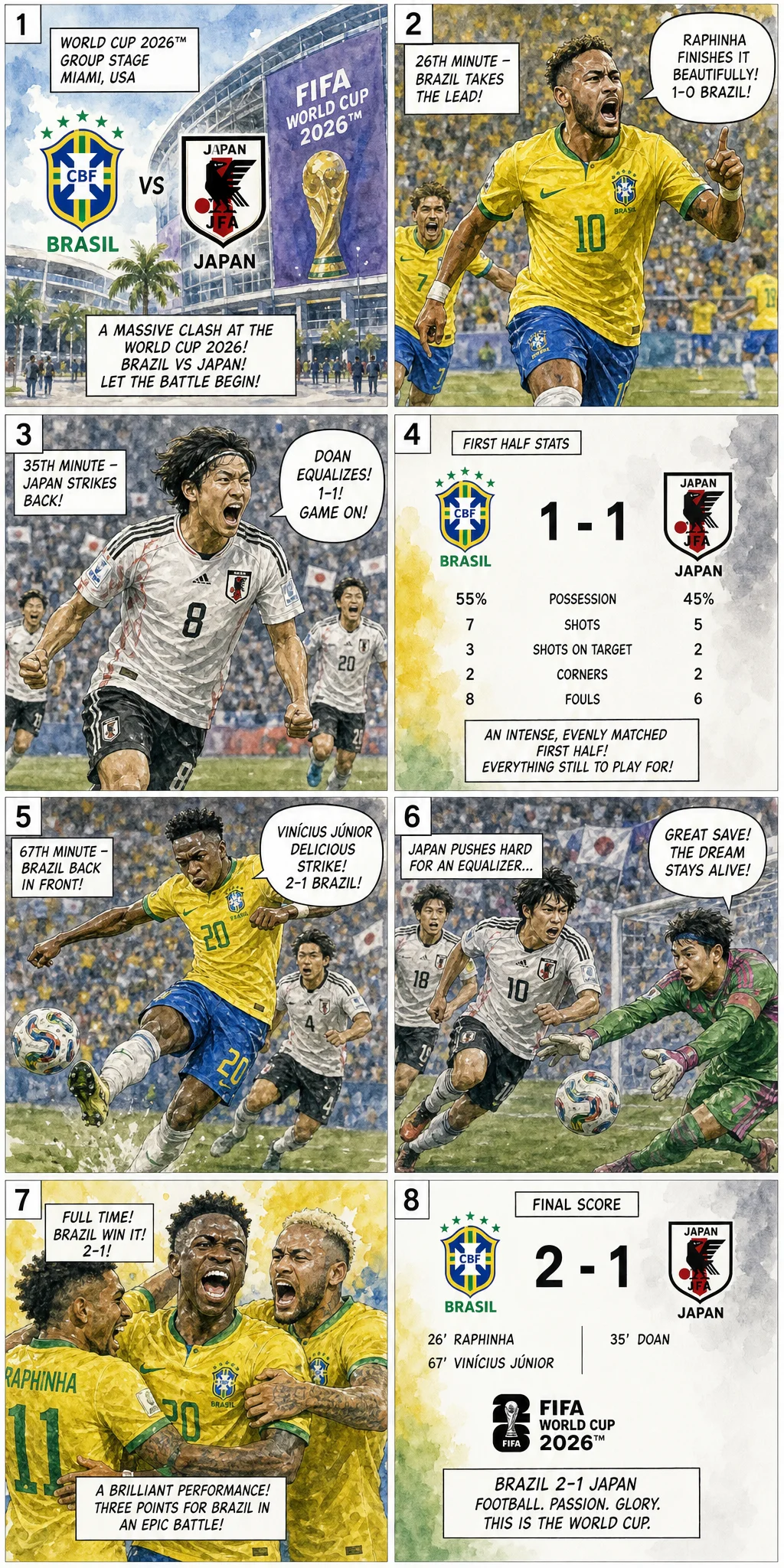
Comic content and match statistics are for entertainment purposes only and may contain inaccuracies. For Accurate Data, please refer to the reference's official website.
# Brazil 2-1 Japan: Samba survives Samurai blue scare
The NRG Stadium in Houston, Texas, on that humid Tuesday evening in the summer of 2026, housed not merely a football match but a collision of worlds, a Round of 32 fixture in the FIFA World Cup that carried within its 90-plus minutes the tensions of a century of Brazilian footballing identity and the quiet, insistent ambition of a Japanese side that had long ago ceased to be a footnote in the global game, and the result—Brazil 2, Japan 1—would be recorded in the annals not for its inevitability but for the manner in which it was seized from the jaws of an upset that would have echoed far beyond the boundary lines of the Texan gridiron adapted to the beautiful game.
The first half unfolded like a slow, deliberate chess match played on a board where the pieces had been rearranged by history itself: Brazil, the five-time champions, carrying the weight of a nation that had not lifted the trophy since 2002 and had seen its footballing hegemony questioned by European pragmatism, faced Japan, a team that had grown from the technical disciples of Zico to a disciplined, modern side that could absorb pressure and strike with a venom that belied their underdog status. And strike they did, at the 29th minute, when a player whose name would soon be whispered in the bars of São Paulo and the izakayas of Tokyo—Kaishu Sano—produced a moment of individual brilliance that cut through the Brazilian defense like a katana through silk. It was a solo goal, a run that began somewhere inside the Japanese half, a surge of acceleration and a finish that left Alisson Becker rooted to his line as the ball nestled into the net, giving Japan a 1-0 lead and silencing the raucous Brazilian contingent that had filled the lower tiers of the stadium with their yellow and green. The moment was not an accident; it was the product of a tactical plan that saw Japan cede possession but compress space, daring Brazil’s overlapping full-backs to advance while Sano lurked in the shadows of the midfield line, ready to pounce on a loose ball and turn defense into a narrative of their own making. The half-time scoreline, Japan 1-0 Brazil, was not a reflection of the balance of play—the expected goals (xG) would later reveal a chasm: Brazil 1.72 against Japan’s 0.23—but it was a testament to football’s cruel arithmetic, where the better side can be undone by a single incandescent burst of individualism.
As the players retreated to the dressing rooms, the air in the NRG Stadium carried the weight of a thousand Brazilian anxieties. This was a team that had stumbled through its group stage, that had failed to convince even as it advanced, and now it faced the prospect of elimination in the last 32 at the hands of a nation that, only a few decades earlier, would have been considered a minor obstacle. The ghost of 1950 loomed, not directly but as a distant ancestor of all Brazilian failures, the memory of the Maracanã tragedy that had scarred the national psyche and that resurfaced whenever the team found itself behind in a knockout match. The second half began with the Brazil players emerging from the tunnel with a different expression—not desperation, exactly, but a kind of controlled fury, a recognition that technique alone would not suffice against a Japan side that had, in the words of some analysts, Europeanised its discipline without sacrificing its technical heritage. The pressure mounted, wave after wave, as Brazil sought the equalizer, and the Japanese defense, organized, resilient, and well-drilled, held firm for nearly the entire second period, repelling crosses and shots with a stoicism that seemed to mock the Brazilian heroes of the past.
Then came the breakthrough, and it arrived in a manner that was both mundane and glorious: a cross from Gabriel—which Gabriel, the records are frustratingly silent on the matter, but whether it was Gabriel Jesus or Gabriel Magalhães or another of the many Gabriels that populate this Brazilian generation, the delivery was precise, dipping into the corridor of uncertainty that exists between goalkeeper and center-back, and there, rising above the melee, was Casemiro, the defensive midfielder who had been the unsung heartbeat of two Champions League triumphs at Real Madrid, to meet the cross with a header that crashed past the Japanese goalkeeper and into the net. The exact minute of that goal is lost to the ambiguity of the official match report—it happened somewhere in the second half, the sportswriters of the world noting only that it came after the interval—but its timing was everything, rebalancing the match and restoring a semblance of order to the tournament’s narrative arc. The Brazilian players mobbed Casemiro, but the celebration was brief, for they knew that a draw in normal time would only send the match into extra time, and against a Japanese side that had grown in confidence with every minute they held the lead, the prospect of 30 more minutes was fraught with peril.
The final phase of the match became a study in tension, the kind that football produces when the stakes are highest and the margin for error is measured in inches. Brazil pushed forward, knowing that a single counterattack from Japan could send them home, and Japan, for their part, withdrew into a defensive shell, hoping to see out the regulation time and then trust to the lottery of penalties. It was in this context that a secondary drama unfolded: Lucas Paqueta, the elegant midfielder who had been the creative fulcrum of Brazil’s attack, appeared to suffer a hamstring injury after winning a free kick against Takehiro Tomiyasu, the Japanese full-back, and his departure forced a reshuffle that could have disrupted Brazil’s rhythm. But the team found its hero not in the expected stars but in a player who had been a peripheral figure at Arsenal, a winger whose speed and directness had often been criticized as one-dimensional until the moment when one dimension was all that was required. Gabriel Martinelli, introduced as a substitute, became the protagonist of the stoppage-time drama that would define this match.
The stoppage-time board went up, and the figure was six minutes—six minutes added to a match that had already been stretched by injuries and substitutions—and the Brazilian supporters, many of whom had been on the verge of despair, sensed that there was still time. The exact moment is contested: some sources place the winner in the 95th minute, the heart of those six minutes, while others insist it was the 96th, the very last of the added time, the sixth of six minutes, when the ball fell to Bruno Guimarães, the Newcastle midfielder who had spent the tournament anchoring the midfield, and he lifted his head and delivered a cross—or was it a pass?—that found Martinelli in space inside the box. Martinelli did not hesitate. The finish was clean, precise, and devastating, a strike that sent the ball past the Japanese goalkeeper and into the net, triggering a cacophony of noise that seemed to shake the very foundations of the NRG Stadium. The goal was a winner, and it broke Japan’s hearts in the most brutal fashion possible, not in the flow of the match but in the dying embers of injury time, when all they had to do was hold on for a few more seconds.
And yet the drama was not entirely over, for in the immediate aftermath of the goal, as the Brazilian players celebrated and the Japanese lay on the turf in despair, Casemiro—the man who had scored the equalizer, the veteran who had shouldered so much of Brazil’s defensive responsibility—picked up a knock, a leg injury that forced him to be replaced by Fabinho in the final seconds of stoppage time. The substitution was a formality, a way to see out the match, but it carried its own symbolic weight: the old guard limping off, the new guard coming on, a transition that mirrored Brazil’s long search for an identity that could marry their romantic past with the demands of modern football. When the final whistle blew, the scoreline was Brazil 2, Japan 1, and the Brazilians advanced to the Round of 16, but the memory of Japan’s performance would linger longer than the result itself.
To understand the deeper meaning of this match, one must look beyond the goals and the statistics, beyond the xG that suggested Brazil dominated but the reality that Japan came within a whisker of one of the great upsets. This was a game played in the shadow of the 2026 World Cup’s unusual geography—the tournament had been spread across three nations, the United States, Canada, and Mexico, a political and logistical arrangement that reflected the increasing commercialisation of the sport but also the cultural tensions inherent in staging a global event in a country where football is not the dominant sport. The NRG Stadium, a monument to American football and its spectacle of violence and precision, was repurposed for the world’s game, and the clash between Brazil and Japan became a metaphor for the collision of foot, and of philosophies. Brazil, the nation that gave the world the samba style, the ginga, the idea that football is an art form, was forced to grub for a victory against a Japan that had absorbed the lessons of European efficiency and Asian resolve. The Japanese, in their blue shirts, played with a structure that would have made a Prussian general proud, while Brazil’s chaos—their moments of brilliance interspersed with moments of disarray—seemed to reflect the country’s own political turmoil, the eternal struggle between hope and reality.
The injury to Paqueta, occurring after a free kick won against Tomiyasu, was a microcosm of the night’s physicality: Brazil’s creative spark extinguished at a crucial moment, only for the team to find a substitute who would write his name into the history books. And Casemiro, who had scored the equalizer, limped off in the final seconds, a warrior who had given everything and could do no more. The victory was far from perfect; it was ugly, it was desperate, and it was earned through sheer will rather than through the brilliance that Brazilian football has always promised. But that, perhaps, is the story of Brazil at this World Cup: a team that no longer dazzles but still refuses to die. For Japan, the loss was a tragedy of the highest order, a performance that would be remembered for its tactical intelligence and its resilience, a performance that deserved more than a 95th-minute dagger. In the end, the weight of history, of a country that has won the World Cup five times and expects nothing less than victory, proved too heavy for a Japan side that had everything except a few more seconds of composure. The NRG Stadium fell silent for a moment, then erupted in Brazilian song, and the world moved on to the next round, but the echoes of this match—the struggle, the near-miss, the redemption—will haunt both sets of supporters for years to come.