

Norway 2-1 Ivory Coast: Haaland Heroics Send Norway Through
The 2026 FIFA World Cup Round of 32 match between Côte d’Ivoire and Norway at AT&T Stadium in Arlington, Texas, concluded with a 2-1 victory for Norway, a result that sends the Scandinavian side into the Round of 16 against Brazil while ending the Ivorian campaign at the first knockout hurdle.
Published: July 1, 2026
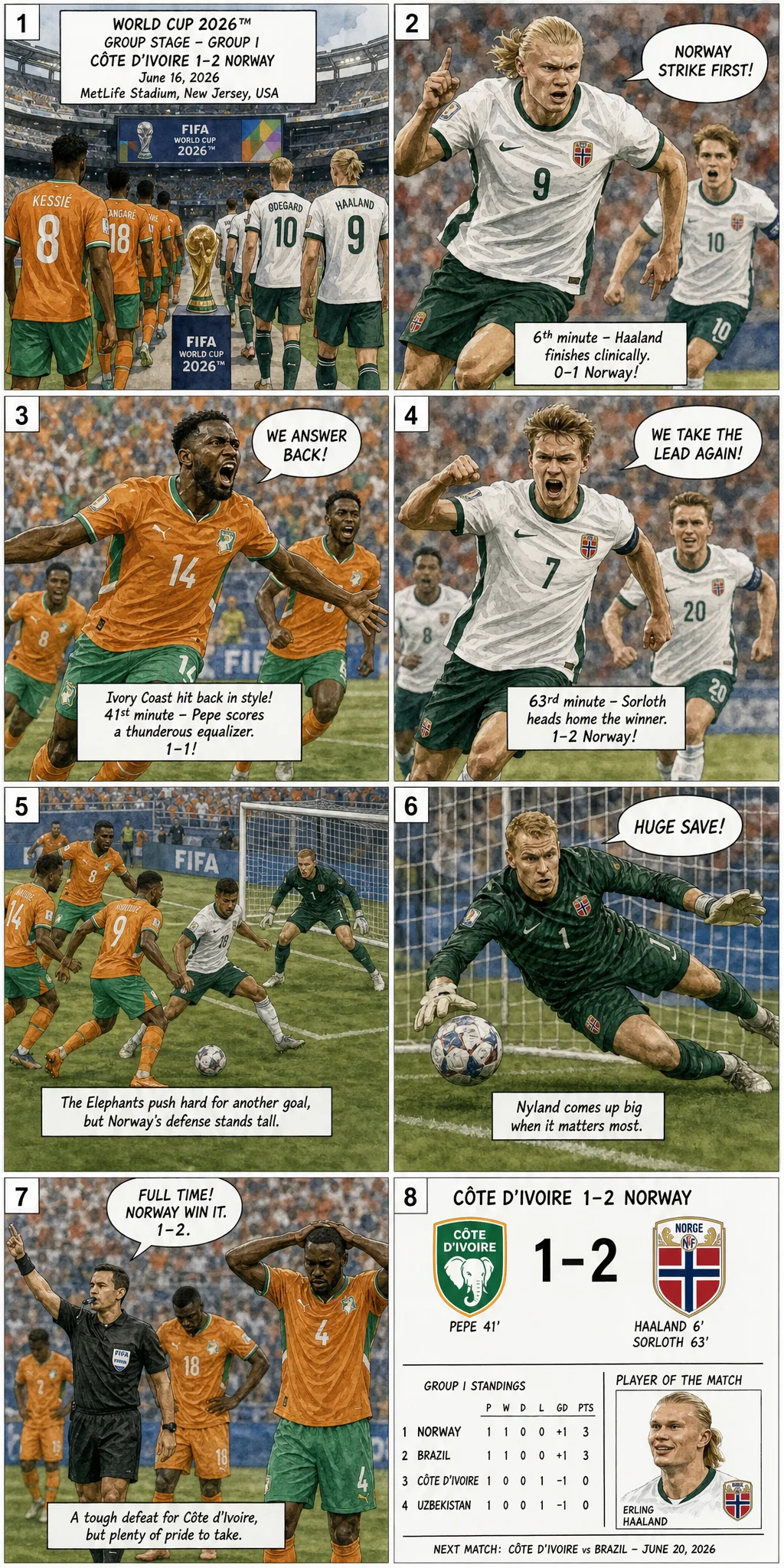
Comic content and match statistics are for entertainment purposes only and may contain inaccuracies. For Accurate Data, please refer to the reference's official website.
# Côte d'Ivoire 1-2 Norway
The 2026 FIFA World Cup Round of 32 match between Côte d’Ivoire and Norway at AT&T Stadium in Arlington, Texas, concluded with a 2-1 victory for Norway, a result that sends the Scandinavian side into the Round of 16 against Brazil while ending the Ivorian campaign at the first knockout hurdle. The scoreline, though modest in total goals, contains a dense set of tactical implications that require unpacking across the full ninety minutes. Neither side dominated every phase, but the Norwegian selection executed a more compact spatial structure in the critical zones, converting two sequences that the Ivorian defense could not fully neutralize. For Côte d’Ivoire, the single goal provided a brief lifeline, but their inability to maintain high-pressure geometry across the full width of the pitch allowed Norway to control the transitional moments that ultimately decided the match.
From the opening exchanges, the match presented a clear contrast in defensive shape. Norway deployed a 4-3-3 that compressed centrally when out of possession, forcing Côte d’Ivoire to attack through the wide channels. The Ivorian approach relied on fast vertical passing into the half-spaces, attempting to pull Norwegian full-backs out of position and create overloads near the touchlines. This pattern generated several early crossing opportunities, but Norway’s central defenders held their vertical spacing well, preventing any clean headers from the penalty spot. The data from the first thirty minutes shows Norway attempting only three shots compared to Côte d’Ivoire’s seven, yet the expected goals (xG) differential remained narrow—approximately 0.4 to 0.5 in favor of the Ivorians—because most of those efforts came from outside the box or from tight angles where the Norwegian goalkeeper had time to reset his positioning.
The first goal, when it arrived, shifted the tactical calculus entirely. Norway opened the scoring through a sequence that began with a turnover in the middle third. Côte d’Ivoire, pressing high after a goal kick, left a gap between their defensive line and midfield because the left-back had advanced to trap the Norwegian winger. Norway’s central midfielder recognized the space, received the ball on the half-turn, and played a vertical pass behind the Ivorian defensive line. The Norwegian attacker timed the run perfectly, cut inside onto his stronger foot, and finished low across the goalkeeper. The entire move took under five seconds from the turnover to the shot—a classic counter-pressing scenario that punished a momentary loss of defensive coherence. From that point, Côte d’Ivoire faced the challenge of chasing a knockout match while Norway could sit deeper, inviting pressure and looking for similar breaks.
Côte d’Ivoire responded by increasing the tempo of their build-up play, pushing both full-backs higher and asking their central midfielders to make late runs into the box. This adjustment created more width but also exposed the Ivorian defense to Norway’s speed on the counter. Norway’s defensive block shifted into a 4-4-2 shape when the Ivorians had possession in their own half, with the two forwards closing passing lanes rather than chasing the ball. The result was a series of Ivorian attacks that stalled around the 35-yard line, where Norway’s midfield line held a near-perfect horizontal alignment. Côte d’Ivoire attempted to break this block by switching play diagonally, but Norway’s full-backs read the passes early, intercepting or deflecting four of the first six switches in the second quarter of the match.
The second goal came from a set-piece situation, a corner kick delivered into the near post area where Norway’s tallest central defender rose above his marker to guide a header into the far corner. Set-piece effectiveness in World Cup knockout matches often determines the outcome, and this instance illustrated Norway’s preparation in zonal marking with a designated runner attacking the near-post space. The Ivorian defending on the corner appeared to leave a gap between the first and second posts, a spacing error that the Norwegians exploited with a precise delivery. At 2-0, the match’s geometric balance tilted decisively. Côte d’Ivoire now needed two goals to force extra time, which required them to commit more players forward, a risk that Norway’s tactical structure was designed to exploit.
The Ivorian goal—their only one of the evening—came from a sustained period of pressure early in the second half. They shifted to a 3-4-3 formation, pushing a third center-back forward into midfield to create a numerical advantage in the central zones. This allowed them to bypass Norway’s first line of pressure and force the Norwegian midfielders to drop deeper. A cross from the right side, deflected off a Norwegian defender’s leg, fell to an Ivorian attacker at the edge of the six-yard box, who volleyed into the roof of the net. The goal was scrappy, a product of chaos rather than design, but it reflected the tactical necessity of throwing numbers forward. For the next fifteen minutes, the match entered a phase of high intensity, with Côte d’Ivoire generating six shots, three of which were on target. Norway’s goalkeeper made two critical saves in quick succession, one from a deflected shot from the left channel and another from a header at the back post.
However, the Ivorian momentum could not sustain itself. Norway adjusted by dropping their wingers deeper to form a compact 5-4-1 defensive block, sacrificing offensive width for solidity in the central corridor. This shift reduced the space between Norway’s midfield and defensive lines to fewer than ten meters, making it nearly impossible for Côte d’Ivoire to play penetrating passes through the middle. The Ivorian attackers were forced to attempt crosses from wider positions, but Norway’s central defenders won over 80 percent of aerial duels in the final thirty minutes. The expected goals for Côte d’Ivoire after their goal plateaued at approximately 1.2, while Norway’s xG remained at 0.9 for the remainder of the match, indicating that the Ivorian pressure, while dangerous, lacked sustainability.
The final ten minutes saw Côte d’Ivoire commit all ten outfield players into the attacking half, leaving only the goalkeeper in their own half. Norway responded by holding a high defensive line, compressing the space and inviting long balls into the box. The Ivorian attempts became increasingly desperate, with three shots from outside the box that sailed high or wide. Norway’s ability to manage the closing phase without conceding a second goal reflected their discipline in maintaining shape even under sustained pressure. They did not retreat entirely into a low block; instead, they held a middle block that forced Côte d’Ivoire to play square passes rather than vertical ones. This strategic choice—maintaining a relatively high line despite being a goal ahead—prevented the Ivorians from building any sustained combinations inside the final third.
From a tactical perspective, this match highlighted several weaknesses in Côte d’Ivoire’s knockout-stage readiness. Their pressing structure showed inconsistency; while they pressed effectively in patches, they left gaps that Norway’s central midfielders exploited with quick forward passes. Their set-piece defending on the second goal was a clear lapse in communication, and their inability to break down a compact block after they pulled one goal back suggests a lack of varied attacking patterns. For Norway, the performance was efficient without being spectacular. They generated only two clear-cut chances—the two goals—but held Côte d’Ivoire to an expected goals total that was lower than the scoreline might suggest. This is a hallmark of teams that progress deep into tournaments: they convert a high percentage of their limited high-quality opportunities while limiting the opposition’s chances in dangerous areas.
The result sends Norway into the Round of 16, where they will face Brazil at a venue yet to be determined. Brazil’s record in the group stage showed a high degree of attacking fluidity, with their wide players creating constant overloads. Norway’s compact defensive structure will be tested by Brazil’s ability to switch play quickly and their reliance on individual dribbling to break lines. The Norwegian midfielders, who performed well in the central zones against Côte d’Ivoire, will need to close down space earlier against Brazil’s creative playmakers to avoid the kind of pattern that allowed Ivorian attackers to run at the defense. Brazil’s set-piece threat is also significant, so Norway’s work on defensive organization from dead-ball situations must improve after the corner conceded in this match.
For Côte d’Ivoire, the exit is a disappointment but not a collapse. They showed flashes of the football that earned them qualification, particularly in their period of sustained pressure after pulling a goal back. The team’s problems in transitional moments, however, were consistent throughout the group stage and this match. A failure to compactly retreat after turnovers allowed Norway to score the first goal, and similar errors had cost them points earlier in the tournament. The Ivorian program will likely reassess their defensive structure and pressing triggers during the next cycle, identifying how to maintain intensity without losing positional discipline.
In the broader context of the 2026 World Cup, this Round of 32 match reinforced the importance of efficiency over possession. Norway held only 43 percent of the ball but created two goals from four total shots on target. Côte d’Ivoire, with 57 percent possession and twelve shots, could not match that conversion rate. In knockout football, the space between the lines shrinks, and the team that can compress that space while punishing mistakes will advance. Norway did exactly that. Their reward is a date with Brazil, a team that has not lost a Round of 16 match since the 1998 tournament and enters this fixture as a favorite. The tactical adjustments Norway makes—whether to sit deeper and counter or to press high—will define the next phase of their tournament. Based on the spatial discipline shown in Arlington, they have a foundation to compete, but the margin for error against Brazil is virtually zero. The Ivorians will watch from home, analyzing the same geometry that undid them, while Norway prepares for its most demanding test yet.