

Belgium 3-2 Senegal: Stoppage-Time Comeback Seals Victory
There was, in the unfolding of this Round of 32 match at Lumen Field, a particular kind of historical gravity that no mere scoreline can fully contain. Belgium 3-2 Senegal: the numbers stand as a final verdict, but the encounter itself was a dense palimpsest of colonial memory, post-independence assertion, and the peculiar tensions that arise when a European football power built on linguistic fracture meets an African nation whose footballing identity was forged in the crucible of French assimil
Published: July 2, 2026
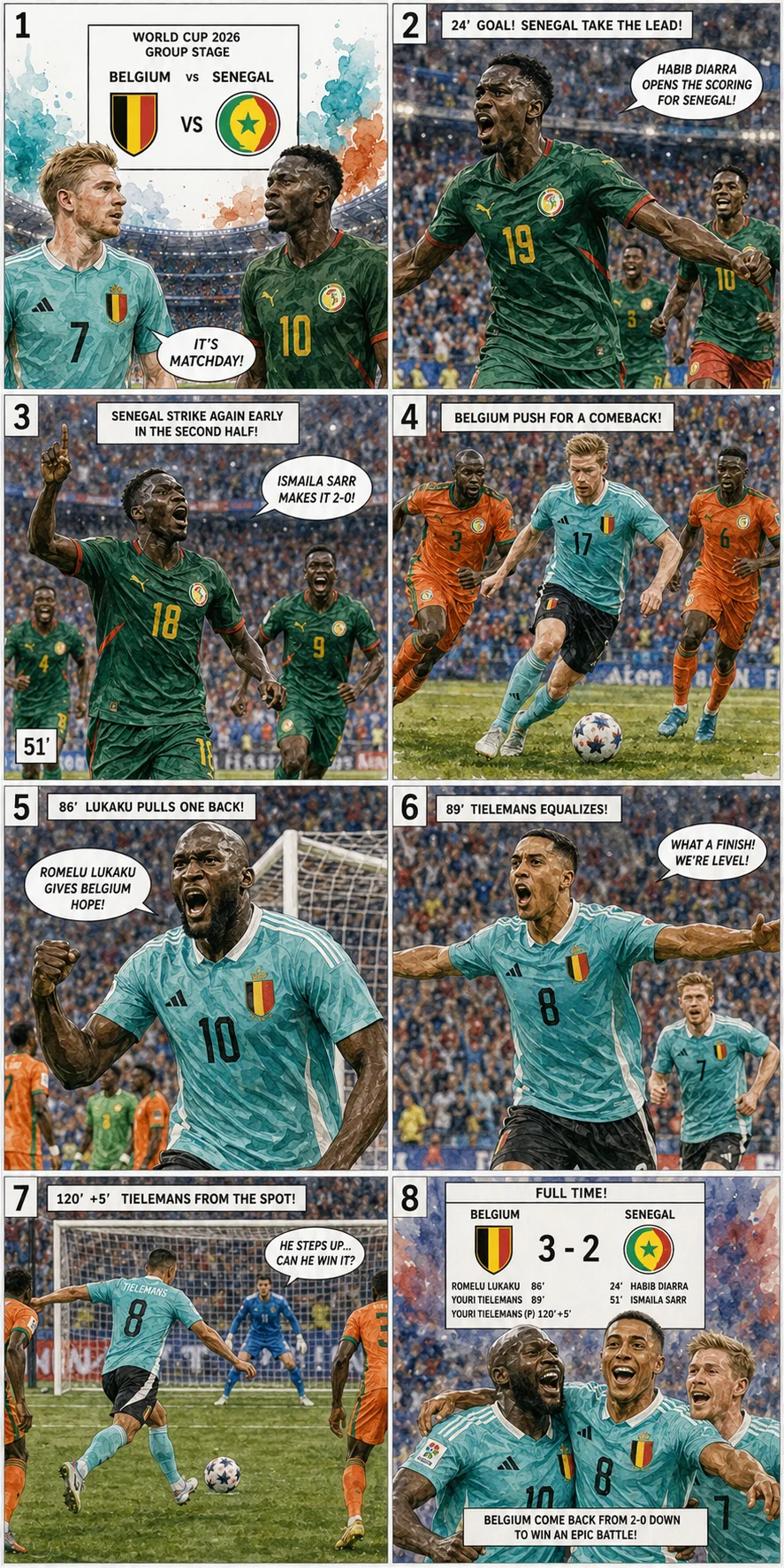
Comic content and match statistics are for entertainment purposes only and may contain inaccuracies. For Accurate Data, please refer to the reference's official website.
# Belgium 3-2 Senegal: Stoppage-Time Comeback Seals Victory
The first light of the Pacific Northwest autumn fell upon Lumen Field as if the heavens themselves were unsure what to make of the spectacle about to unfold, a round of thirty-two tie in the 2026 FIFA World Cup that pitted Belgium, that most curious of European footballing laboratories, against Senegal, the nation whose very existence on the pitch has long been a testament to the tensile strength of post-colonial identity, and the final score—three goals to two in favour of the Europeans—told only the crudest arithmetic of a contest that was, in its deeper rhythms, a referendum on how two very different footballing civilizations confront the abyss of elimination. The stadium, built on the ancestral lands of the Duwamish people, had been transformed by the global tournament into a temporary crossroads, a place where the fog off Puget Sound mingled with the incense of chants from Dakar and Brussels, and where the outcome would not merely decide who advanced to the round of sixteen but would illuminate the fissures of history, economics, and footballing philosophy that separate the former colonial power from the former colony, the industrial heartland of European integration from the Sahelian nation that had, against all odds, carved out a place among the world’s elite by sheer force of athletic will and organizational defiance.
The match itself, as all such encounters must be understood, was not an isolated event but the latest chapter in a long and tangled narrative of migration, exploitation, and cultural exchange that began long before the first ball was kicked at Lumen Field. Belgium, a country that has spent the better part of a century wrestling with its own internal divisions—Flemish versus Walloon, immigrant versus native-born, cosmopolitan versus parochial—had arrived in the Pacific Northwest carrying the weight of a golden generation that had never quite delivered the ultimate prize, a team built on the dual pillars of technical sophistication and defensive fragility, a squad whose very composition reflected the demographic reality of a nation that had absorbed waves of Moroccan, Congolese, and Turkish immigration while simultaneously exporting its footballing talent to the richest leagues of Europe. Senegal, by contrast, was a team that had emerged from the shadow of French colonial rule to become the standard-bearer of African football, a nation whose triumph at the 2021 Africa Cup of Nations had been read not merely as a sporting achievement but as a political statement, a declaration that the continent could produce champions on its own terms, without the patronage of former imperial masters, and that the diaspora—players born in France, Italy, or Spain who had chosen to represent the land of their ancestors—could forge a collective identity stronger than the sum of its scattered parts. To watch these two squads take the field at Lumen Field was to witness a collision of two different ideas of modernity, the Belgian model of hybridity and institutionalised youth development versus the Senegalese model of resilience, improvisation, and the harnessing of a globalised talent pool, and the three-to-two scoreline, with its narrow margin and its implication of dramatic swings, seemed perfectly calibrated to reflect the tension between order and chaos that defined the ninety minutes.
The first crucial context, without which no analysis of this match can proceed, is the group stage that preceded it, a gauntlet of four matches per team that had winnowed the field from thirty-two nations to the thirty-two who would contest the round of thirty-two—a quirk of the expanded tournament format that meant the group phase had been both more forgiving and more treacherous than in previous editions, allowing third-place finishers to advance while also demanding that every point be weighed against the possibility of a more favourable draw in the knockout rounds. Belgium, drawn in a group that included relatively manageable opposition alongside one traditional heavyweight, had emerged with a record that combined moments of breathtaking attacking flair with periods of alarming defensive disorganisation, a pattern that had become so familiar to observers of the Red Devils that it had taken on the quality of a tragic flaw, a fatal inability to sustain concentration over the full ninety minutes that had cost them dearly in past tournaments. Senegal, on the other hand, had navigated a group of considerable difficulty, facing teams from three different confederations that tested their ability to adapt their style to varying opponents, and they had done so with a pragmatism that belied the stereotype of African teams as undisciplined or tactically naive, holding possession when necessary, counterattacking with venom when the opportunity arose, and relying on a defensive structure that had been honed by years of exposure to the highest levels of European club football. The fact that both teams had advanced to the round of thirty-two meant that they had already demonstrated the capacity to survive the chaos of the group stage, but the knockout rounds demanded a different kind of ruthlessness, a willingness to engage in the grim calculus of risk and reward that separates the merely competent from the truly great, and the atmosphere at Lumen Field was charged with the knowledge that a single mistake could undo weeks of preparation and years of collective dreaming.
When the match began, with the raucous energy of the Senegalese supporters creating a wall of sound that seemed to press against the very fabric of the stadium, it became immediately apparent that this would not be a cagey, tactical affair of the kind that often characterises early knockout matches between evenly matched teams. Belgium, true to their historical character, sought to impose their technical superiority from the first moments, circulating the ball with the patient geometry of a team that believes it can unlock any defence through the sheer precision of its passing sequences, while Senegal, equally true to their own tradition, defended in a compact block that invited pressure before springing into the transition with the sudden violence of a coiled serpent. The first goal, when it came, was characteristic of the match’s underlying logic—a moment of individual brilliance that pierced the collective discipline of the opposing defence, a flash of insight or improvisation that no amount of tactical preparation could have prevented, and it was scored by the team that had been dominating possession but had struggled to convert that dominance into clear-cut chances. The celebration that followed, a cacophony of red and black and yellow flags waving in the Seattle drizzle, was a reminder that even in the most cosmopolitan of tournaments, in a stadium built on land that had been stolen from one people and loaned to another, the act of scoring a goal remains one of the purest expressions of collective joy, a moment when the abstract idea of the nation becomes concrete and visceral, when the tension of the match gives way to the release of shared triumph. But Senegal, as they had done throughout the group stage and as they had done in their own historical journey from colonial neglect to global respectability, refused to be cowed by the setback, and they responded with the kind of purposeful aggression that suggests a team that has internalised the lessons of its own tradition, a team that knows that the path to glory is paved with the bodies of favourites who failed to respect the underdog’s capacity for revenge.
The second goal, scored by Senegal in response to Belgium’s opener, was a testament to the virtues of patience and tactical discipline, a move that had been rehearsed a thousand times on the training grounds of Dakar and Nice and Paris, a set piece or a counterattack or a moment of individual brilliance that drew the Belgian defence out of shape and punished their tendency to overcommit in search of a second goal. The stadium erupted once more, this time in the green and yellow of the Lions of Teranga, and for a moment the narrative of the match seemed to shift, the story of Belgian dominance giving way to a story of Senegalese resilience, the tale of the former colony rising to challenge the former coloniser on the neutral ground of the Pacific Northwest. Yet football, as the Spanish historian might note, is never so simple as a single reversal of fortune, and Belgium’s response to the equaliser was revealing of their own psychological makeup—a team that has been accused of lacking the mental fortitude to win the biggest prizes, but also a team that has repeatedly demonstrated an ability to summon moments of transcendent quality when the situation demands it. The third goal, which restored Belgium’s lead before the end of the first half, was the product of the kind of intricate combination play that has been the hallmark of Belgian football for a generation, a series of passes that seemed to defy the geometry of the pitch, a final strike that left the Senegalese goalkeeper with no chance, and the half-time whistle brought a temporary ceasefire in a battle that was far from decided.
The second half began with Senegal pressing more aggressively, sensing that the momentum of the match had not entirely swung in Belgium’s favour, that the two-one deficit was a scoreline that could be overturned with the right combination of courage and fortune. The fourth goal of the match, which extended Belgium’s lead to three-one, was controversial in its genesis, a decision by the officiating team that appeared to divide the stadium and the watching world, a moment of ambiguity that football historians will debate for years, a goal that stood despite protests that it should have been ruled out for some infraction of the laws of the game that the referee and his assistants judged not to have occurred. This goal, whatever its merits or demerits, seemed to break the spirit of the Senegalese team temporarily, the weight of the two-goal deficit pressing down on their shoulders like the burden of a colonial past that can never fully be escaped, and Belgium, sensing their opponent’s vulnerability, began to play with a confidence that bordered on arrogance, the kind of swagger that has both endeared them to neutrals and infuriated their critics over the years. But Senegal, true to the history of African football, true to the legacy of the 2002 World Cup quarterfinalists, true to the memory of the heroes who had fought for independence and dignity on and off the pitch, refused to submit, and they pulled one goal back in the closing stages of the match, a strike that sent a jolt of electricity through the Senegalese supporters and raised the spectre of an improbable comeback, a draw forced in normal time, an extension of the match into extra time and possibly penalties, a prospect that filled the Belgian players with the dread of a team that had lost its nerve in similar situations before.
The final ten minutes of the match were a study in the psychology of survival, a period in which Belgium retreated into a defensive shell, seeking to protect their narrow advantage with the desperation of a team that knows its reputation is on the line, while Senegal threw everything forward, committing bodies into the Belgian penalty area with the abandon of a team that has nothing to lose and everything to gain. The Lumen Field crowd, a mixture of neutrals and partisans from both sides, became a character in the drama itself, their roars and groans and gasps punctuating the ebb and flow of the action, and the final whistle, when it came, brought with it a collapse of bodies on both sides—the Belgians sinking to their knees in exhaustion and relief, the Senegalese lying on the turf in disbelief and heartbreak, the knowledge that their tournament was over, that the dream of becoming only the second African nation to reach the quarterfinals of the World Cup had been extinguished by a single goal, by a controversial decision, by the cruel arithmetic of three-to-two. The Belgian players, as they embraced each other and waved to their supporters, knew that they had escaped by the narrowest of margins, that their performance had been far from convincing, that the path ahead would only grow more difficult, while the Senegalese players, as they walked around the pitch to acknowledge their fans, knew that they had represented their nation with honour and courage, that they had come within a whisker of sending the European favourites home, and that the future of Senegalese football remained bright even in the shadow of this painful defeat.
What this result means for both teams moving forward is a question that will be debated in the cafes of Brussels and the streets of Dakar for months and years to come. For Belgium, the victory at Lumen Field is a reprieve, a chance to continue a campaign that many had written off after their inconsistent group stage, but it also carries with it the burden of expectation, the knowledge that they have not yet proven themselves capable of beating the best teams when it matters most, the suspicion that their defence remains vulnerable to the kind of direct, aggressive attacking that Senegal employed to such effect. The round of thirty-two victory buys them time, a chance to address their weaknesses in training and to hope that the luck that smiled on them in Seattle will continue to smile as the tournament moves deeper into the knockout stages, but it also sets them up for a meeting with a stronger opponent in the round of sixteen, a team that will have studied the Senegalese blueprint for exposing Belgian frailties and will attempt to exploit them with even greater precision. For Senegal, the defeat is a bitter pill to swallow, but it is a defeat that will be remembered not as a failure but as a testament to their growth as a footballing nation, proof that they can compete with the established powers of European football on equal terms, that their programme of development and their connection to the diaspora have created a team capable of challenging for the highest honours. The Lions of Teranga leave the tournament with their heads held high, having demonstrated that African football is no longer a curiosity or a romantic story but a genuine force to be reckoned with, and the lessons they have learned in the cauldron of Lumen Field will serve them well in future editions of the World Cup, in future Africa Cup of Nations, in the long struggle to assert the identity and the dignity of a continent that has given so much to the beautiful game.
In the end, as the lights of Seattle flickered through the rain that had begun to fall more heavily over Lumen Field, the scoreline of Belgium three, Senegal two stood as a monument to the complexity of football and the irreducibility of history, a result that could be interpreted in a dozen different ways depending on the perspective of the observer. The Spanish football historian, gazing at the match report from a distance, might see in this encounter the echo of older struggles, the memory of the Berlin Conference that carved Africa into pieces for European exploitation, the legacy of the Belgian Congo that left scars still visible in the relationship between the two nations, the stubborn refusal of football to be reduced to a mere game, its insistence on carrying within it the weight of empire and resistance, of migration and identity, of hope and despair. The three goals of Belgium were not merely goals; they were arguments for a certain kind of footballing order, a vision of the sport as a rational, technically proficient activity that rewards discipline and planning, while the two goals of Senegal were counter-arguments, testimonies to the power of improvisation, collective will, and the subaltern’s determination to speak back to power. And the narrow margin of victory, the single goal that separated triumph from elimination, was a reminder that in football, as in history, the outcome is never predetermined, that the forces of domination can be challenged, that the underdog can come within a whisker of rewriting the script, and that the match report, no matter how carefully written, can only capture the surface of the drama that unfolded under the grey skies of the Pacific Northwest, in a stadium built on contested ground, between two teams whose meeting was a collision of worlds, a dialogue between past and future, a dance of power and resistance that will continue long after the final score has been forgotten.