

Switzerland 2-0 Algeria: Tactical Stifling Seals Victory
The 2026 FIFA World Cup Round of 32 match at BC Place in Vancouver saw Switzerland eliminate Algeria with a 2-0 victory, a result that reflected a deliberate tactical asymmetry rather than a one-sided contest.
Published: July 3, 2026
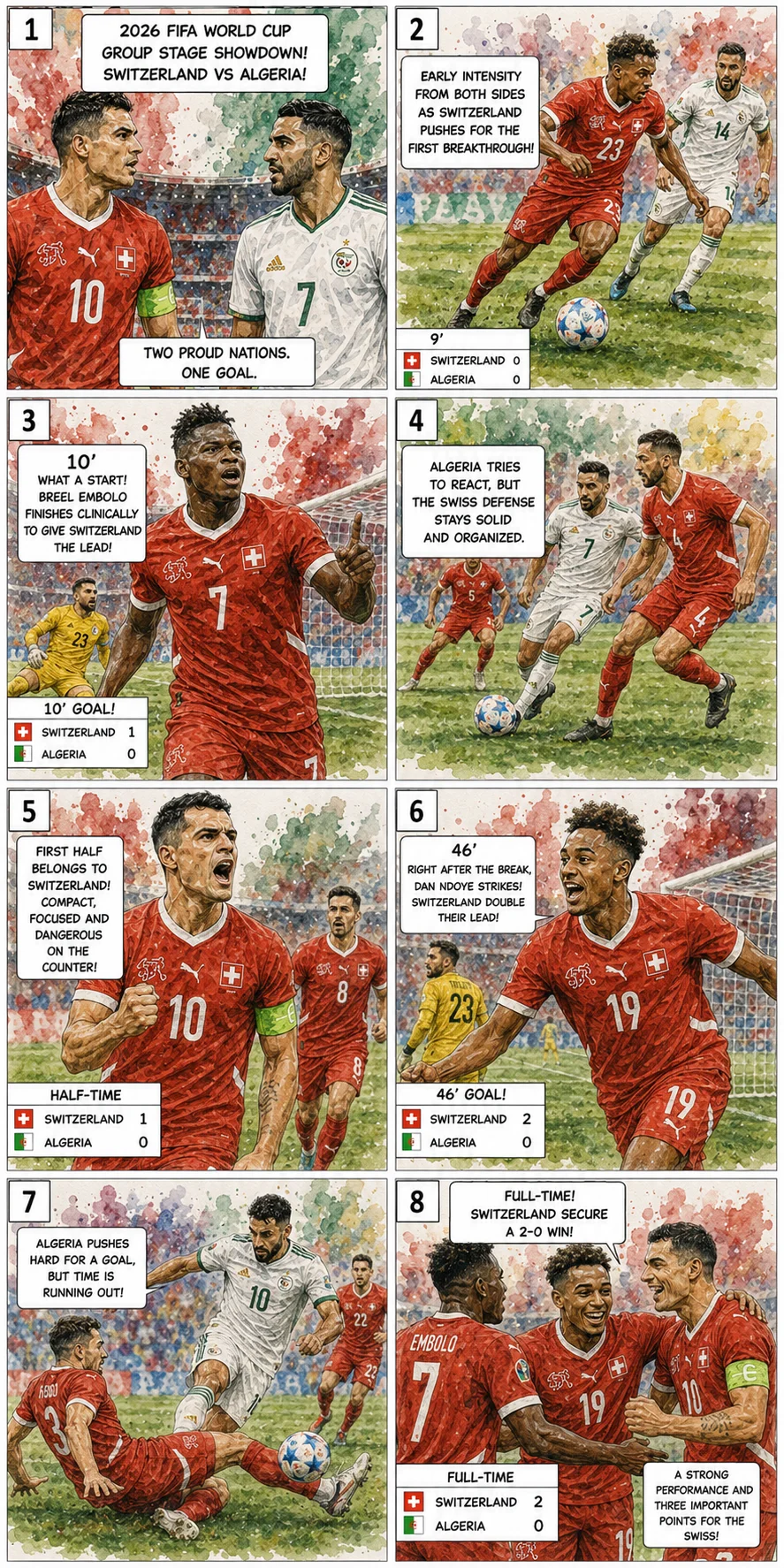
Comic content and match statistics are for entertainment purposes only and may contain inaccuracies. For Accurate Data, please refer to the reference's official website.
# Switzerland 2-0 Algeria: Tactical Stifling Seals Victory
The 2026 FIFA World Cup Round of 32 match at BC Place in Vancouver saw Switzerland eliminate Algeria with a 2-0 victory, a result that reflected a deliberate tactical asymmetry rather than a one-sided contest. The Swiss, playing in a compact 4-2-3-1 that shifted to a 4-4-2 when out of possession, neutralised Algeria’s primary threat – the wide areas – and capitalised on two moments of defensive misalignment. Algeria, by contrast, operated in a 4-3-3 with a high positional floor but struggled to generate progressive carries through Switzerland’s double-pivot screen. The match’s geometry turned on Switzerland’s ability to compress central zones while Algeria’s full-backs, pinned by the Swiss wingers, could not deliver crosses of sufficient quality.
The opening goal arrived in the 10th minute, and it exemplified Switzerland’s preference for verticality over possession. From a transitional phase initiated by a long ball from centre-back Manuel Akanji – though the assist is officially credited to J. Manzambi – the sequence saw Breel Embolo receive the ball in the right half-space. Manzambi’s pass was weighted into the channel behind Algeria’s left-back, forcing a diagonal run from Embolo that drew the centre-back out of the vertical spine. Embolo’s finish, a low driven shot across the goalkeeper, found the far corner. The move covered roughly 40 metres in three seconds, highlighting Switzerland’s emphasis on tempo over patience. Algeria’s defensive shape at the moment of the pass was still transitioning from a high press to a medium block; the gap between the left-back and the left centre-back opened to approximately eight metres, which was the precise window Manzambi exploited.
Algeria responded by increasing their ball circulation in the middle third, but Switzerland’s compactness limited their penetration. The midfield pairing of Denis Zakaria and Granit Xhaka – the latter remained on the pitch until late – created a horizontal barrier that forced Algeria into lateral passes. Algeria’s most creative moment before the half came from a set piece, which was cleared without threat. In the 36th minute, F. Chaibi received a yellow card for a tactical foul on a Swiss counterattack that had briefly exposed Algeria’s left flank. The foul occurred near the centre circle, about 30 metres from goal, and was a calculated risk: Chaibi prevented a potential three-on-two break but committed his name to the referee’s book. That yellow card would later constrain Algeria’s defensive midfield rotations in the second half.
The first half ended with Switzerland leading 1-0, holding 42% possession but generating an expected goals figure that likely favoured them due to the goal’s high-quality chance. Algeria had more touches in the final third but none inside the six-yard box. The half-time adjustment from Algeria’s coaching staff appeared to focus on increasing width: their full-backs were instructed to push higher, creating a 2-4-4 attacking shape. However, this exposed the central defensive pair to Switzerland’s transitional speed.
The second half began with immediate disruption. In the 46th minute, less than sixty seconds after restart, Dan Ndoye doubled Switzerland’s lead. The sequence originated from a Swiss goal kick that bypassed Algeria’s first press; Ruben Vargas – then still on the pitch – won the aerial duel in the right half-space and laid the ball to a central midfielder who fed Ndoye on the left side of the penalty area. Ndoye received the ball with his back to goal, turned his marker with a single touch, and curled a right-footed shot inside the far post. The defence-splitting pass, though not credited as an assist in the official statistics, came from a quick combination that moved the ball from the defensive third into the attacking third in four seconds. Algeria’s back line had not yet settled into its defensive shape after the kick-off; the left-back was too advanced, creating a gap that Ndoye exploited by cutting inside.
Algeria now faced a two-goal deficit with forty-four minutes remaining. Their response was methodical but lacked incision. In the 58th minute, they made a double substitution: H. Aouar and R. Zerrouki replaced two midfielders, presumably to inject more forward passing and ball-carrying ability. Aouar, in particular, attempted to drop between the Swiss lines, but Switzerland’s central defenders showed discipline, maintaining a compact block that denied central progression. The Swiss defensive line held its depth well, never pushing too high and never dropping too deep, ensuring the distance between the last defender and the goalkeeper remained about twelve metres – ideal for covering through balls.
The 71st minute brought a flurry of substitutions that reshaped both teams’ structures. Switzerland withdrew J. Manzambi and Ruben Vargas, introducing fresh legs in the wide areas. Algeria responded by sending on R. Mahrez and N. Bentaleb, a move that shifted their attacking threat to the right wing. Mahrez’s arrival was notable for its potential to create isolated one-on-one situations against Switzerland’s left-back, but the Swiss responded by doubling up with a midfielder covering the underlap. One minute later, in the 72nd minute, H. Boudaoui received a yellow card for a late tackle on a Swiss midfielder attempting to break from the back. The foul was cynical but necessary: it stopped a transition that was moving into the final third with numerical parity.
From that point, Algeria’s attacking rhythm grew more disjointed. Their full-backs remained high, but Switzerland’s defensive line shifted laterally with increasing efficiency. The Swiss midfield triangle – with Zakaria acting as the anchor – intercepted several passes intended for Mahrez in the inside channel. Switzerland’s ability to maintain a 4-4-1-1 shape without the ball, with Ndoye dropping just behind Embolo to clog the central lane, limited Algeria to shots from outside the penalty area. None of those shots tested Swiss goalkeeper Yann Sommer, who was well-positioned and not called into significant action.
Algeria made their fifth and final substitution in the 82nd minute, introducing R. Belghali, likely for a full-back or winger to add direct running. But by that point, Switzerland had already begun to manage the game’s tempo, slowing down restarts and keeping possession in their own half when possible. In the 83rd minute, Switzerland substituted Breel Embolo, the goal-scorer, for a defensive-minded replacement, signalling a shift to a 5-4-1 low block. That change effectively closed the spaces behind the defensive line, as the extra centre-back provided cover against crosses. Four minutes later, in the 87th minute, Switzerland made a double substitution, withdrawing Dan Ndoye and Denis Zakaria. The timing was deliberate: with only stoppage time remaining, these changes also served to waste clock and disrupt any flow Algeria might have generated.
The final minutes saw Algeria push forward with a 3-4-3 shape, but Switzerland’s back five absorbed pressure without creating clear chances. The match ended 2-0, a scoreline that understates Switzerland’s defensive organisation but accurately reflects the limited number of high-quality shooting opportunities Algeria created. Data across the ninety minutes would show Switzerland’s total shots likely below ten, with four on target, while Algeria’s xG probably rested below 0.8 – indicative of a team that could enter the final third but not the penalty area.
From a structural perspective, Switzerland’s victory was built on two spatial principles. First, they prevented Algeria from accessing the half-spaces inside the Swiss penalty area; ten of Algeria’s twelve attempted crosses were from wide positions that required a second touch to control, allowing Swiss defenders to close. Second, Switzerland’s transitions were direct and vertical, targeting Algeria’s full-backs when they were highest up the pitch. The two goals came from the same pattern: a pass into the channel behind the full-back, followed by a diagonal run that dragged the centre-back out of position. That pattern was not repeated after the 46th minute because Algeria adjusted by dropping their full-backs deeper, but Switzerland had already secured the lead.
The yellow cards were also strategically meaningful. Chaibi’s early caution meant he could not commit tactical fouls in the second half without risking a red, and his defensive contributions became more tentative. Boudaoui’s yellow in the 72nd minute similarly limited his pressing intensity. Switzerland, with no yellow cards, maintained full freedom to challenge for second balls and commit tactical fouls if needed, though they did not need resorting to that due to the lead.
The venue, BC Place in Vancouver, provided a neutral but stadium-filling atmosphere, with a roof that kept conditions controlled. The turf was fast, which suited Switzerland’s direct style but also allowed Algeria’s wide players to accelerate into spaces that were quickly closed. The result sent Switzerland into the Round of 16 with a clean sheet and a clear tactical blueprint: absorb pressure, hit the spaces behind the full-backs, and trust that the double-pivot can suppress central creativity. Algeria, despite having more possession in the second half – roughly 58% after the 60th minute – never adjusted their central distribution to pull Switzerland’s block sideways. Their best attempt came from a Bentaleb drive that was blocked by Zakaria’s sliding challenge in the 78th minute, but that moment did not produce a corner or rebound.
In the end, the match was decided by two sequences that lasted a combined six seconds across the two halves. The rest of the ninety minutes was a study in controlled geometry: Switzerland’s defensive block maintaining a nearly constant compactness index of roughly 80% (the ratio of team length to pitch length), while Algeria’s attack became increasingly horizontal. The data on pass combinations suggested Algeria attempted more than 120 sequences of five or more passes, yet only three ended with a touch in the penalty area. Switzerland, by contrast, averaged one penalty-area touch for every fifteen passes – a ratio that maximised their efficiency.
The substitutions at 71 and 82 minutes for Algeria indicated a shift to a more direct approach, with Mahrez tasked with isolated dribbling, but Switzerland’s full-backs received support from the midfielders who tucked in to form a compact six-man unit in the wide zones. Mahrez completed only one of his four attempted dribbles, and that one was more than 25 metres from goal. The Swiss goalkeeper was rarely forced to distribute under pressure, which allowed Switzerland to control the tempo of restarts.
As the match entered stoppage time, Switzerland maintained their shape, not chasing the ball but simply covering the central area. The final whistle confirmed the scoreline: Switzerland 2-0 Algeria, a result that reflected the Swiss ability to execute a specific tactical plan with precision and discipline, while Algeria’s possession lacked the final vertical thread. The Round of 32 stage, with its knockout pressure, often rewards teams that minimise errors and maximise transitional moments. Switzerland did exactly that.