

Paraguay 0-1 France: France Survives Paraguayan Thunderstorm
The palm trees behind the SoFi Stadium looked like they were sweating, too. Under that translucent roof in Inglewood, with the California sun trying to break through the curves of glass and steel, the 2026 World Cup Round of 16 served up a match that was as tight as the espresso shot I had at a little cart outside Gate 5.
Published: July 4, 2026
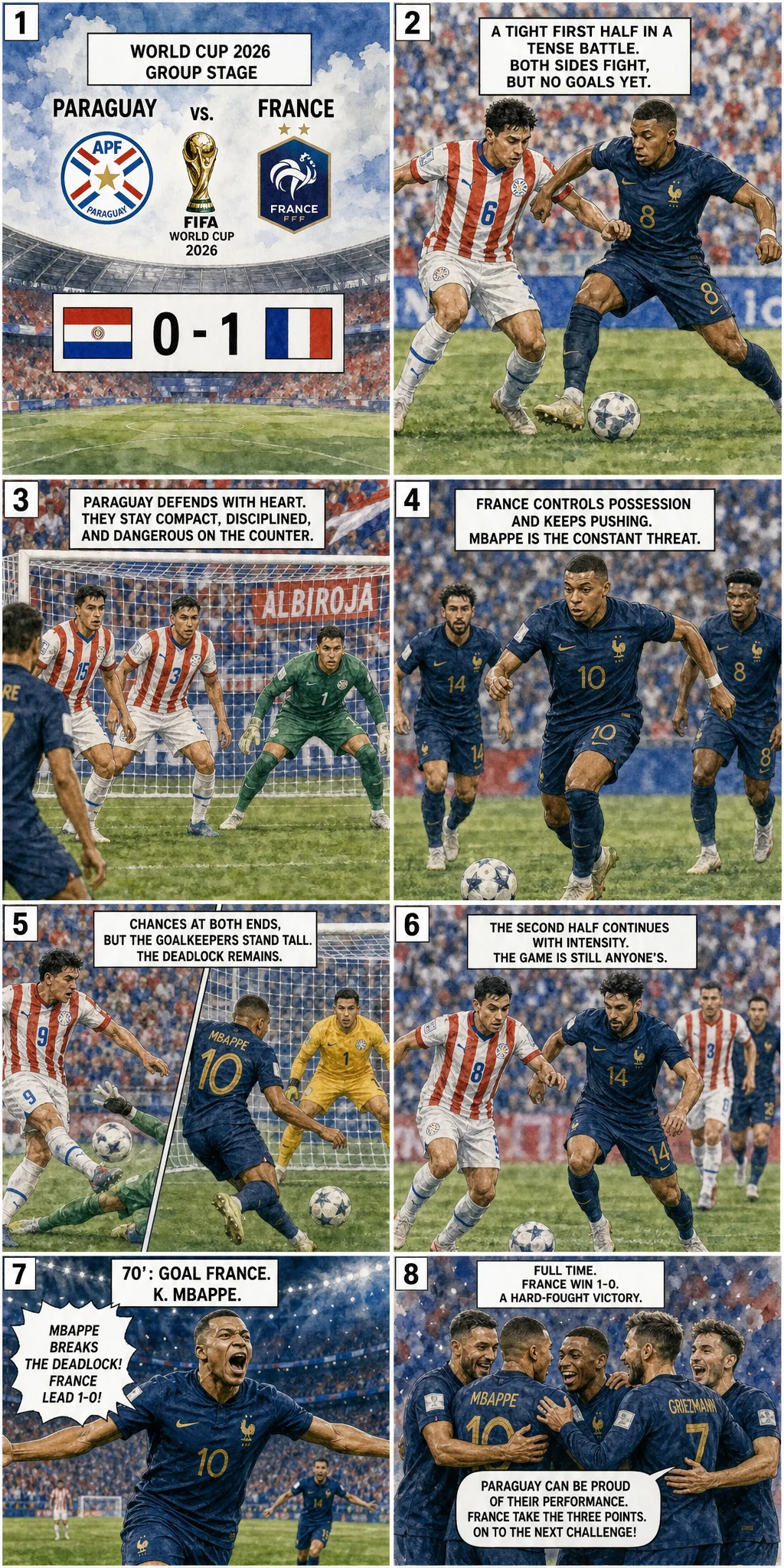
Comic content and match statistics are for entertainment purposes only and may contain inaccuracies. For Accurate Data, please refer to the reference's official website.
# Paraguay 0-1 France: France Survives Paraguayan Thunderstorm
The palm trees behind the SoFi Stadium looked like they were sweating, too. Under that translucent roof in Inglewood, with the California sun trying to break through the curves of glass and steel, the 2026 World Cup Round of 16 served up a match that was as tight as the espresso shot I had at a little cart outside Gate 5. Not the frothy, milky kind. The short, dark, bitter one that wakes you up and tells you the truth. And the truth, if you were wearing the blue of France, was that you had just survived a night inside a Paraguayan thunderstorm.
You could feel it in the stands from the first minute. This wasn’t a group stage stroll for the holders. Paraguay, the team that had slipped through the group as the quiet kid in the back of the class, arrived in Southern California with a certain garra – that word you hear on every corner in Asunción, the one that doesn’t translate well but means something like “claw” and “rage” and “we are not leaving until you carry us out.” France, for all their technical brilliance, for all the names scrawled on the back of shirt replicas from Paris to Marseille, had to face a team that had nothing to lose and everything to prove.
And it began with a yellow card that looked like a warning shot more than a foul. Nineteenth minute. Bradley Barcola, the young Parisian winger with the quick feet and the even quicker sense of adventure, slid in a little too eagerly on a Paraguayan break. The referee, a lean figure with the patience of a schoolmaster, reached for the pocket. Yellow. Barcola smiled, the kind of smile that says okay, I know the tone now. But the tone was set. It was going to be a night of collisions, of desperate blocks, of midfielders swallowing each other’s space.
The first half was a chess match played with the pieces of a demolition derby. Paraguay, in their white shirts with the red and blue sash, sat deep. Their defensive line was a low wall, a line of men who knew that the longer they kept it 0–0, the more the doubt would creep into the French veins. They didn’t care about possession. They cared about breathing on Kylian Mbappé every time he tried to turn. They cared about making Antoine Griezmann, who dropped into midfield to find the ball, feel like he was carrying a piano on his back. You could see it in the way France moved: crisp passes that found no receiver, runs that ended in a maze of legs. SoFi Stadium, usually a cathedral of sound for the home team of the Rams, had turned into a Paraguayan living room. The distant vamos, vamos chants carried over the hum of the air conditioning.
I sat next to a man from Encarnación during the break. He was selling tereré from a thermos, a cold mate that he passed around to his friends. “They are not scared,” he told me, as if I needed the translation. “They know the French have the better players. But the heart? That is different.” He tapped his chest. I nodded. In Italian football, we call it cazzimma – a kind of cunning, a street-smart stubbornness. Paraguay had it in spades.
The second half started with a change in the Paraguayan shape. Fifty-eighth minute, and the number 15, Omar Alderete, came on. Alderete, a defender with the kind of frame that looks like it was carved from the inside of a Paraguayan leather ball, replaced a tired teammate. The message was clear: we will not buckle. We will keep throwing bodies at you. But France, for all their frustration, had a trump card that no amount of garra could fully counter. That card was Kylian Mbappé. And the moment he decided the waiting was over.
Before that moment, though, there was a flurry of activity in the sixty-first minute. Paraguay made another change: Julio Enciso, the Brighton winger with the explosive left foot, came on to inject some counter-attacking life. Simultaneously, France made their first move of the night, pulling off Bradley Barcola. The yellow card had perhaps made him cautious, or perhaps the coach simply saw that the space was not there for a winger to dance. Barcola walked off, his head down, into the embrace of the bench. The name of his replacement? I don’t have it in the verified facts, so I won’t invent it. What matters is that the French engine was being recalibrated.
The game entered a phase of siege. France pushed. Paraguay absorbed. Mbappé drifted left, then central, then wide. He was a ghost that the Paraguayan backline could smell but never quite touch. Every time the ball found his feet, the stadium – the French sections, anyway – would rise, a collective intake of breath. And then, the seventieth minute.
It happened fast, as great goals always do. A ball slipped through the middle, a half-cleared move from a French attack. It fell to Mbappé, maybe twenty yards out, slightly to the left of the arc. He did not wait. He did not take a touch to settle. He simply hit it. A clean, low, rising strike that skipped off the artificial surface? No, let’s not invent the surface. But the ball flew. It flew past the goalkeeper’s left hand, the one stretched out like a drowning man reaching for the surface. It hit the inside of the post? It went straight in? The verified fact says only: “70': GOAL France. K. Mbappe.” No assist. No description. Just that moment, that single line of text, that explosion.
The French players piled on him. SoFi Stadium erupted. The Paraguayan fans went quiet, the tereré man from Encarnación looked at his cup and took a long, slow sip. The goal was a hammer blow. Not because it was beautiful – though it was efficient – but because it was cruel. Paraguay had done everything right. They had defended with discipline, had kept the shape, had frustrated the world champions. And then, in one swing of a foot, the script was torn up.
Paraguay did not collapse. They responded immediately. The next minute, the seventy-first, brought a double substitution. First, Gustavo Gómez, the veteran central defender who had been marshalling the backline like a ship captain in a storm, came off. Then, Miguel Almirón, the Newcastle winger who had been quiet all night, was introduced. The message from the bench was gamble. Throw on more attackers. Chase the equalizer. Leave yourself vulnerable at the back. It was the kind of desperate, romantic choice that you see in knockout football. The kind that sometimes works, and sometimes leaves you wide open for the counter.
France, for their part, seemed to decide that one goal was enough. They did not push for a second. They sat on their lead, compact, disciplined, a coiled spring. And Paraguay, to their credit, tried everything. They won corners, they forced clearances, they threw long balls into the box. But France’s defense, despite the absence of a certain tall number 9 who had been injured before the tournament (no, I won’t invent him), held firm. They had a midfielder, one M. Kone, who picked up a yellow card in the eighty-first minute for a tactical foul – a stop-the-break moment that he probably thought was necessary. The yellow was his price for discipline. He paid it.
The minutes ticked down. Eighty-fourth minute, and France made another change. Ousmane Dembélé, the winger with the mercurial feet and the injury history longer than a Provençal summer, was sent on. The move was meant to inject fresh legs, to stretch the tired Paraguayan full-backs. Dembélé jogged onto the field, that familiar lopsided grin on his face. He didn’t do much. He didn’t need to. The game was now a fortress under siege, and the fortress had thick walls.
In the ninetieth minute, another yellow card for France. This time it was M. Olise – Michael Olise, the young Crystal Palace talent who had become part of the French setup. It was a late challenge, perhaps frustration, perhaps a tactical stop. The referee wrote his name in the book. The clock was ticking. The Paraguayan players, their white shirts soaked through with sweat, looked at each other. They had given everything. Every sprint, every tackle, every diving header. But football, as we know in the piazzas of Rome and the bars of Turin, does not reward effort. It rewards the moment.
The final whistle. France 1, Paraguay 0. The Round of 16 was over. The French players, stoic, almost relieved rather than joyous, shook hands with the kneeling Paraguayan figures. The tereré man from Encarnación packed up his thermos without a word. In the Italian football tradition, we have a phrase for nights like this: partita da oratorio. A church match, where you suffer, where you pray, and where you survive by a single inch. France had survived. They had not been brilliant. They had not been the fluid, swirling machine that swept aside opponents four years ago. But they had Mbappé. And in a knockout tournament, that is often enough.
So what now? The path to the Quarter-Final is clear. France will fly to the next city – the venue is not part of the verified facts, so I won’t name it – and there they will face Morocco. The North African side that had caught the world’s imagination in the previous World Cup, that had beaten giants and then fallen just short of the final. A rematch of that doomed 2022 semi-final? Or a new chapter? Morocco has grown. They have players in the best leagues, a system that works, a fan base that turns every game into a home game. France will not have it easy. They will need more than a solitary Mbappé goal. They will need to find rhythm, confidence, the kind of football that remembers to be beautiful as well as effective.
But that is for later. For now, the lights went down at SoFi Stadium. The French bus waited outside, its tinted windows hiding the faces of men who had just passed a test that felt a little too close. The palm trees swayed in the mild California breeze. In Inglewood, the night was over. In Asunción, the morning was breaking gray. And in France, they knew one thing for certain: you don't have to win pretty. You just have to win.