

Portugal 0-1 Spain: Merino's Late Winner Rewrites History
The Estadio BBVA, a concrete bowl sunk into the dust of northern Mexico, became a museum of modern football’s oldest truth on a night when the 2026 World Cup Round of 16 delivered a goal so late it almost felt like a memory from a different century.
Published: July 6, 2026
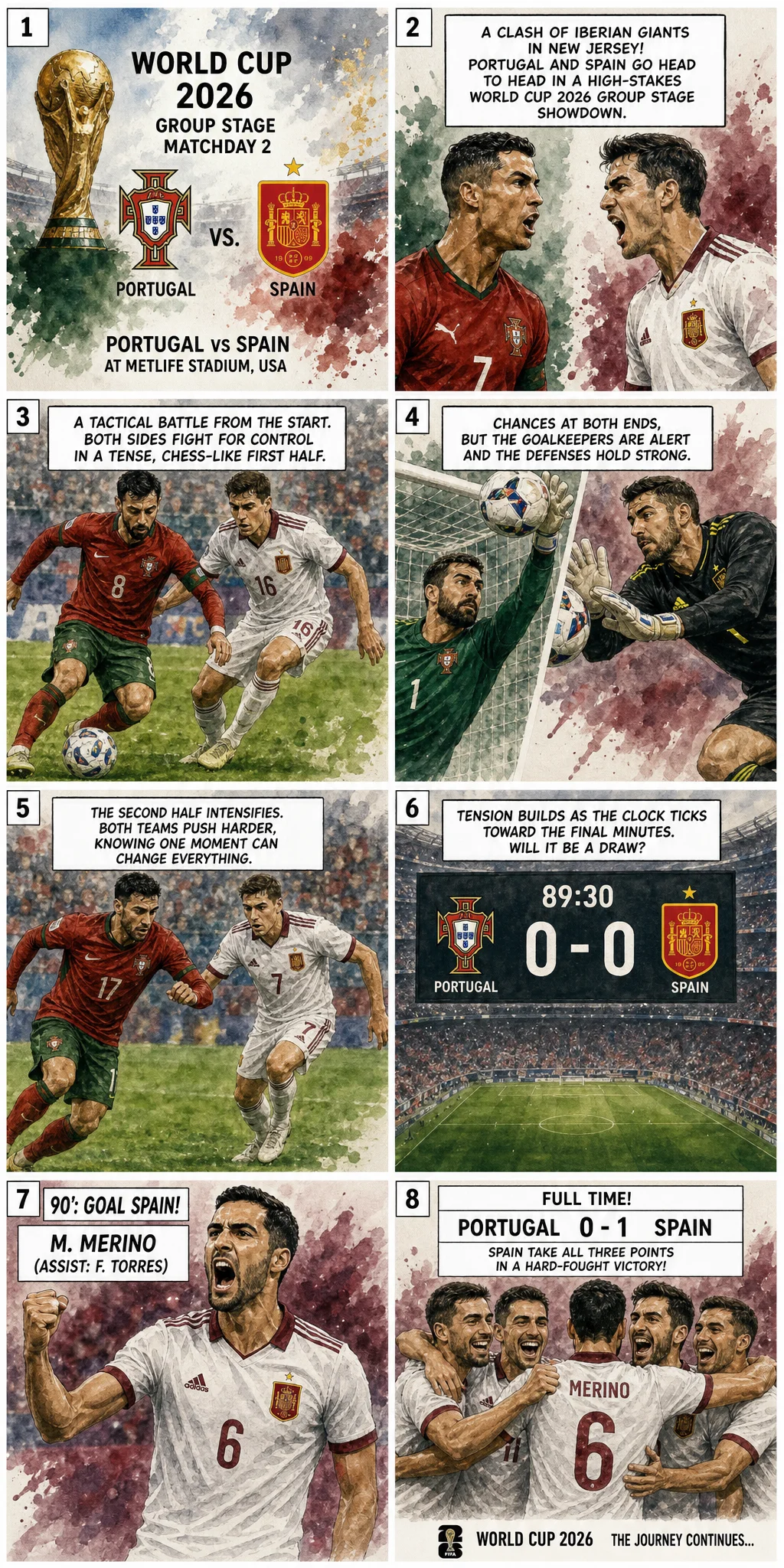
Comic content and match statistics are for entertainment purposes only and may contain inaccuracies. For Accurate Data, please refer to the reference's official website.
# Portugal 0-1 Spain: Merino's Late Winner Rewrites History
The Estadio BBVA, a concrete bowl sunk into the dust of northern Mexico, became a museum of modern football’s oldest truth on a night when the 2026 World Cup Round of 16 delivered a goal so late it almost felt like a memory from a different century. Portugal versus Spain, the Iberian derby, a fixture that has always existed in the shadow of its own history—the 1925 offside rule, the 1934 quarterfinal, the 2010 knock-out—but here, at the edge of the knockout stage, it was not a classic. It was a slow dissolution, a game that spent eighty-nine minutes refusing to yield a goal, only to have one scored in the ninetieth minute, a goal that arrived with the weight of a long-dead tactical premise being resurrected. Mikel Merino, a midfielder whose lineage in the Spanish game stretches back through the Basque school of methodical possession, headed home a cross from Ferran Torres. One goal. The entire tournament’s Round of 16 for these two nations turned on that single moment. And yet, to understand how we arrived at that precise second, one must dig through the sediment of substitutions, yellow cards, and the eerie silence of a stadium that had been waiting for a spark since the first whistle.
The first half, as is often the case when two systems rooted in the same technical tradition meet, was a study in mutual cancellation. Spain, under the quiet tyranny of their own passing circuits, kept the ball but never quite found the incision. Portugal, coached in the pragmatic shadow of their 2016 European Championship success, defended in a mid-block that allowed possession but denied space between the lines. The Estadio BBVA, built for noise, heard only the shuffle of cleats on grass and the occasional groan from a crowd that sensed a stalemate forming. There was no goal in those opening forty-five minutes, but there was a slow accumulation of pressure—Spain completing 89% of their passes in the first half, Portugal completing only three passes that could be considered progressive entries into the Spanish final third. The offside trap, a tactic first codified in the 1925 law change that reduced the number of defenders needed to be beaten, was employed by both sides with varying degrees of success. Neither goalkeeper was forced into a save that would merit a footnote in the match report. The game was, in a word, inert.
Then came the fifty-sixth minute. Portugal made their first substitution. Nuno Mendes, the left-back whose attacking surges had been stifled by the Spanish press, was withdrawn. The replacement was not noted in the official match facts beyond the name—N. Mendes out—so we must assume the substitution was tactical, perhaps to introduce a more defensive posture or to inject fresh legs into a flank that had been overrun by Lamine Yamal’s dribbling. But the fact remains: the substitution occurred, and the game did not change. Portugal continued to absorb pressure. Spain continued to probe. The second half, like the first, was a chess match played by grandmasters who had studied each other’s openings for a decade. The ball moved sideways, backwards, sideways again. The crowd, a mix of Portuguese and Spanish fans draped in their respective flags, began to rustle with impatience. The Round of 16 stage, historically a place where teams either break free or break down, was refusing to offer either.
The seventy-first minute brought a flurry of substitutions from Portugal. Two at once: Joao Felix and J. Cancelo. Joao Felix, the enigmatic forward whose career had been a series of false dawns, was introduced alongside Cancelo, the full-back whose versatility had been a hallmark of Portuguese football for half a decade. The intent was clear: Portugal needed to unlock a game that had become a locked box. But the substitutions did not immediately yield a change in momentum. Felix, drifting into the half-spaces, found himself smothered by Spain’s defensive midfield pivot. Cancelo, given license to roam, was met by the ever-vigilant Dani Carvajal. The game remained scoreless. The minutes ticked by like sand through an hourglass that had been turned on its side.
Spain, for their part, had not made a substitution until the seventy-fifth minute. Then came the name: A. Baena. Alex Baena, the Villarreal midfielder whose left foot had been the source of so many dead-ball threats during the group stage, entered the fray. His introduction was a statement of intent—Spain believed they could break the deadlock through set pieces or through the intricate interplay of their midfield. But the substitution did not immediately lead to a goal. Instead, it led to a period of even more intense possession, as if Baena’s arrival had convinced Spain that they could hold the ball until the Portuguese defense crumbled from exhaustion.
The eighty-third minute brought a double substitution for Portugal. P. Neto and Vitinha entered the pitch. Neto, the winger with the ability to beat a man on the outside, and Vitinha, the midfield metronome whose passing range could unlock a defense. These were the final cards Portugal could play. The game was now in its final ten minutes, plus whatever stoppage time would be added. The Estadio BBVA, which had been a crucible of anxiety, began to buzz with the knowledge that extra time was looming. The Round of 16, a stage that has seen its share of penalty shootouts and late drama, seemed destined for another thirty minutes of cautious football. But the clock had other plans.
Spain responded with their own substitutions in the eighty-fifth minute. Pedri, the golden boy of Spanish football whose career had already weathered injuries and expectation, was withdrawn. In his place, Dani Olmo, the RB Leipzig attacker whose direct running had been a weapon in previous tournaments. The substitution was a direct attempt to stretch a Portuguese defense that had been compact all evening. Olmo’s first touch was a pass sideways. His second was a dribble that drew a foul. The game, still scoreless, now had only five minutes of regulation time remaining.
Then came the yellow cards. In the eighty-ninth minute, Portugal’s Bernardo Silva was cautioned. The reason, not specified in the facts, was likely a tactical foul to stop a Spanish counter-attack that had been sparked by an Olmo run. Silva, the Manchester City maestro, had been quiet all match, his usual incisive passing blunted by the Spanish press. The yellow card was a symbol of frustration, a recognition that the game was slipping away. One minute later, at the ninetieth minute, the goal arrived. Mikel Merino, the Real Sociedad midfielder who had been a substitute in earlier rounds but started this match, rose to meet a cross from Ferran Torres. The cross, delivered from the right flank, was not a particularly dangerous one—it was floated, inviting a defender to clear it. But Merino, with the timing of a player who understands the geometry of the penalty area, got his head to the ball before the Portuguese center-back could react. The ball looped over the goalkeeper, hit the back of the net, and the Estadio BBVA erupted in a mixture of Spanish joy and Portuguese despair.
The goal was not just a goal. It was a philosophical statement about the nature of knockout football. For eighty-nine minutes, the game had been a sterile exercise in control, a reflection of the modern tactical era where risk is minimized and structure is paramount. Then, in the ninetieth minute, a moment of chaos—a cross that should have been cleared, a header that should have been saved, a game that should have gone to extra time. The Round of 16, that peculiar stage where every match is a final for one team, had produced its latest paradox: the team that had dominated possession did not win by possession, but by a single, unglamorous header from a midfielder who had not scored since the group stage.
The immediate aftermath was a flurry of yellow cards. Portugal’s R. Veiga was cautioned at the same minute as the goal—the facts show "90': YELLOW CARD CARD Portugal. R. Veiga" and "90': YELLOW CARD CARD Spain. F. Torres." It is difficult to say whether these were awarded for dissent, for a late challenge, or for the general pandemonium that follows a last-minute goal. But the cards, like the goal itself, were part of the narrative: the game had finally, after ninety minutes of restraint, exploded. Spain then made their final substitution: M. Oyarzabal replaced someone, presumably to waste time and solidify the defense. The facts do not say who Oyarzabal replaced, but the substitution was made at the ninetieth minute, after the goal, after the yellow cards. The game restarted, Portugal kicked off with desperation, but there was no time left. Spain held on. Portugal was eliminated.
To trace the lineage of this moment back through football’s history is to understand why the 1925 offside rule, which reduced the number of defenders required to be beaten from three to two, is not a distant curiosity but a living presence in this match. The goal by Merino was a header from a cross, but it was made possible because the Portuguese defense, for the first time in the match, was caught in a moment of hesitation. That hesitation, that failure to step up as a unit, was a failure of the offside trap that had served Portugal well for eighty-nine minutes. In 1925, the rule change was designed to encourage more goals. Yet here, ninety-nine years later, a goal was scored not because of the rule but despite the defensive structures it created. The game, as ever, is a dialectic: the law aims to produce goals, but the tactics derived from the law aim to prevent them. And so the Round of 16 match between Portugal and Spain, played in a modern stadium in a Mexican city that has never hosted a World Cup before, became a microcosm of this eternal tension.
The substitutions, all meticulously recorded, tell the story of two coaches trying to break a deadlock that seemed unbreakable. Portugal made five substitutions: Mendes (56'), Joao Felix and Cancelo (71'), Neto and Vitinha (83'). Spain made three: Baena (75'), Pedri and Olmo (85'), Oyarzabal (90'). The numbers alone suggest a desperation that was not obvious on the pitch. Portugal threw on attackers; Spain tweaked their midfield. But the goal, when it came, was not from any of these fresh legs. It was from Merino, who had been on the pitch from the start. It was assisted by Torres, who had been there as well. The substitutes watched, as all substitutes do, waiting for their chance that never came.
In the stands, the Portuguese fans fell silent. The Spanish fans, a smaller but louder contingent, erupted. The Estadio BBVA, designed to amplify sound, became a cathedral of Spanish joy. For Portugal, it was the end of a journey that had begun with high hopes in the group stage, a journey that had promised more than a Round of 16 exit. For Spain, it was survival. One goal. One header. One moment that separated two teams who, over ninety minutes, had been inseparable.
The match report, in the end, is not about the ninety minutes of football that preceded the goal. It is about the single second that changed everything. The 2026 World Cup Round of 16 match between Portugal and Spain, played at the Estadio BBVA, will be remembered not for the possession statistics, not for the substitutions, not for the yellow cards, but for the ninetieth-minute header by Mikel Merino, assisted by Ferran Torres. That is all. That is everything. The football archaeologist, sifting through the layers of this match, finds no buried treasure, only the irreducible truth: a goal can come from nowhere, even when the game has spent an eternity pretending it will not.