

Spain 2-1 Belgium
The Estadio Azteca, that concrete colosseum where Pelé once danced and Maradona’s hand of God descended, bore witness to another chapter in football’s slow, tectonic drift. This was a quarter-final of the 2026 World Cup, a stage where the ghosts of 1970 and 1986 lingered in the ozone-thin air of Mexico City, and where two European traditions collided, each carrying its own archaeology of tactical thought.
Published: July 10, 2026
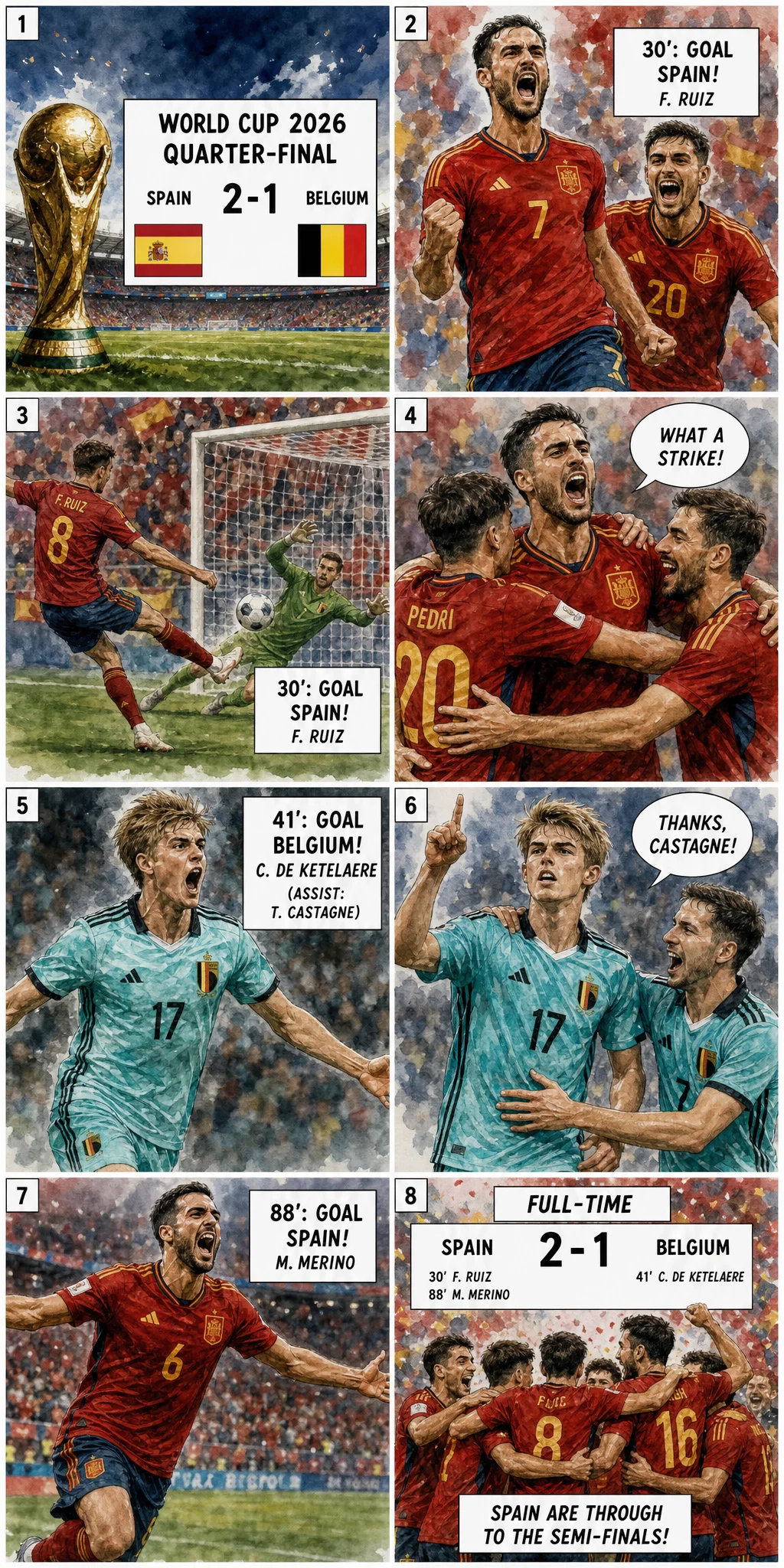
Comic content and match statistics are for entertainment purposes only and may contain inaccuracies. For Accurate Data, please refer to the reference's official website.
# Spain 2-1 Belgium
The Estadio Azteca, that concrete colosseum where Pelé once danced and Maradona’s hand of God descended, bore witness to another chapter in football’s slow, tectonic drift. This was a quarter-final of the 2026 World Cup, a stage where the ghosts of 1970 and 1986 lingered in the ozone-thin air of Mexico City, and where two European traditions collided, each carrying its own archaeology of tactical thought. Spain, the heirs to the tiki-taka empire that conquered the world in 2010, faced Belgium, the golden generation that never quite found its gold, now weathered and recast in the image of a pragmatic, counter-punching machine. The match itself was a study in time—how a game can compress decades of evolution into ninety minutes of searing, often indecipherable, narrative.
The opening half-hour was a quiet excavation of Spanish possession, a methodical sifting of passes that recalled the days when Vicente del Bosque’s side suffocated opponents with the weight of their own geometry. Luis de la Fuente’s Spain, however, had added a more vertical incision to that patient weave. In the 30th minute, the ball found its way to Fabián Ruiz, the midfielder whose career had been a wandering between Napoli’s coastal flair and PSG’s synthetic ambition. He struck with the kind of clean, unadorned finality that suggests a player who has stopped thinking and started knowing. The goal was not a masterpiece of combination play but a sudden punctuation mark in a sentence that had been winding toward an inevitable full stop. Spain 1–0, and the Azteca, which had been humming with the low-frequency hum of a million mosquitoes, erupted into a sharper pitch.
Belgium, however, had not crossed the Atlantic simply to admire the frescoes of the opponent’s passing patterns. Their own history is one of overlapping cycles—from the failed promise of the 1980s to the halcyon days of the 2018 semifinal run—and they have learned to absorb pressure with a kind of stoic mournfulness. In the 41st minute, a move that began with Timothy Castagne on the right flank unraveled the Spanish defensive rug. Castagne, a full-back whose career had been a testament to the quiet value of positional discipline, delivered a cross that found Charles De Ketelaere. The young forward, still searching for the consistency that had once made him a star at Milan, rose with an acute sense of timing. His header was not powerful but precise, a redirect that bypassed Unai Simón’s dive and nestled into the far corner. 1–1, and the stadium’s collective breath was stolen by the sudden shift in momentum.
The immediate aftermath of that equalizer brought a flash of temperature. In the 43rd minute, Pau Cubarsi, Spain’s prodigious teenage defender, was cautioned for a challenge that was less violent than it was strategically desperate. The yellow card felt like a scar on the skin of a game still bleeding from the equalising wound. Cubarsi, who had been called up for his composure beyond his years, now had to balance the tightrope of a knockout tie with the knowledge that one more misstep would shrink his world to the width of a tunnel. The half ended with both sides retreating into their technical areas, leaving the pitch to the ghosts of past Azteca dramas—the 1970 Brazil that redefined elegance, the 1986 Argentina that redefined genius.
The second half began with Spain attempting to reassert their territorial claim. The rhythm of the game became a kind of pendulum, each swing narrower than the last. Then, in the 55th minute, de la Fuente made a double substitution that felt like an archaeological dig into his own squad: Álex Baena entered the field, and Fabián Ruiz—the man who had scored the opener—was withdrawn. The logic was one of preservation and refreshment, but the symbolism was unmistakable: a goal scorer replaced by a creator, as if Spain was acknowledging that the first goal had already been archived and now they needed a new manuscript. Baena, a midfield artist from Villarreal, brought a different kind of filigree—more direct, more inclined to slide passes through the eye of a needle.
Belgium responded in kind. The 60th minute saw Leandro Trossard and Hans Vanaken step onto the pitch, followed a minute later by Maxim De Cuyper. This was a triple substitution that seemed to come from a playbook of desperation and hope. Trossard, the Arsenal winger who had made a career from cutting inside and shooting with his right foot, was meant to exploit the width that had been vacated by Spain’s pressing. Vanaken, the towering midfielder from Club Brugge, brought aerial presence and a languid passing range. De Cuyper, a left-back with more promise than pedigree, was tasked with providing overlapping runs. The game became a series of shards, each substitution a new fragment of a broken mirror.
Then, in the 71st minute, a moment that felt like a telegram from another era: Thibaut Courtois, the giant goalkeeper who had been the backbone of Belgium’s golden generation, was introduced. The specifics of which custodian he replaced were lost in the noise of the substitution board, but the sight of Courtois—long-limbed, almost vulnerable in his own immensity—stepping onto the Azteca pitch was a reminder of how much had changed since his heroics in the 2018 World Cup. He was no longer the impenetrable figure of four years earlier; injuries and club turmoil had eroded some of his aura. Yet here he was, in a quarter-final, with the weight of a nation’s unfulfilled ambitions balanced on his shoulders.
Spain made their next move in the 79th minute, introducing Mikel Oyarzabal, the Real Sociedad forward whose left foot had been a source of quiet devastation for years. The clock was ticking into a territory where every pass carried the scent of elimination. Belgium’s Kevin De Bruyne, who had been playing with an intensity that seemed to pull the game toward his own gravitational field, received a yellow card in the 85th minute for a frustrated tackle. It was a rare crack in his composure, a signal that even the most brilliant orchestrators can succumb to the panic of the moment. De Bruyne was immediately substituted off in the 86th minute, his tournament effectively ended by a decision that felt both tactical and merciful. At the same time, Spain introduced Dani Olmo, the RB Leipzig playmaker whose ability to drift into half-spaces had troubled many defenses.
The decisive moment arrived in the 88th minute. Mikel Merino, a midfielder who had spent much of his career in the shadow of more celebrated compatriots, received the ball in a position that was neither here nor there, somewhere between the penalty arc and the D. He struck with a clean, rising drive that Courtois could only palm into the roof of the net. The goal was a product of the chaos that had been brewing since the first half—a breakdown of Belgium’s defensive structure, a momentary lapse in Courtois’s positioning, and the sheer stubbornness of a player who had been waiting for a stage like this. The Azteca erupted in a sound that seemed to peel back layers of history, from the terraces that had roared for Pelé to those that now roared for Merino.
The final minutes were a scramble of desperation and discipline. In the 90th minute, Aymeric Laporte was booked for a cynical foul that was more about breaking the rhythm than breaking a bone. Axel Witsel, Belgium’s veteran anchor, also saw yellow for a challenge that summed up his team’s growing frustration. The referee’s whistle, when it finally came, drew a line under a match that had been a microcosm of football’s slow evolution—a game where possession was once king, then became a burden, then became a weapon again. Spain had won 2–1, and the quarter-final was decided not by a grand design but by the irreducible reality of a late, lucid strike.
What comes next is a confrontation with France, a team that embodies a different kind of footballing archaeology: the empire built on speed, individual brilliance, and the tactical flexibility that has defined Les Bleus since the days of Platini. Spain will carry into that semi-final the memory of this Azteca night, the yellow cards and the substitutions, the knowledge that their possession can still be broken by a single moment of vertigo. But they will also carry the fact that, in the end, the game belongs to those who keep digging through the rubble of chance until they find a stone worth holding. France awaits, and the ground will shift again.