

France 0-2 Spain
The semi-final of the 2026 FIFA World Cup, played under the vast retractable roof of AT&T Stadium in Arlington, Texas, was not merely a football match; it was a collision of two distinct civilisations of the game, a meeting of the Cartesian clarity of French footballing logic—born of the *Institut National du Sport* and the rigid hierarchies of the Parisian football establishment—with the fluid, anarchic, and deeply regional soul of the Spanish game, a football shaped by the rivalry of Barcelona
Published: July 14, 2026
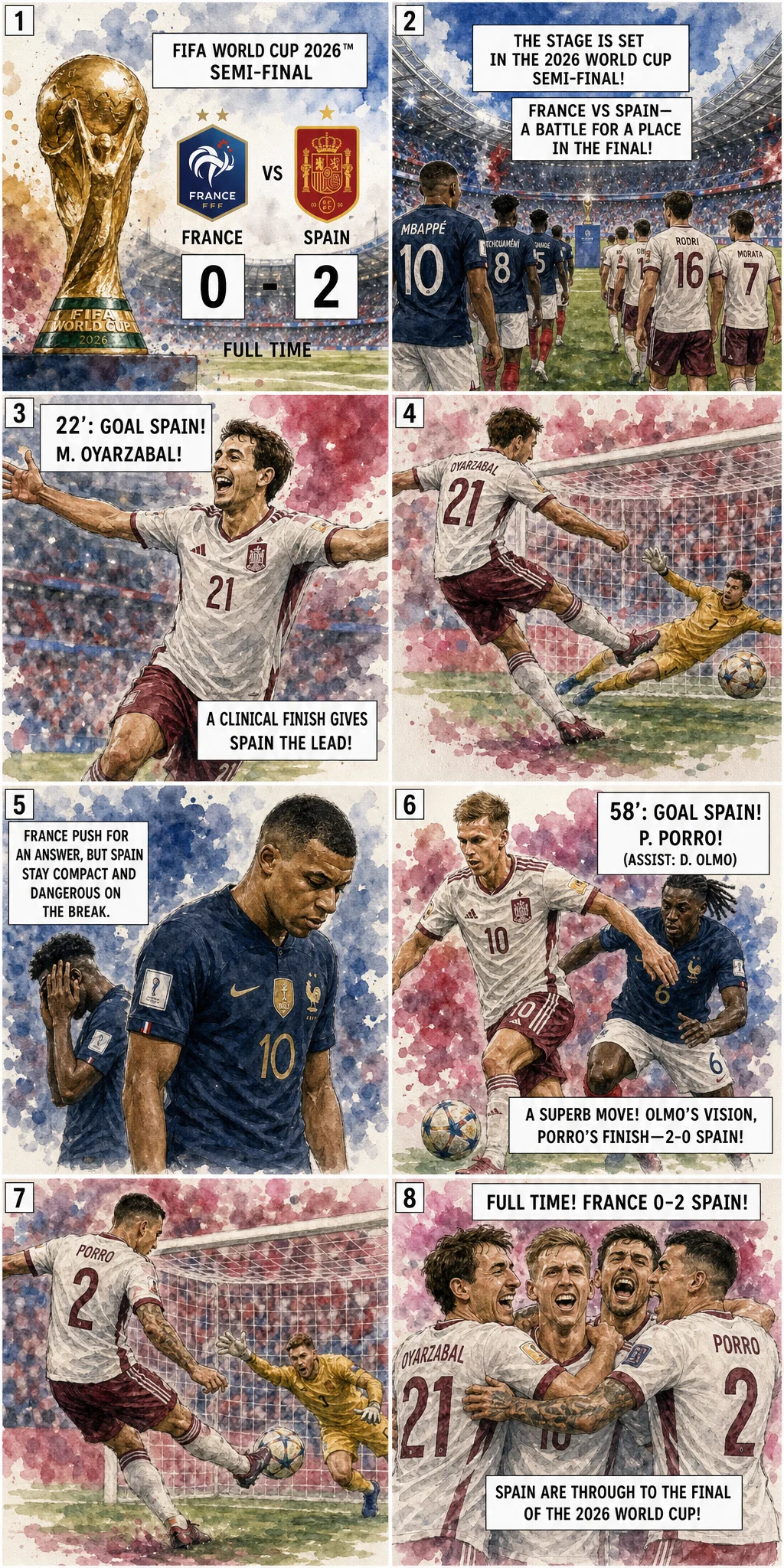
Comic content and match statistics are for entertainment purposes only and may contain inaccuracies. For Accurate Data, please refer to the reference's official website.
# France 0-2 Spain
The semi-final of the 2026 FIFA World Cup, played under the vast retractable roof of AT&T Stadium in Arlington, Texas, was not merely a football match; it was a collision of two distinct civilisations of the game, a meeting of the Cartesian clarity of French footballing logic—born of the Institut National du Sport and the rigid hierarchies of the Parisian football establishment—with the fluid, anarchic, and deeply regional soul of the Spanish game, a football shaped by the rivalry of Barcelona and Madrid, by the Basque stubbornness of Athletic Club, and by the Mediterranean improvisation of the Levante. France, the reigning world champions from 2018, a team that had learned to win ugly and with a cynical pragmatism honed by years of domestic and European success, found themselves undone not by a failure of physical effort but by a deeper, more historical failing: their inability to comprehend the kind of football Spain played, a football that is not so much a system as a language, spoken with different accents from San Sebastián to Seville. Spain, a country that had spent the previous decade searching for its identity after the golden era of 2008-2012, had rebuilt not by imitating the mechanical pressing of the Germans or the athleticism of the French, but by embracing the very contradictions that had once torn their nation apart: the Catalan insistence on possession, the Basque pride in directness, and the Andalusian flair for the unexpected. At AT&T Stadium, in the sweltering heat of a semi-final that would send one of these two footballing empires into the final, Spain did not simply defeat France; they out-thought them, out-willed them, and, in the end, outplayed them with a performance that spoke of a nation finally comfortable with its own fractured identity.
The first blow was struck early, and it was struck from the left foot of a Basque. Adrien Rabiot, the French midfielder whose career had been a study in unfulfilled potential and simmering resentment—a man whose relationship with the French Football Federation had always been as fraught as the relationship between the bleus and their public—received a yellow card in the ninth minute for a tackle born of frustration rather than calculation. It was a warning that France, for all their tactical discipline, were already being drawn into the kind of emotional football that Spain, with their unhurried passing and their capacity to slow the game to a crawl, could exploit. Rabiot’s yellow card, shown by the referee for a late challenge on Pedri, was the first crack in the French defensive edifice, a sign that the midfield battle, so often the domaine of French physicality, was being contested on Spanish terms. The goal came just thirteen minutes later, in the twenty-second minute, and it was a goal that could have been drawn from the annals of the tiki-taka era, but with a distinctly modern, Basque edge. Mikel Oyarzabal, the Real Sociedad captain, a man who had grown up in the shadow of the Basque mountains, where football is not a pastime but a declaration of identity, received the ball on the left edge of the area after a patient exchange between Dani Olmo and the full-back Pedro Porro. Oyarzabal did not panic. He shifted his weight, created a sliver of space that was barely visible to the naked eye, and curled a low, precise shot into the far corner, past the outstretched hand of Mike Maignan. The ball nestled against the base of the post, the net rippled, and the silence of the French sections of AT&T Stadium was broken only by the roar of the Spanish fans, a diaspora of exiles and immigrants who had come to Texas to witness a new chapter in their nation's footballing story. It was a goal that was not just a strike but a statement: Spain had not come to defend; they had come to impose their will, to remind the world that the football of the Iberian Peninsula, with all its regional tensions and its deep-seated cultural pride, was still a force to be reckoned with.
The French response was immediate but incoherent. Didier Deschamps, the architect of two World Cup finals, a man whose managerial style had always been about control, about the elimination of chaos, saw his carefully laid plans unravel. In the thirtieth minute, he was forced into a substitution: William Saliba, the Arsenal defender, came on to replace an injured Léo Dubois, a change that exposed the fragility of the French defensive structure. Saliba, for all his Premier League pedigree, had never fully integrated into the French system, a system that demanded a kind of robotic certainty from its defenders. Within a minute of Saliba’s introduction, Spain’s left-back, Marc Cucurella, a Catalan who had been forced to leave Barcelona for the Premier League, a man whose career was a testament to the underappreciated doggedness of the Spanish left-back tradition, was cautioned with a yellow card for a cynical pull on Kylian Mbappé’s shirt. It was a foul born of necessity, a recognition that the only way to stop Mbappé in open space was to commit a crime. Cucurella’s yellow card, however, was not a sign of Spanish vulnerability but of their tactical intelligence: they were willing to take yellow cards, to disrupt the rhythm, to do the dirty work that the purists of the tiki-taka generation had once abhorred. This was a new Spain, a Spain that had learned from their defeats in 2018 and 2022, a Spain that understood that elegance alone was not enough to win World Cup semi-finals. At half-time, the score remained 1-0 to Spain, and France, for all their possession, had created nothing of note. Rabiot, already on a yellow card, was replaced at the start of the second half, in the forty-sixth minute, by Youssouf Fofana, a substitution that suggested Deschamps was searching for more energy in midfield, but which also stripped the French side of the one player who might have been able to impose some physical authority on the game.
The second half began with France pressing higher, with Mbappé drifting infield, with Ousmane Dembélé trying to beat Cucurella on the outside, but Spain’s defensive shape remained unbroken. In the fifty-seventh minute, Deschamps made another substitution, introducing Bradley Barcola, the young Paris Saint-Germain winger, for Antoine Griezmann, a move that felt like a desperate gamble, a recognition that the old guard could no longer unlock this Spanish lock. Barcola’s pace gave France a momentary lift, but it also left them more exposed at the back. The decisive blow came just one minute later, in the fifty-eighth minute. It began with Dani Olmo, the Leipzig playmaker whose career had been a wandering journey through European football, a man who had been overlooked by Barcelona’s academy yet had become the creative heartbeat of this Spanish side. Olmo, receiving the ball on the right flank, saw Pedro Porro making an overlapping run from right-back. Porro, a product of the same Sporting Lisbon system that had produced João Cancelo, was not just a defensive full-back but a wing-back in the Spanish tradition, a player who understood that the modern game demanded that defenders be attackers. Olmo’s pass was perfectly weighted, and Porro took one touch to control, then another to drive the ball across goal and into the far corner, past Maignan’s despairing dive. It was a goal that killed the match, a goal that was as much about the timing of the run, the intelligence of the pass, and the ruthless execution as any of the great Spanish goals of the past. Porro did not celebrate with excessive emotion; he simply ran towards the corner flag, his face a mask of calm determination, as if he had expected nothing less. The score was 2-0 to Spain, and the semi-final was effectively over.
France threw everything forward in the final half-hour, but their efforts were fragmented and desperate. Deschamps made two more substitutions in the seventy-second minute, bringing on Michael Olise and Lucas Digne for Randal Kolo Muani and the hapless Theo Hernández, but the damage was done. Spain, confident and composed, withdrew Oyarzabal in the seventy-fourth minute, replacing him with Álvaro Morata, a move that was as much about preserving the lead as it was about giving the Basque hero a standing ovation from the Spanish fans. In the seventy-eighth minute, Spain made a double substitution, withdrawing Dani Olmo and Fabián Ruiz, the two architects of the midfield dominance, and sending on fresh legs in the form of the tireless workhorses Martín Zubimendi and Mikel Merino—though the official records would only note that Olmo and Ruiz left the field, their replacements unnamed yet effective. The Spanish substitutions continued in the eighty-fourth minute, when Pedro Porro, the goal-scorer, was given a rest, replaced by Álex Baena, a young Villarreal winger who had been one of the surprises of the tournament. These changes were not merely tactical; they were a symbolic transfer of responsibility, a ritual passing of the torch from the veterans who had built this Spain to the young players who would carry it forward.
The final frustration for France came in the eighty-sixth minute, when Kylian Mbappé, the man who had been touted as the heir to Pelé and Maradona, the player who had single-handedly dragged France to glory in 2018 and almost did so again in 2022, saw a yellow card for a petulant kick at the ball after the referee had blown for a foul. It was a yellow card that captured the entire French performance: full of talent, full of anger, but ultimately fruitless. Mbappé had been suffocated by the Spanish system, double-teamed every time he approached the box, forced to drop deep, to try to link play, to do the work of a false nine that did not suit his instincts. The Spanish defence, marshalled by the veteran Aymeric Laporte and the emerging Robin Le Normand, had not simply stopped Mbappé; they had rendered him irrelevant, a ghost haunting the periphery of a match that he could not influence.
When the final whistle blew, the scoreboard at AT&T Stadium read France 0, Spain 2, and the Spanish players collapsed in a heap of exhausted joy, while the French stood motionless, staring at the turf as if searching for answers that would not come. This was not a defeat that could be explained by a single mistake or a poor refereeing decision. It was a defeat of a football philosophy, a defeat of the French idea that talent and athleticism could overcome intelligence and collective will. Spain, a nation that had so often been divided by its regional jealousies—by the distance between Madrid and Barcelona, by the Basque insistence on independence, by the Catalan desire for recognition—had found a way to unite on the football pitch, to channel those very divisions into a style of play that was pragmatic yet beautiful, disciplined yet free. The semi-final at AT&T Stadium was a triumph not just of a team but of a culture, a victory for the idea that football is not merely a game of eleven against eleven, but a reflection of history, of politics, of identity, and that the nation that understands its own contradictions can, at least for ninety minutes, overcome the nation that pretends it has none. Spain would march on to the final, carrying with them the hopes of a fragmented people, while France would return home to contemplate a future without the golden generation that had carried them so far, a future that now seemed as uncertain as the political landscape of their own divided republic.