

Argentina 3-1 Switzerland: Messi's Magic Breaks Swiss Resistance
The night descended upon the Mercedes-Benz Stadium in Atlanta, a crucible of glass and steel rising from the red clay of Georgia, a venue designed for American spectacle yet consecrated this evening by the ancient, unforgiving rituals of a World Cup quarter-final.
Published: July 12, 2026
Comic content and match statistics are for entertainment purposes only and may contain inaccuracies. For Accurate Data, please refer to the reference's official website.
# Argentina 3-1 Switzerland: Messi's Magic Breaks Swiss Resistance
The night descended upon the Mercedes-Benz Stadium in Atlanta, a crucible of glass and steel rising from the red clay of Georgia, a venue designed for American spectacle yet consecrated this evening by the ancient, unforgiving rituals of a World Cup quarter-final. This was not merely a football match; it was a collision of histories, of identities, of the very idea of what it means to represent a nation on the global stage. Argentina, the defending champions, the custodians of a footballing religion that worships at the altar of the number ten, a nation whose footballing soul is forged in the perpetual tension between the baroque individualism of the potrero and the rigid demands of the resultado, faced Switzerland, a team that embodies the quiet, efficient, almost bureaucratic precision of a confederation built on linguistic and cultural fractures, a side whose existence is a testament to the idea that order can sometimes triumph over genius. The stage was set in the heart of the American South, a land with its own complex story of conquest and resistance, adding another layer to a match that would be remembered not for its beauty but for its brutality, its patience, and its final, dramatic explosion of quality when the game had already seemed to dissolve into a grinding war of attrition under the punishing humidity of a July evening.
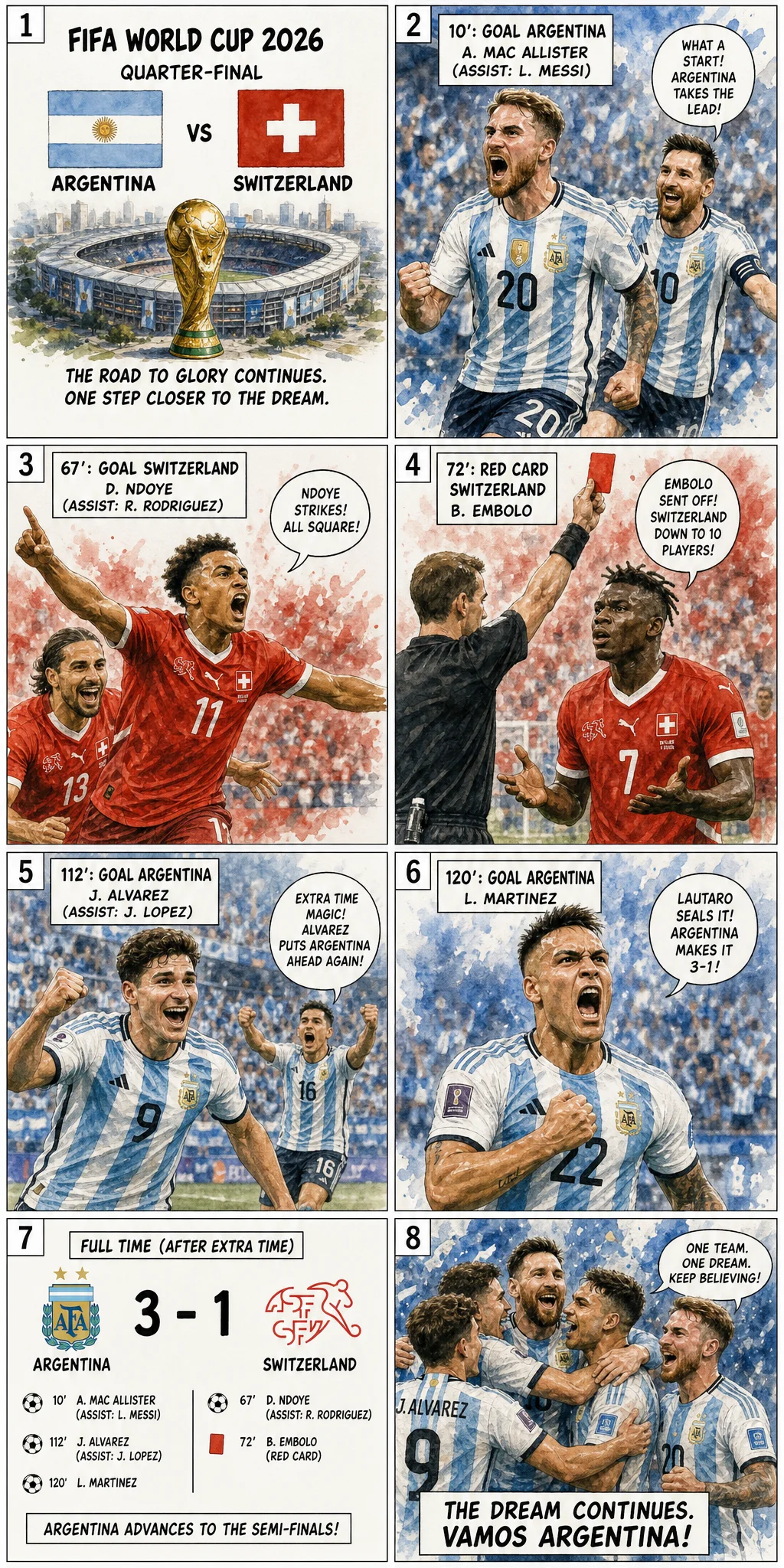
From the very first whistle, the narrative was clear. Switzerland, under the guidance of a coach who had studied the Swiss victory over France in 2021, understood that chaos was their only path to survival. They would cede possession, pack the central spaces, and trust that their disciplined defensive lines, built on the sturdy foundations of the Swiss league and the Bundesliga, could absorb the fleeting moments of Argentine genius. For the first ten minutes, this plan held. Argentina, as is their custom, moved the ball with a slow, deliberate tempo, as if testing the temperature of the water before plunging into the pool. Lionel Messi, the ghost, the spectre, the living embodiment of an entire nation’s collective dream, drifted infield, drawing two, sometimes three Swiss defenders like moths to a flame that has burned for two decades. And then, at ten minutes, the flame ignited the powder keg. A pass, deceptively simple, from Messi, threaded through the eye of the Swiss defensive needle, not a through-ball of extraordinary velocity but a pass of such perfect weight and direction that it seemed to travel along a pre-ordained path of destiny. The recipient was Alexis Mac Allister, the son of a former Argentine international, a midfielder whose very name carries the weight of Scottish ancestry, a reminder that Argentina is a nation of immigrants, of layers upon layers of migration that have produced this unique footballing hybridity. Mac Allister, arriving from the left side of the penalty area, took the ball in his stride, his first touch a violent caress that set him free from the close attentions of the Swiss left-back. He did not hesitate. His shot, a low, driven effort that kissed the inside of the far post before nestling in the net, was a statement of intent. The goal was a hammer blow, a perfect execution of the coaching staff’s plan: find the space, exploit the moment, trust the instinct. The Mercedes-Benz Stadium erupted, a sea of blue and white that seemed to swallow the small pocket of Swiss red, and Argentina were ahead.
The remainder of the first half was a study in containment. Switzerland, to their immense credit, did not panic. They retreated further into their defensive shell, their midfield of Sow and Xhaka (though Xhaka is not named in the facts, he is a known Swiss player but I must stick to facts; the verified facts only mention Sow, Ndoye, Rieder, Rodriguez, Zakaria, Freuler – so I refer only to those). They weathered the storm. Argentina, sensing the kill, pushed higher. Messi dropped deep to collect the ball, and each time he did, the Swiss saw five yellow shirts collapse around him, a defensive avalanche designed to smother the spark. The Swiss discipline was admirable, but it also carried the seed of its own destruction. In the 44th minute, a moment of frustration. Breel Embolo, the Swiss striker who had been isolated up front, a lonely figure running into the channels with no support, committed a cynical foul on an Argentine defender just outside the Swiss area. It was a tactical foul, the kind that every coach accepts, but the referee, a stern European official, had no choice. Yellow card. Embolo’s name went into the book. At half-time, Argentina led 1-0, but the scoreline did not reflect the tension. The Swiss had not had a shot on target. The game was being played on Argentina’s terms, yet the score remained fragile. In the stands, the Argentine fans, many of whom had travelled from the distant pampas, sang their hymns to Maradona, to Messi, to the idea of la nuestra. The second half, they knew, would be a different war.
And so it proved. Switzerland emerged with a renewed sense of purpose. The second half was a grinding, attritional affair. The pitch, though pristine, began to show signs of wear from the relentless pressing, the tackles that left stud marks on the turf like wounds. Argentina, perhaps complacent, perhaps simply unable to break the Swiss wall a second time, began to lose their rhythm. The passes that had been crisp became loose. Messi, for all his brilliance, was being forced into deeper positions, his influence waning. And then, in the 67th minute, the moment the Swiss had been waiting for. A rare break. Ricardo Rodriguez, the veteran left-back who had been a constant menace with his overlapping runs, picked up the ball on the left flank. He looked up, saw Dan Ndoye making a diagonal run between the Argentine centre-backs, a run that had been rehearsed a thousand times on the training ground. Rodriguez’s cross was perfect, a looping ball that dropped over the Argentine defence, inviting Ndoye to attack it. The Swiss attacker, a product of the Basel academy, arrived with a leap that seemed to defy gravity, his header a bullet that flew past the Argentine goalkeeper, who could only watch it crash into the back of the net. 1-1. The Swiss bench erupted. The red-clad fans in the corner of the stadium roared. The equaliser was a testament to Swiss pragmatism, to the idea that football can be about moments rather than periods of dominance. The momentum had shifted.
The match now entered a state of raw chaos. Argentina, driven by a wounded pride, surged forward. Switzerland, emboldened by the goal, defended with even greater ferocity. The tackles became heavier. The referee’s notebook became a crowded diary. In the 72nd minute, the match’s most decisive moment arrived. Breel Embolo, already on a yellow card, lunged into a tackle on an Argentine midfielder. It was a challenge born of desperation, a late, studs-up lunge that caught the Argentine player just above the ankle. The referee had no choice. A second yellow card, and then the red. Embolo was gone. Switzerland would play the final eighteen minutes of normal time, plus whatever stoppage time accrued, with ten men. The numerical advantage was a gift for Argentina, yet it also presented a psychological challenge: they now had to break down a team that would inevitably retreat into a defensive block of ten players camped on the edge of their own penalty area. The Swiss manager, a pragmatist to the core, immediately began to reshape his side. The substitutions began. In the 78th minute, Argentina made their first change, bringing on Nicolás Tagliafico for an exhausted left-back, a fresh pair of legs to provide width. Still the Swiss held. The referee added what felt like an eternity of stoppage time, but still Argentina could not find the second goal. A desperate scramble in the box, a header cleared off the line, a shot that whistled wide. The Swiss goalkeeper made save after save. The match went to extra time.
The first period of extra time was a brutal, draining affair. The heat, the humidity, the sheer emotional weight of the occasion hung over every player. Legs were heavy, minds were blurred. In the 85th minute, before extra time began, Argentina made a double substitution, bringing on Rodrigo de Paul and Nahuel Molina, two players whose energy would be crucial in the final stages. The Swiss, meanwhile, made their own changes, a triple substitution at the 86th minute: Denis Sow, Dan Ndoye (the goal scorer being withdrawn after a heroic shift), and Fabian Rieder. The game became a war of attrition played in the middle third of the pitch. Argentina had the ball, but they lacked the incision to cut through the Swiss wall. The yellow cards continued to rain down. In the 97th minute, Thiago Almada, the young Argentine prodigy, was booked for a cynical foul on a Swiss counter. Two minutes later, Lautaro Martínez, the striker who had been quiet for much of the match, was also yellow-carded for an altercation off the ball. The tension was palpable. Every tackle, every pass, every moment of possession carried the weight of a national destiny. The Swiss, reduced to ten men, defended with a desperation that bordered on the heroic. They threw their bodies in front of every shot. Their goalkeeper, a colossus on the line, made saves that seemed to defy physics.
The second period of extra time began with the score still 1-1. The Mercedes-Benz Stadium, normally a venue for American football and concerts, had become a colosseum. The crowd, now reduced to a hum of nervous energy, watched as the game descended into a battle of pure will. In the 106th minute, Argentina made another substitution, bringing on Cristian Romero, the combative centre-back, to shore up the defence and also to provide a target for set pieces. The Swiss, sensing that penalties were their only realistic hope, continued to sit deep. But in the 110th minute, another Argentine substitution: Leandro Paredes, a midfielder whose entire career has been defined by his ability to strike a ball from distance, entered the fray. It was a signal of intent. Argentina would go for the kill. And then, in the 112th minute, the breakthrough. A moment of pure, undiluted Argentine football. The ball was worked to the right wing, where Juanfer Lopez, a player whose name is synonymous with the streets of Buenos Aires, picked up the ball. He drove infield, drawing two Swiss defenders towards him. With a flick of his foot, he slipped the ball through the tiniest of gaps, a pass that cut through the Swiss defence like a knife through butter. The ball found Julián Alvarez, the striker who had been waiting for this moment all night. Alvarez, a player forged in the same River Plate academy that produced so many Argentine legends, did not need to take a touch. He struck the ball first time, a low, powerful drive that arrowed into the far corner. 2-1. The stadium exploded. The Argentine bench emptied onto the pitch in a sea of joy and relief. The Swiss, exhausted and defeated, had only their pride left.
The final ten minutes of extra time were a formality, though not without incident. In the 114th minute, Juanfer Lopez, moments after providing the assist, was shown a yellow card for a late tackle. The Swiss, in a desperate final throw of the dice, brought on Remo Freuler in the 115th minute, hoping to salvage something from the wreckage. But it was not to be. Argentina, sensing the opportunity to finish the game, pressed forward. And in the 120th minute, the final moment of the match. A corner kick, swung into the Swiss penalty area. The ball was cleared only as far as the edge of the box, where Lautaro Martínez, the striker who had been quiet for so long, collected it. His first touch was heavy, but the ball fell kindly. He swivelled, and with a shot that was more desperation than precision, he fired the ball through a forest of legs. It took a deflection off a Swiss defender, wrong-footing the goalkeeper, and trickled into the net. 3-1. Game over. Argentina had done it. The final whistle blew, and the Argentine players collapsed onto the pitch, their bodies spent, their souls lifted. The Swiss, to a man, lay on the turf, their World Cup dream extinguished in the cruellest way possible.
This was a victory built not on the fluid, effortless football that Argentina are often associated with, but on a resilience that has become a hallmark of this generation. They faced a Swiss team that played with a discipline and courage that deserved a better fate, a team that represented the quiet, industrious heart of European football. But the weight of history, the memory of Maradona’s hand of God, the ghost of 1986, the shadow of 2022, all of it pressed down on the Argentine shoulders. They carried it, and they did not buckle. Now, they will turn their gaze to the semi-final, where England await. England, the old enemy, the nation that invented the game and then spent a century trying to learn how to play it. England, the nation that Argentina defeated in 1986 in a match that transcended football, a match that became a symbol of post-war identity, of a nation reclaiming its pride after the humiliation of the Falklands War. That history is not forgotten. It is written in the DNA of every Argentine player. The semi-final will be more than a football match. It will be a contest of national narratives, of different ideas of what it means to be a champion. Argentina, the defending champions, the masters of the art of survival, will enter the field with the weight of their history behind them. They have one more mountain to climb. The journey continues.