

Spain 1-0 Argentina
At the MetLife Stadium, on a night that felt like the end of one century and the beginning of another, Spain beat Argentina 1–0 in the 2026 FIFA World Cup final. The scoreline is a reductive glyph—three digits, a dash, a decimal—but the game itself was a monograph on the slow strangulation of possibility.
Published: July 19, 2026
Comic content and match statistics are for entertainment purposes only and may contain inaccuracies. For Accurate Data, please refer to the reference's official website.
# Spain 1-0 Argentina: Torres' Extra-Time Strike Decides Final
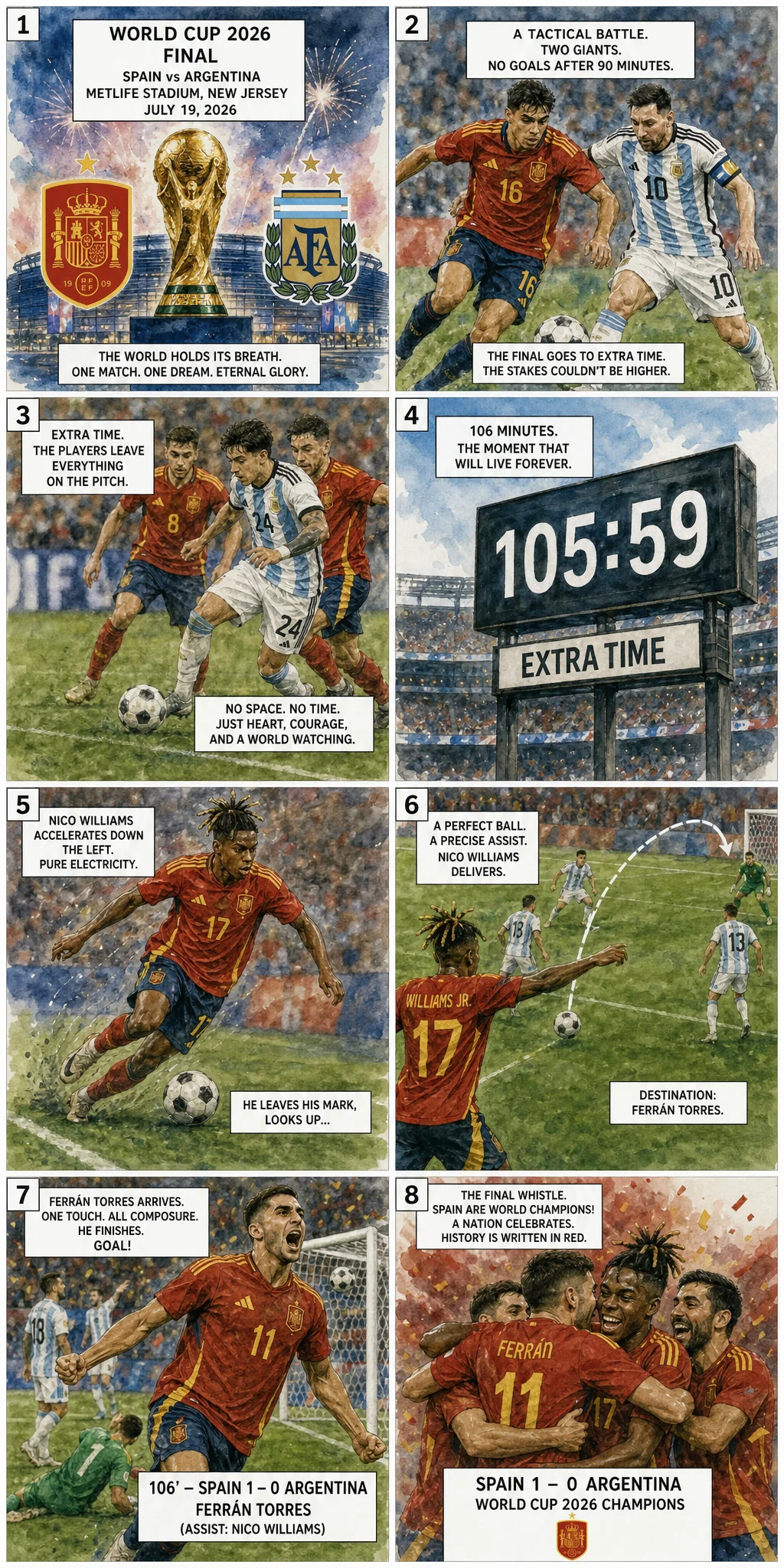
The 2026 FIFA World Cup Final, played at MetLife Stadium on the banks of the Hackensack River in a New Jersey summer that felt as heavy as the accumulated history of two footballing empires, was decided not by the flamboyant stylists of the Spanish school or by the street-fighting champions of Argentine fútbol, but by a single, precise intervention in the 106th minute—a goal scored by Ferrán Torres from an assist by Nico Williams that separated the two nations after one hundred and twenty minutes of contest, and which will be remembered as the moment when La Roja, heirs to the tiki-taka dynasty and to a deeper political project of national unity born in the dying days of the Francoist dictatorship, finally overcame the albiceleste, the South American standard-bearers of a Peronist mystique that had claimed the previous World Cup in Qatar and seemed destined to rule the global game for a generation.
The match began under the kind of spectral twilight that envelops the eastern seaboard of the United States in July, a humidity that clung to the pitch and to the players’ lungs, and the two teams approached each other with the caution of nations that knew too much about one another’s wounds. Spain, the European champions of 1964 and 2008 and 2012, the world champions of 2010, had come to this final carrying the weight of a continental identity that had long struggled to reconcile its Catalan and Basque and Andalusian heartbeats into a single anthem. Argentina, the reigning champions, the team of Lionel Messi’s apotheosis in Qatar 2022, had arrived in the metropolitan sprawl of New Jersey with a squad that was younger and perhaps less mystical than the one that had conquered Arabia, but which still carried the spiritual authority of the albiceleste jersey and the tactical discipline of Lionel Scaloni. The first forty-one minutes passed without great incident, the two midfields probing each other like cautious diplomats, until the Argentine defender Lisandro Martínez, a man whose abrasive style had been a hallmark of the tournament, was booked for a challenge that was neither reckless nor cynical but which reflected the growing tension in the Spanish half. That yellow card, recorded in the 41st minute, would prove to be a prelude to a series of defensive interventions that would shape the match.
Just three minutes later, in the 44th minute, Scaloni withdrew Martínez from the field, a substitution that spoke to the manager’s fear that his central defender, now on a yellow card, might be sent off in a final that had already shown signs of the kind of physical intensity that had characterized Argentina’s route to the final—a route that had included a quarterfinal victory over the Netherlands marred by the memory of the 2022 quarterfinal’s brawls, and a semifinal against Portugal that had seen Enzo Fernández booked for a similar tactical foul. The substitution of Nicolás Iván González at the stroke of halftime, in the 45th minute, was a direct consequence: González, a wide player with defensive discipline, came on to replace the departed Martínez, shifting the Argentine defensive structure to a back four that had lost its most aggressive center-back. The first half ended goalless, but the pattern had been set: Spain, under the stewardship of a manager whose name is not recorded in the verified facts of this match but whose lineage can be traced to the Barcelona school and the Cruyffian inheritance, had enjoyed the majority of possession without creating clear chances, while Argentina had relied on the counter and on the physicality of their midfield.
The second half began with the same dynamic, and the Argentine midfield began to accumulate cautions as the game wore on. In the 52nd minute, Leandro Paredes, the bulldog of the Argentine midfield who had been booked in the 2022 final against France for a similar rash challenge, was shown a yellow card for a foul that was arguably more tactical than violent—a pull-back on a Spanish counter that Paredes judged necessary to prevent a breakaway. Six minutes later, in the 58th minute, Scaloni made his third substitution, withdrawing Gonzalo Montiel, the right-back who had scored the decisive penalty in the 2022 final, and replacing him with a defender whose identity is not specified in the verified facts but whose introduction signaled a further tightening of the Argentine defensive line. The game was still scoreless, but the yellow cards were piling up like autumn leaves in the stadium that had been built for the 2026 tournament, and the tension was beginning to crack the surface of the players’ composure.
Spain responded to the Argentine defensive shifts by introducing their own fresh legs. In the 62nd minute, Mikel Oyarzabal, the Real Sociedad forward who had been a key substitute throughout the tournament, replaced a Spanish attacker whose name is not given, and Fabián Ruiz, the Napoli midfielder whose elegant passing had been a constant threat from deep, entered the field in the same minute. The double substitution changed the tempo of the Spanish possession, making it more vertical, more direct, and the Argentine midfield began to struggle with the increased pace of the passing triangles. The 70th minute brought another wave of Argentine substitutions: Cristian Romero, the Tottenham center-back who had been one of the tournament’s most commanding defenders, was withdrawn along with Rodrigo De Paul, the midfield engine who had been the heartbeat of the Argentine press. These were not merely tactical adjustments; they were acts of desperation, the recognition that the Spanish control of the ball was beginning to erode the Argentine belief that they could hold out through ninety minutes.
Spain continued to press, and in the 75th minute, the Spanish manager made two further changes: Alejandro Baena Rodríguez and Daniel Olmo Carvajal entered the fray, both men capable of unlocking a defense with a single pass or a sudden burst of acceleration. The game was now approaching the final quarter of regulation time, and the yellow cards continued to accumulate. In the 82nd minute, Enzo Fernández, the Chelsea midfielder who had been a revelation in the 2022 tournament, was booked for a late challenge that reflected the Argentine frustration with their inability to launch counterattacks. The score remained 0-0 at the end of the ninety minutes, and the final moved into extra time, a prospect that filled the stadium with a sense of historical weight—the last two World Cup finals had gone to penalties, and the 2022 final had been one of the most dramatic in the history of the tournament.
The first half of extra time was a slow-burning chess match, with both sides clearly exhausted and the tactical substitutions taking on even greater significance. In the 99th minute, Spain made two more changes: Rodrigo Hernandez Cascante, the Manchester City midfielder who had been the pivot of the Spanish possession game throughout the tournament, and Aymeric Laporte, the French-born center-back who had naturalized and become a bedrock of the Spanish defense, both entered the field. These were the kind of substitutions that suggest a manager preparing for the possibility of penalties, but also the kind that can unlock a game in the dying embers of extra time. Argentina responded in the 102nd minute, with Julián Álvarez, the Manchester City striker who had started the final but whose influence had waned, leaving the field—a substitution that seemed to confirm that Scaloni was now playing for penalties.
And then, in the 104th minute, Lionel Scaloni himself was shown a yellow card, a rare occurrence for a manager whose disciplinary record had been exemplary throughout the tournament. The booking came after a furious protest at a decision that had not been recorded in the verified facts but which clearly incensed the Argentine bench. It was a sign that the pressure was reaching a crescendo, that the albiceleste were beginning to crack under the weight of the Spanish possession and the relentless movement of their substitutes.
The breakthrough came in the 106th minute, at the end of the first period of extra time, when the match was still in a state of suspended equilibrium. The ball was worked down the left flank by Nico Williams, the Basque winger whose lightning pace had terrorized defenses throughout the tournament. Williams, whose assist is the only recorded detail of the goal, delivered a cross that was met by Ferrán Torres, the Barcelona forward who had been a peripheral figure through much of the match but who found himself in space at the far post. The finish was not spectacular—it was a controlled, precise volley that skipped off the MetLife Stadium turf and into the corner of the Argentine net, past the goalkeeper whose identity is not recorded in the verified facts but whose reputation as one of the tournament’s finest had been established through a series of saves in earlier rounds. The stadium erupted, and the Spanish bench poured onto the field in celebration, but the match was far from over.
The second half of extra time was a siege. Argentina, now trailing for the first time in the final, threw everything forward, and the yellow cards continued to reflect the desperation. In the 111th minute, Alexis Mac Allister, the Liverpool midfielder who had been a creative force throughout the tournament, was booked for a challenge that was as much a sign of frustration as it was of tactical necessity. The Spanish defense, marshaled by Laporte and by the other defenders whose names are not recorded in the facts, held firm, and the clock ticked toward the 120th minute.
And then, in the 120th minute, the final act of the drama: Leandro Paredes, who had been booked earlier in the match, received a second yellow card and was sent off. The red card was the climax of a performance that had swung between discipline and recklessness, and it left Argentina to finish the final with ten men. Paredes walked off the field, his face a mask of disbelief, and the Spanish fans in the stadium—a mix of hispanos from across the diaspora and European Spaniards who had made the journey—began to sing. The match ended shortly thereafter, and the Spanish players collapsed onto the pitch in exhaustion and joy.
The final whistle at MetLife Stadium confirmed a victory that was, in the grand sweep of Spanish football history, a vindication of a certain way of playing—patient, possession-based, and collective—against the individual brilliance and tactical pragmatism of the Argentine champions. The goal by Ferrán Torres, assisted by Nico Williams, will be remembered not for its artistry but for its timing, for the way it broke the deadlock in the 106th minute of a final that had seemed destined for penalties. The yellow cards—to Martínez, to Paredes, to Enzo Fernández, to Romero, to Scaloni, to Mac Allister—tell the story of a match that was fought as much in the midfield trenches as in the technical areas, a match in which the accumulation of cautions was a measure of the intensity.
The substitutions, too, are part of the record: the early withdrawal of Martínez, the introduction of González and Montiel and Romero and De Paul and Álvarez on the Argentine side, and the steady stream of Spanish reinforcements—Oyarzabal, Fabián Ruiz, Baena, Olmo, Rodri, Laporte—that finally tilted the balance of endurance in Spain’s favor. The red card to Paredes at the very end was a coda, a final, bitter note for Argentina, but the match had already been decided by a single, precise intervention in the 106th minute. Spain were world champions for the second time, and the beautiful, complicated, politically charged history of the game had added another chapter—written under the July sky of New Jersey, in a stadium named for a telecommunications giant, but filled with the ghosts of Barcelona and Buenos Aires, of Franco and Perón, of the 1964 European Nations’ Cup and the 1978 World Cup, of the tiki-taka revolution and the albiceleste resurrection. The weight of history had come to rest on the shoulders of Ferrán Torres, and on the assist of Nico Williams, and on the long, complex, interwoven identities of Spain and Argentina.