

Croatia: Journey to 2026
The Croatia national football team, known as Vatreni — the Fiery Ones — for the red-and-white checkered jerseys that have become one of football's most recognizable sights, represents one of the most extraordinary stories in international sport. The
Published: June 5, 2026
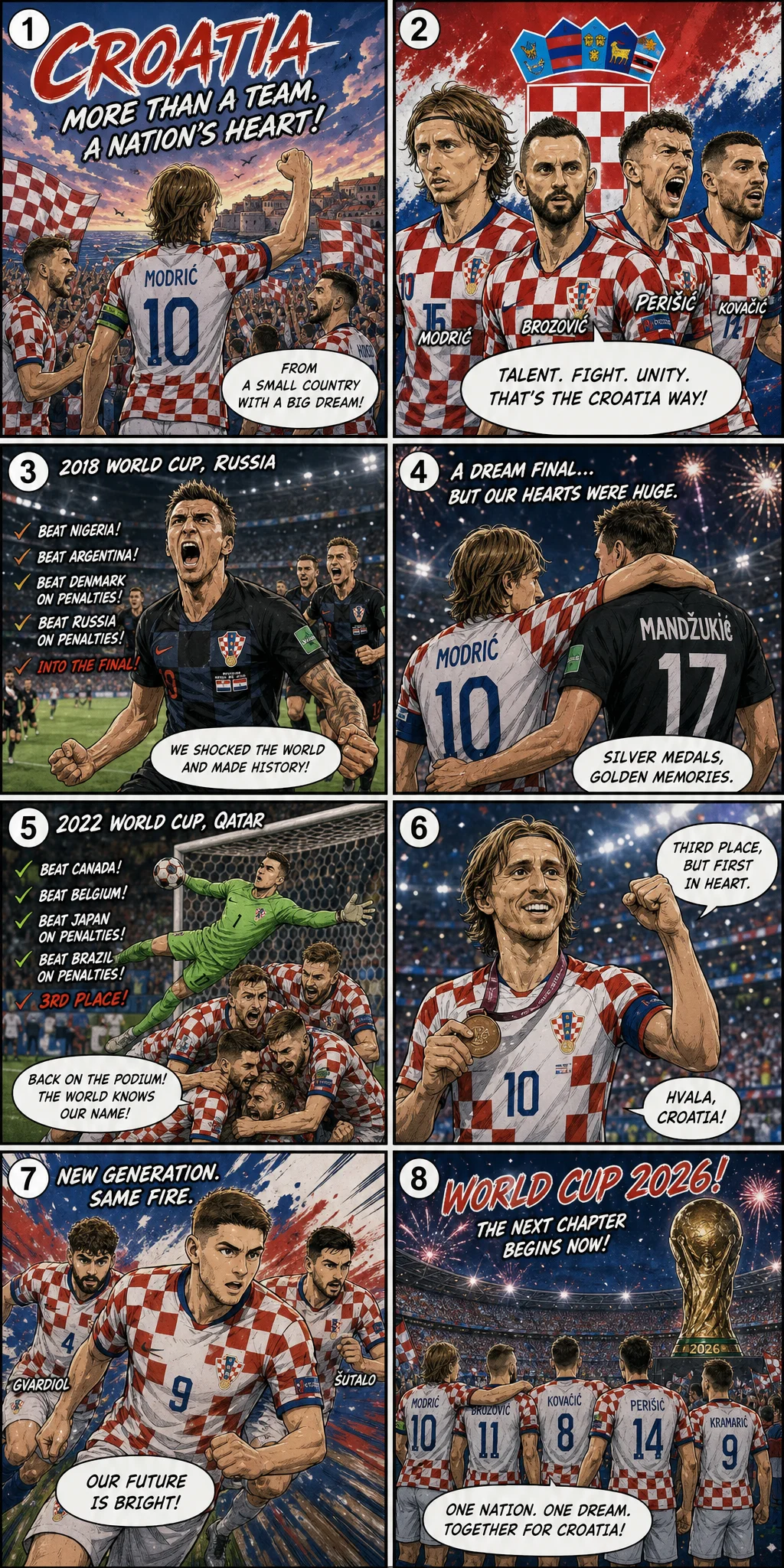
Comic content and match statistics are for entertainment purposes only and may contain inaccuracies. For Accurate Data, please refer to the reference's official website.
# Croatia: The Checkered Ones and the Art of the Impossible
The Croatia national football team, known as Vatreni — the Fiery Ones — for the red-and-white checkered jerseys that have become one of football's most recognizable sights, represents one of the most extraordinary stories in international sport. The country has existed as an independent nation for barely over three decades. Its population is smaller than that of many cities. Yet Croatia has reached a World Cup final and a World Cup semifinal in consecutive tournaments. A nation of barely four million people, independent only since 1991, Croatia has reached a World Cup final and a World Cup semifinal in consecutive tournaments. As the Vatreni prepare for 2026, they carry the expectations their own success has created — and the quiet confidence that their golden generation may have one more miracle left.
Football in Croatia predates the modern nation by nearly a century. The game arrived in the late nineteenth century through Austro-Hungarian influence, with the first clubs forming in Zagreb, Split, and the coastal cities of Dalmatia. Hajduk Split, founded in 1911 by Croatian students studying in Prague, became the club of the Dalmatian people, its name derived from the hajduk freedom fighters who resisted Ottoman rule. Dinamo Zagreb emerged as the capital's institution. The Dinamo-Hajduk rivalry is the nation's eternal derby — central versus coastal, urban versus maritime, establishment versus rebellion.
Within Yugoslavia, Croatian footballers were both celebrated and constrained. The Yugoslav team that reached the 1930 World Cup semifinals relied heavily on Croatian players. The tradition continued through decades, culminating in the prodigious talents of the 1987 FIFA World Youth Championship-winning team — Robert Prosinecki, Zvonimir Boban, Davor Suker, Robert Jarni. The political dimension was always present. The 1990 match between Dinamo Zagreb and Red Star Belgrade descended into a riot with Boban famously kicking a policeman who was attacking a Dinamo supporter — retrospectively viewed as a symbolic moment in Croatia's march toward independence. When Croatia declared independence in 1991 and endured a brutal war, football became a vehicle for asserting national identity and international recognition.
Croatia's 1998 World Cup campaign remains one of the most remarkable debuts in tournament history. Under the theatrical Miroslav Blazevic, Croatia reached the semifinals and finished third, defeating the Netherlands 2-1. Davor Suker won the Golden Boot with six goals, his left foot among the deadliest weapons in the tournament. The 3-0 quarterfinal demolition of Germany — the European champion, a football superpower reduced to rubble by the checkered onslaught — announced Croatia not as a plucky newcomer but as a genuine force.
The decade following 1998 was a period of relative decline, with group-stage exits in 2002 and 2006 and missing 2010 entirely. The reinvention arrived in the form of a generation that would surpass even 1998. Luka Modric, born in 1985 in the Dalmatian hinterland, his childhood marked by displacement during the war and the murder of his grandfather, emerged from Dinamo Zagreb and via Tottenham to become the midfield heartbeat of Real Madrid and the first man other than Messi or Ronaldo to win the Ballon d'Or in a decade. Alongside Modric grew Ivan Rakitic, Mario Mandzukic — the warrior striker whose relentless pressing and knack for crucial goals embodied Croatian resilience — Dejan Lovren, and Domagoj Vida.
The 2018 World Cup was Croatia's masterpiece. Maximum points from the group, including a 3-0 demolition of Argentina. Three consecutive extra-time knockout matches against Denmark, Russia, and England — a cumulative physical burden that seemed impossible for a squad of Croatia's depth. The semifinal against England, trailing early to a Kieran Trippier free-kick, looked like the end. Instead, Ivan Perisic equalized, Mandzukic scored in the 109th minute, and Croatia — playing their third extra time in ten days — looked fresher in the 120th minute than England. The image of Modric, the smallest man on the pitch, still sprinting in the dying moments, became the defining photograph of Croatian sporting history. The final against France was a bridge too far — 4-2 despite a performance that felt closer than the scoreline — but Croatia had already won.
The 2022 World Cup demonstrated 2018 was no fluke. Croatia reached the semifinals again, defeating Japan and Brazil on penalties. The quarterfinal against Brazil — the tournament favorite, the five-time champion — was a study in Croatian character. Brazil scored a goal of sublime quality in extra time through Neymar. Croatia equalized in the 117th minute through Bruno Petkovic. They won the shootout, Dominik Livakovic becoming the hero. Brazil, the beautiful game's most beautiful practitioners, eliminated by a nation of four million whose football is built on something more elemental than beauty. Croatia arrives at 2026 with an aging but indomitable core. The nation of four million has taught the world about resilience, about collective will, about the possibility of the small overcoming the large through sheer refusal to accept defeat.
The Croatian football philosophy — if a nation of four million producing Luka Modric and reaching back-to-back World Cup semifinals can be reduced to a philosophy — is built on technical excellence expressed through collective resilience. Croatian players grow up in a football culture that values first touch, close control, and the specific capacity to receive the ball under pressure and emerge facing forward. The Dinamo Zagreb academy and the Hajduk Split tradition, for all their rivalry, share this commitment. The small population that limits Croatia's depth also creates an intensity of competition — every talented player is identified early, developed thoroughly, and tested against the highest available standards. The diaspora provides an additional talent pool, with players like Rakitic (born in Switzerland) and others raised abroad choosing to represent their parents' homeland. The result is a football nation that punches so far above its demographic weight that the metaphor strains credulity. Four million people. A World Cup final. Two semifinals. A Ballon d'Or winner. The checkered jersey has become one of football's most recognizable sights, and the team that wears it has taught the world something about what small nations can achieve when talent, technique, and an indomitable collective will converge. The 2026 World Cup represents, most likely, the final tournament for Modric and the core of the golden generation. They have already given Croatian football everything. They seem determined to give it a little more.
The achievement of Croatian football cannot be measured in trophies alone — though the 2018 World Cup runners-up medal and the 2022 bronze represent the kind of hardware most nations of four million would consider fantasy. The achievement is in the persistence of a football identity against demographic odds that make success structurally improbable. Croatia produces approximately one-tenth the number of professional footballers that France or Germany produce. Its domestic league operates at a fraction of the budget of Europe's major competitions. Its players are scattered across a dozen countries, reassembling for national team duty weeks rather than months before tournaments. And yet, twice in succession, that assembly has produced semifinalists. The checkered jersey has become a symbol of something beyond football — a small nation's refusal to accept the demographic arithmetic that says it should not be here, should not be winning, should not be forcing Brazil to penalties in a World Cup quarterfinal. The 2026 tournament is most likely the final chapter for Modric and the golden generation's core. Whatever happens, Croatian football has already won. The only question is how much more it intends to take.