

Ghana: Journey to 2026
The Ghana national football team, known as the Black Stars for the single star on the nation's flag — the lodestar of African independence and Pan-African aspiration — carries the hopes of a football-mad nation that has come closer than any other to
Published: June 5, 2026
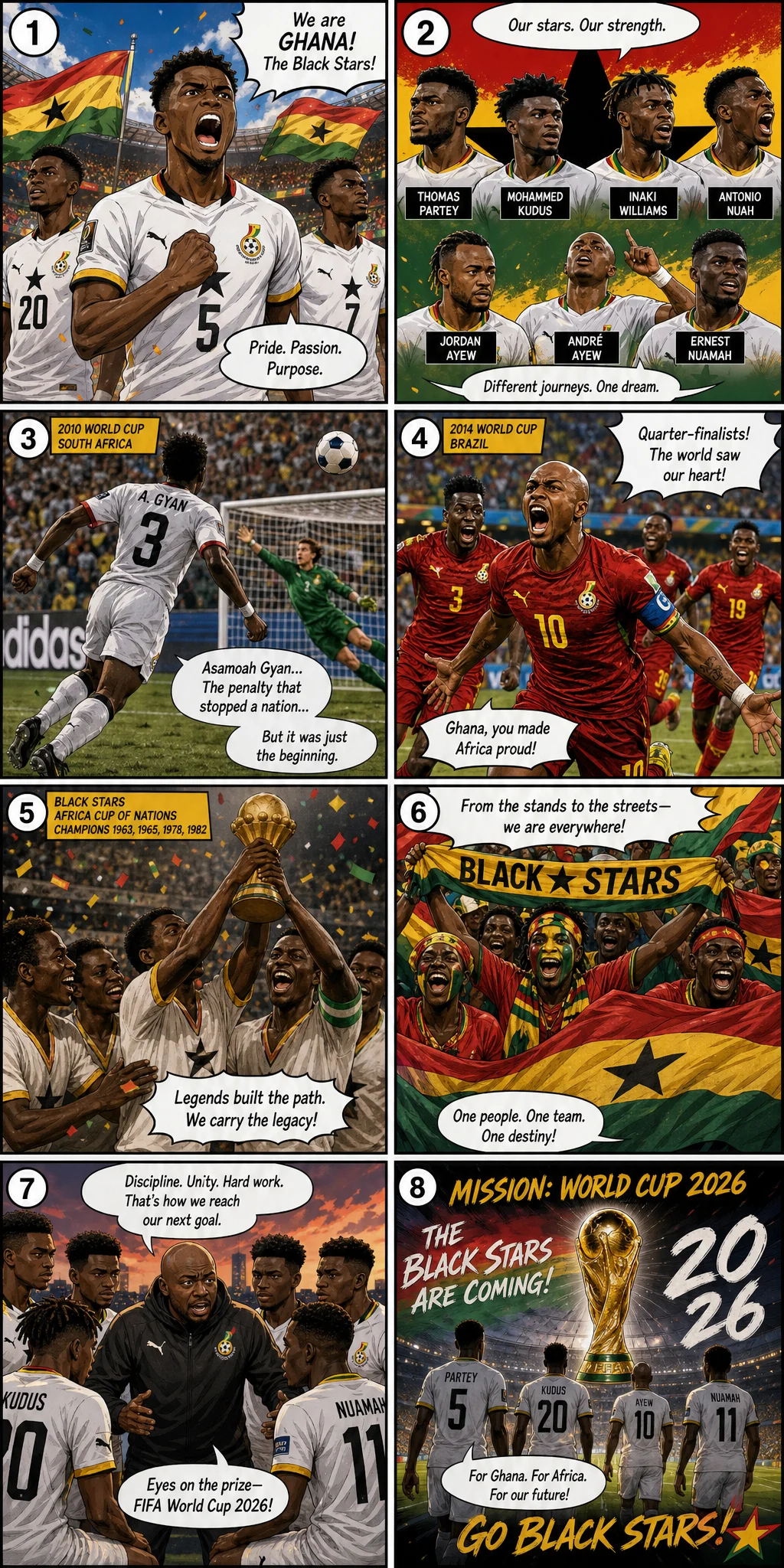
Comic content and match statistics are for entertainment purposes only and may contain inaccuracies. For Accurate Data, please refer to the reference's official website.
# Ghana: The Black Stars Illuminating a Continent
The Ghana national football team, known as the Black Stars for the single star on the nation's flag — the lodestar of African independence and Pan-African aspiration — carries the hopes of a football-mad nation that has come closer than any other to bringing African football to the World Cup's ultimate stages. One penalty kick in 2010. One crossbar in Johannesburg. One Luis Suarez handball away from an African semifinalist. The Black Stars — named for the single black star on Ghana's flag, the lodestar of African independence and Pan-African aspiration — pursue the 2026 World Cup seeking to recapture the magic that made them Africa's most compelling story and finally break through the barrier that stopped them in 2010.
Football in Ghana traces its organized origins to the early twentieth century under British colonial rule. The game spread rapidly through the coastal cities of Accra, Cape Coast, and Sekondi. The Gold Coast Football Association was founded in 1920. By the 1930s, a competitive club structure centered on Hearts of Oak (founded 1911 in Accra) and Asante Kotoko (founded 1935 in Kumasi) had emerged. The Hearts-Kotoko rivalry is among Africa's oldest and most passionate, a cultural fault line dividing families and cities on derby days.
Ghana achieved independence in 1957 under Kwame Nkrumah, who understood football's power for national unity and international recognition. Nkrumah invested state resources in football development. The Black Stars won the Africa Cup of Nations in 1963 and 1965, establishing continental power just years after independence. Pan-African politics and football intertwined — the national team was explicitly positioned as a symbol of African capability and dignity, a rebuttal to colonial narratives of inferiority. This political dimension persists into the modern era, coloring every World Cup campaign with deeper meaning.
Ghana's international breakthrough came at youth level. The under-17 team, the Black Starlets, won the FIFA U-17 World Championship in 1991 and 1995. The 1991 team featured Samuel Kuffour, whose career at Bayern Munich established the template for Ghanaian success in Europe. The 1995 team produced Stephen Appiah, the future captain whose leadership would carry Ghana to its first World Cup. The under-20 team won the FIFA U-20 World Cup in 2009, defeating Brazil on penalties, with a core — Andre Ayew, Jonathan Mensah, Dominic Adiyiah — that would form the spine of the 2010 quarterfinal squad.
Ghana's first World Cup qualification, in 2006, was a landmark. The Black Stars advanced from a group containing Italy, the Czech Republic, and the United States before losing to Brazil in the round of 16. The tournament announced Ghana to the global audience and established the template: technically proficient, physically imposing, tactically organized, and unafraid of football's established powers.
The 2010 World Cup in South Africa, the first on African soil, was Ghana's moment. Carrying an entire continent's hopes, the Black Stars advanced from a group containing Germany, Serbia, and Australia before defeating the United States 2-1 in extra time — Asamoah Gyan's thunderous left-footed winner remains the goal against which all Ghanaian World Cup moments are measured. The quarterfinal against Uruguay in Johannesburg on July 2, 2010, is one of the most famous and traumatic matches in World Cup history. Tied 1-1 deep into extra time, Dominic Adiyiah's header was goal-bound. Luis Suarez, standing on the goal line, deliberately blocked the ball with his hands — a professional foul trading a certain goal for a red card and a penalty. Suarez was sent off. Asamoah Gyan, Ghana's penalty specialist, stepped up. His shot struck the crossbar. The match went to penalties. Ghana lost. Suarez, watching from the tunnel, celebrated. An entire continent mourned.
Ghana was one penalty kick from becoming the first African World Cup semifinalist — a barrier almost certainly broken had Gyan scored. The aftermath continues to reverberate. Suarez became, for African football fans, a villain of almost mythical dimensions. Gyan, one of Ghana's greatest players, spoke of the psychological weight carried for years.
Legends of the Black Stars include Abedi "Pele" Ayew, Ghana's greatest-ever player and three-time African Footballer of the Year, whose elegance and creativity at Marseille — where he won the 1993 Champions League — influenced a generation. His sons, Andre and Jordan Ayew, have both captained the Black Stars, creating one of football's most distinguished dynasties. Michael Essien, the "Bison," set the standard for the modern box-to-box midfielder. The decade following 2010 has been challenging — bonus disputes, governance issues, group-stage exits — but Ghana's talent pipeline continues producing. The Black Stars pursue 2026 seeking to recapture the magic of 2010 and finally complete the journey that stopped one penalty kick short of immortality.
The Ghanaian football identity — the specific combination of technical proficiency, physical power, and emotional intensity that has made the Black Stars Africa's most compelling World Cup story — continues to evolve. The current generation, developed in European academies and competing in Europe's top leagues, brings tactical sophistication that previous Ghanaian teams, for all their talent, sometimes lacked. The midfield features players comfortable in possession-based systems and counter-attacking structures alike. The defense has the athleticism to compete with elite forward lines and the organization to maintain shape under sustained pressure. The attacking options are varied — wingers who can isolate full-backs, strikers who can hold the ball up and bring midfielders into play, creative midfielders who can operate between the lines. The raw materials for a deep World Cup run are present. The question, as it has always been for Ghana, is whether the institutional support — the preparation, the administration, the specific organizational competence that distinguishes tournament success from tournament disappointment — matches the playing talent. If it does, the Black Stars have the capacity to become the first African World Cup semifinalist. The continent has been waiting since 2010. The wait may finally be ending.
The emotional architecture of Ghanaian football is built around a single moment — Asamoah Gyan's penalty striking the crossbar in Johannesburg, the ball arcing away from the goal that would have made Ghana the first African World Cup semifinalist, Luis Suarez celebrating on the touchline. That moment has defined Ghanaian football for fifteen years, and every subsequent World Cup campaign has been, in some sense, an attempt to move beyond it. The 2026 tournament offers that opportunity. The current squad is as talented as any Ghana has produced. The expanded format creates a more navigable path. The psychological weight of 2010 cannot be erased — but it can be replaced by something new. A quarterfinal victory. A semifinal appearance. The specific achievement that transforms a national football identity from "the team that almost" to "the team that did." Ghana has been waiting for that transformation since the night in Johannesburg when everything changed in the space between a striker's boot and a crossbar. The 2026 World Cup is the next chance to finally change the story.