

Panama: Journey to 2026
The Panama national football team, known as Los Canaleros — the Canal Men — represents one of the most improbable success stories in modern football. A nation of barely four and a half million people, long dismissed as a baseball country whose greate
Published: June 5, 2026
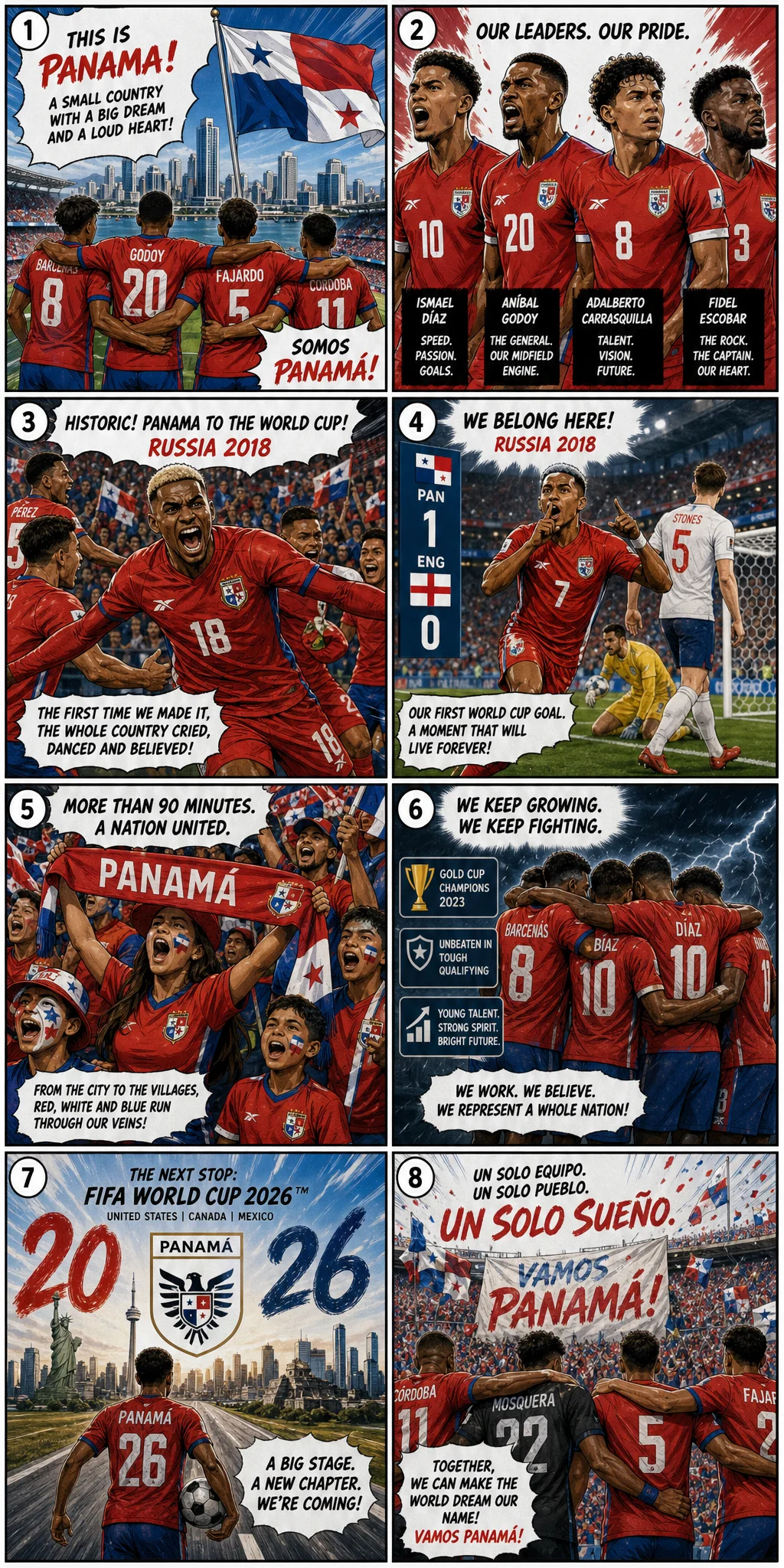
Comic content and match statistics are for entertainment purposes only and may contain inaccuracies. For Accurate Data, please refer to the reference's official website.
# Panama: The Canaleros' Impossible Dream
The Panama national football team, known as Los Canaleros — the Canal Men — represents one of the most improbable success stories in modern football. A nation of barely four and a half million people, long dismissed as a baseball country whose greatest sporting heroes swung bats rather than kicked balls, stormed into global football consciousness on a single October night in 2017 when everything that was supposed to happen in CONCACAF qualifying did not. A nation of barely four and a half million people, long dismissed as a baseball country in a baseball region, Panama stormed into global football consciousness with a World Cup qualification that defied every expectation. As Los Canaleros pursue the 2026 World Cup, they embody the belief that football's frontiers are never truly fixed.
Football arrived in Panama in the early twentieth century, carried by the same transnational currents that shaped the nation. The Panama Canal, the engineering marvel that defines the country's geopolitical significance, brought workers, merchants, and travelers from across the globe — British West Indians, Europeans, South Americans who brought footballs alongside their tools. The game took root in the Canal Zone and the port cities of Colon and Panama City. Baseball, not football, was the sport of American influence, and for most of the twentieth century, Panama was defined as a baseball nation. Rod Carew, the Hall of Fame hitter, and Mariano Rivera, the greatest closer in Major League Baseball history, were the country's sporting heroes. Football existed in the margins.
Panama's transformation began in the early 2000s. The Panamanian Football Federation, under new leadership, invested in youth development, coaching education, and professionalization of the domestic league. The Liga Panamenia de Futbol provided a competitive foundation. The diaspora expanded the talent identification network. A generational cohort came of age together: Roman Torres, the imposing center-back whose physical presence and emotional leadership defined the team's identity; Luis Tejada, "El Matador," the prolific striker whose 43 international goals placed him among CONCACAF's most prolific; Blas Perez, Tejada's strike partner; Gabriel Gomez, the midfield anchor; Jaime Penedo, the goalkeeper whose cat-like reflexes and 135 caps made him Panama's most-capped player.
The proximate cause of Panama's breakthrough was the leadership of two Colombian coaches. Hernan Dario "Bolillo" Gomez, who had previously led Colombia and Ecuador to World Cups, installed the tactical discipline and belief Panama had historically lacked. Julio Cesar Dely Valdes, one of Panama's greatest-ever players — a striker who scored prolifically for Cagliari, Paris Saint-Germain, and Malaga — managed the national team and brought the credibility only a genuine legend could command. His twin brother Jorge and his nephews created a football dynasty running through Panamanian history.
The defining moment occurred on October 10, 2017. Panama entered the final matchday of CONCACAF qualifying needing a victory over Costa Rica, combined with other results, to reach the 2018 World Cup. The United States, the regional superpower, needed only a draw against last-placed Trinidad and Tobago. Panama took an early lead through Gabriel Torres. Costa Rica equalized. The match entered its final minutes with the score 1-1, a result that would eliminate Panama. In the 88th minute, Roman Torres — the captain, the emotional heartbeat — received the ball inside the Costa Rican penalty area. His first touch was imperfect. His second was a left-footed strike through a forest of legs. The ball found the corner of the net. The Estadio Rommel Fernandez detonated. Simultaneously, in Trinidad, an own goal and a long-range strike gave the Soca Warriors an improbable 2-1 victory over the United States. The combination delivered Panama directly to the World Cup. The United States missed the tournament for the first time since 1986. Panama, the afterthought, was going to Russia.
President Juan Carlos Varela declared October 11 a national holiday. The celebration was cathartic — not merely a sporting achievement but collective vindication, proof Panama could compete on the world's largest stages.
The 2018 World Cup campaign was, by competitive measures, a disappointment — three group-stage defeats. But the Tunisia match contained a moment that transcended results. In the 78th minute, a set piece was delivered into the Tunisian penalty area. Felipe Baloy, the 37-year-old defender playing in his first and only World Cup at the end of a two-decade career, arrived at the far post. His right-footed volley crashed into the roof of the net — the first goal scored by a Panamanian at a World Cup. Baloy sprinted toward the corner flag, face contorted with emotion millions understood instantly. The post-2018 era has been a period of transition. The heroes of qualification have retired or aged out. The current squad — Michael Amir Murillo, Anibal Godoy, Adalberto Carrasquilla, Edgar Yoel Barcenas — represents the modern Panamanian footballer: technically accomplished and comfortable in elite environments. The youth pipeline shows promise. Panama's qualification breakthrough was not an isolated event but the beginning of sustained football development. The 2026 tournament, expanded to forty-eight teams and partially hosted in CONCACAF, represents the Canaleros' next chapter.
The significance of 2026 for Panama extends beyond the competitive opportunity. The tournament is jointly hosted by the United States, Mexico, and Canada — CONCACAF nations, Panama's regional neighbors. The expanded format includes additional qualifying slots for the confederation. The proximity means Panamanian supporters can travel to matches in numbers unimaginable for a tournament in Europe or Asia. The combination — an expanded tournament, regional hosting, a maturing generation of players — creates conditions for Panama's second World Cup appearance to exceed the first in competitive terms. The 2018 campaign was about participation, about Felipe Baloy's goal, about proving that Panama belonged. The 2026 campaign can be about competition — about winning a match, about threatening knockout qualification, about establishing that the Canaleros are not merely World Cup participants but World Cup competitors. The infrastructure is improving. The youth pipeline is producing. The memory of that October night in 2017, Roman Torres' left foot and a nation's catharsis, continues to power Panamanian football forward. Los Canaleros are not done dreaming. The 2026 World Cup is their next horizon.
The question facing Panamanian football is whether the 2018 breakthrough can be converted into sustained competitiveness. The emotional power of that first qualification — Roman Torres' goal, Felipe Baloy's volley, the national holiday declared the next morning — cannot be replicated. You only qualify for your first World Cup once. But the competitive benefits of that experience — the knowledge that Panama belongs on this stage, the familiarity with tournament logistics and pressure, the institutional learning that accrues from participation — can be built upon. The expanded format creates additional qualifying pathways. Regional hosting reduces travel burdens and increases supporter presence. The current generation of players has spent years in European and MLS environments that previous generations could only observe from distance. The Canaleros are not the same team that arrived in Russia in 2018, wide-eyed and overwhelmed. They are a team that has done this before and believes it can do more. The dream that became real on an October night in 2017 has not finished unfolding.