

Gillette Stadium: The Lighthouse of a Dynasty
Gillette Stadium in Foxborough, Massachusetts, will host World Cup matches in 2026. It is a stadium built by a billionaire who rejected two hundred architectural proposals before saying yes, a building that houses six Super Bowl banners and the colde
Published: June 6, 2026
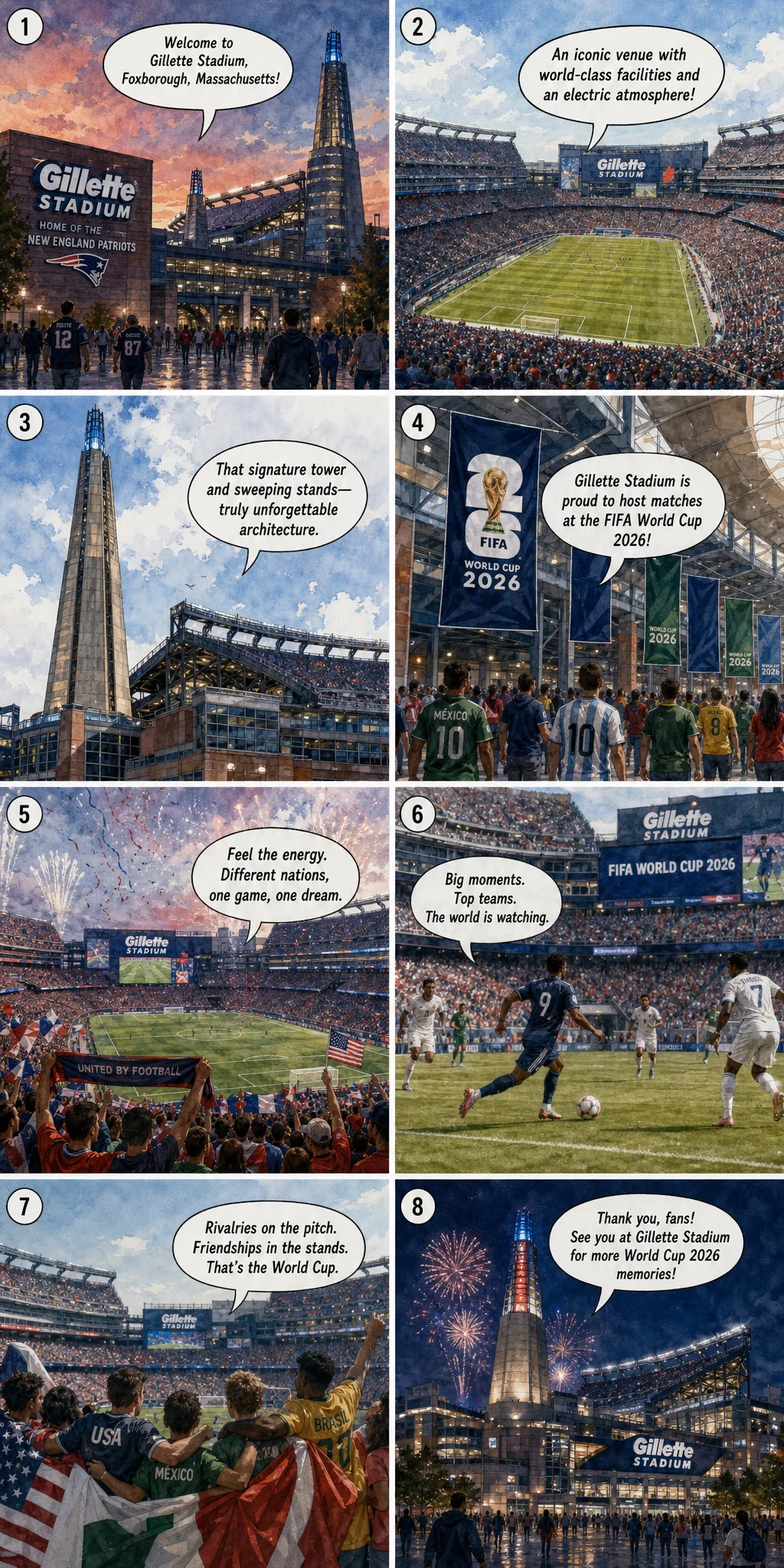
Comic content and match statistics are for entertainment purposes only and may contain inaccuracies. For Accurate Data, please refer to the reference's official website.
# Gillette Stadium: The Lighthouse of a Dynasty
Gillette Stadium in Foxborough, Massachusetts, will host World Cup matches in 2026. It is a stadium built by a billionaire who rejected two hundred architectural proposals before saying yes, a building that houses six Super Bowl banners and the coldest playoff victory in NFL history. To understand why it matters, you must understand what Robert Kraft built — and what he refused to accept.
Two hundred times. Two hundred design iterations. Populous presented Robert Kraft with concept after concept, rendering after rendering, model after model. And two hundred times, Kraft looked at what they brought him and said: not yet. This is the first thing you need to understand about Gillette Stadium. It was not built by a city council vote. It was not extracted from taxpayers through the quiet extortion of public stadium financing. Robert Kraft paid for it himself — all $325 million. And because he was writing the checks, he got to be as particular as he wanted.
On the two hundred and first try, he said yes. What he said yes to was modeled on M&T Bank Stadium in Baltimore, which Populous had designed four years earlier. But Kraft wanted more — a lighthouse, a bridge entrance modeled on the Longfellow Bridge spanning the Charles River, 64,628 seats, 82 luxury suites, the largest outdoor video board in the United States. He wanted a building that felt like New England, like something that belonged to the cold, flinty corner of America that produced him.
Foxborough is not Boston. It is twenty-two miles southwest, twenty-two miles north of Providence, straddling two identities without fully belonging to either. Eighteen thousand residents, one enormous stadium, and a football team the entire region treats as a religion. The Patriots almost left in 1998 — not a negotiating tactic leaked to the Boston Globe but a signed deal. Connecticut Governor John Rowland committed $374 million in state money for a Hartford stadium on the Connecticut River. The press conference happened. The renderings were published. Then it collapsed — a tangle of financing disputes and environmental concerns. Rowland became a New York Jets fan out of spite. Kraft turned back to Foxborough, his own checkbook and vision and two hundred iterations.
The dynasty that unfolded inside this building is statistically improbable and emotionally inexhaustible. Six Super Bowl banners. The first came after the 2001 season, when a sixth-round draft pick named Tom Brady replaced an injured Drew Bledsoe and the universe tilted on its axis. The Patriots' home playoff record at Gillette through 2025: 21 wins, 4 losses. That is not a home-field advantage. That is a throne room.
What happened in this building in January defies not just football logic but meteorological logic. The coldest game in Patriots history: January 10, 2004, divisional round against Tennessee. Temperature at kickoff: 4 degrees Fahrenheit. Wind chill: minus 12. Adam Vinatieri kicked a 46-yard field goal into air so cold the ball might as well have been a frozen potato. The cold became part of the mythology. Gillette in January was not a venue. It was a weapon.
The snow games of the dynasty years — Brady's breath crystallizing in the air, opposing defenses looking like they wanted to be anywhere else on Earth — happened here. The NFL changed its overtime rules because of what the Patriots did in this building. The league changed defensive contact rules after the 2003 AFC Championship, a 24-14 dismantling of Peyton Manning's Colts in which Patriots defensive backs effectively committed legalized assault on receivers for sixty minutes. The building changed football. Bill Belichick patrolled the sideline in a hoodie with the sleeves cut off. Gronkowski spiked footballs with such force the league invented new ways to penalize celebration. The sound of 64,000 people in parkas, roaring in air so cold it hurt to breathe — this was the Gillette experience. Not comfortable. Not polite. Victorious.
June 12, 2024. Tom Brady's Hall of Fame induction ceremony was held inside Gillette Stadium — not in a hotel ballroom, not in Canton, Ohio. Inside the stadium. The lighthouse Kraft had insisted upon, the 220-foot tower in the north end zone, became the backdrop for the immortalization of the player who made the building mean what it means. The lighthouse idea came directly from Kraft — a symbol of New England's maritime identity, a beacon visible for miles. For two decades, it has stood over six championships won, over the greatest dynasty the NFL has ever produced. A billionaire asked architects to try again two hundred times until they got it right. The lighthouse still stands. So do the banners.
When World Cup matches arrive at Gillette in 2026, the stadium will undergo a transformation that is simultaneously superficial and profound. The NFL markings will disappear beneath a grass pitch. The seating configuration will shift to accommodate FIFA's dimensional requirements. The lighthouse will remain — Kraft's two hundred iterations, the 220-foot beacon that has become the stadium's defining silhouette against the New England sky. The building will host group-stage matches, perhaps a knockout fixture, and the international audience will discover what Patriots fans have known for two decades: Gillette is not comfortable and makes no apology for it. The cold in January, the heat in June, the specific New England refusal to soften the experience for anyone — this is the environment that produced the greatest dynasty in professional football history. Six Super Bowl banners. A home playoff record that borders on the absurd. A billionaire who asked architects to try again two hundred times. A lighthouse visible for miles across the Massachusetts countryside. The World Cup has been to many beautiful stadiums. It has never been anywhere quite like Foxborough.
The stadium's origin story — a private citizen paying for the entire project with his own money, rejecting two hundred designs before finding the right one, building a lighthouse in the end zone because it felt like New England — tells you something about what this building represents. It represents the specific American conviction that a single person's vision, sufficiently refined and sufficiently funded, can produce something that outlasts the person. Kraft is in his eighties now. The dynasty he built, the coach and quarterback who defined it, have moved on. The banners remain. The lighthouse remains. And in 2026, when the World Cup comes to Foxborough, the building will host a sport its architect never played but whose rhythms — the buildup, the tension, the sudden eruption of collective joy or anguish — are universal. The Patriots changed football. The World Cup will discover what Foxborough already knows: this is a building that changes whatever happens inside it.