

Estadio BBVA: The Steel Giant and the Saddle Mountain
Estadio BBVA in Monterrey, Mexico, known as El Gigante de Acero — the Steel Giant — will host World Cup matches in 2026. It is the steepest stadium in Mexican football, the first LEED Silver-certified football stadium in North America, and a building
Published: June 6, 2026
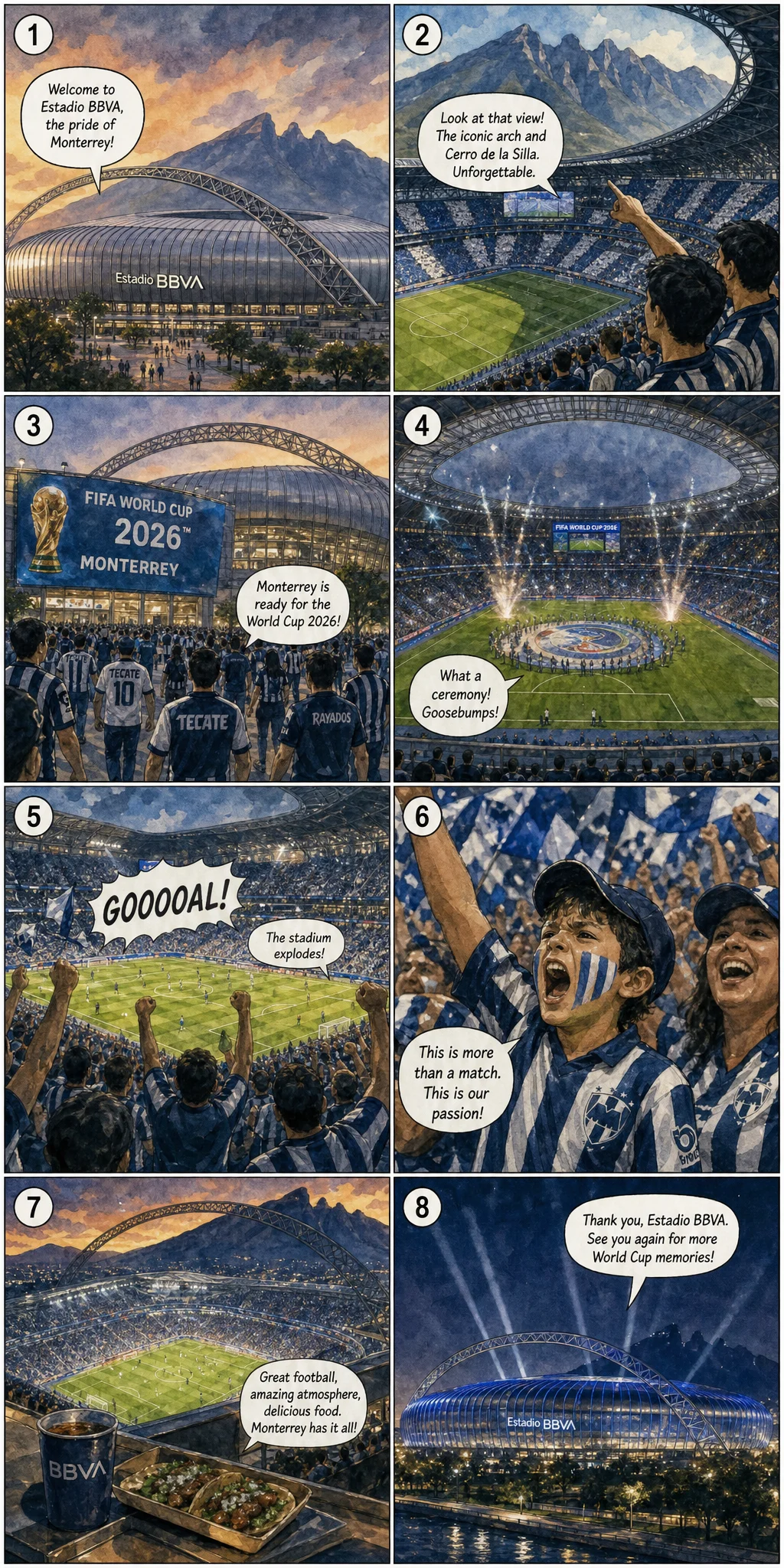
Comic content and match statistics are for entertainment purposes only and may contain inaccuracies. For Accurate Data, please refer to the reference's official website.
# Estadio BBVA: The Steel Giant and the Saddle Mountain
Estadio BBVA in Monterrey, Mexico, known as El Gigante de Acero — the Steel Giant — will host World Cup matches in 2026. It is the steepest stadium in Mexican football, the first LEED Silver-certified football stadium in North America, and a building designed to let a mountain into the conversation. To understand what it means for Monterrey to host the world's game, you must understand what came before the Giant — and what the Giant was built to become.
Cerro de la Silla was there first. Before the stadium, before Monterrey, before football. The mountain — four peaks forming the unmistakable silhouette of a saddle against the sky — has been watching this valley for thirty million years. It watched the foundries rise and the steel pour. It watched a city build itself from iron and ambition at its feet. And now, through the northwestern opening of Estadio BBVA, it watches football.
Every match at the Steel Giant begins with the mountain. You walk in, find your seat, look up — and there it is, framed by the gap in the steel exoskeleton, impassive and eternal. The architects at Populous knew what they were doing when they left that end open. You can roof over the stands, cantilever steel beams across the sky, build the most intimate sightlines in Mexican football — but you cannot compete with a mountain. So they did not try. They let the mountain into the building.
The numbers first, because Monterrey respects numbers. Built between 2011 and 2015. Opened August 2, 2015. Two hundred million dollars. Designed by Populous and VFO, the studio of Federico Velasco, who understood that a stadium in Monterrey must speak the language of steel. Fifty-three thousand seats, the first football stadium in North America to earn LEED Silver certification. Over one-third of the land dedicated to green space — native plants filtering rainwater, recharging the aquifer, the Rio La Silla flowing along the northern boundary.
The number that matters most is thirty-four. Thirty-four degrees — the angle of the grandstand incline, the steepest in Mexican football. Seats positioned at FIFA's minimum allowable distance from the pitch. From the upper deck, you are not watching the match; you are falling toward it, close enough to see expressions, to hear a striker curse when a shot goes wide, to feel the vibration of a tackle through the concrete. In a city that built its identity on industrial precision, the 34-degree stand is engineering as emotion.
The steel roof cantilevers overhead, painted white, a web of trusses that seems to float. The exoskeleton wraps the exterior in bands of silver-gray, catching the late-afternoon sun and glowing amber at golden hour. This is why they call it "El Gigante de Acero" — the Steel Giant. Not a nickname invented by a marketing department. A name that emerged from the city itself, because Monterrey knows steel the way Venice knows water.
Before the Giant, there was the Tec. Estadio Tecnologico served CF Monterrey for sixty-three years — a modest concrete bowl that held 32,000, hosted World Cup matches in 1986, saw Rayados win and lose. It was loved the way old things are loved, not for what they are but for what happened inside them. In 2015, the walk began. Rayados fans made the pilgrimage eight kilometers east toward the Sierra Madre foothills. Some had been going to the Tec for fifty years, their fathers and grandfathers before them. Walking away from that history must have felt like betrayal and rebirth at the same time. Monterrey understands this feeling. The city has been rebuilding itself for a century.
The Clasico Regiomontano is not a football match. It is a civil war contained within ninety minutes. Rayados versus Tigres UANL, blue-and-white against gold-and-blue. The stadium splits down the middle, two colors that cannot coexist. Families divide. Brothers choose sides. A father in a Rayados jersey sits next to his son in Tigres gold, and for two hours they are not family — they are geography, they are history, they are the north of Mexico refusing to agree with itself. When the Clasico comes to the Steel Giant, the building shakes. Literally. Fifty-three thousand people jumping in unison on a 34-degree incline generates structural stress that engineers calculate and fans experience as religion. The noise does not rise — it descends from the steel roof, bounces off concrete, and settles in your chest. The first time you experience it, you understand why they built the Giant out of steel. Anything less would have collapsed under the weight of this derby.
Rayados are the people's team, the industrial team, the team of steelworkers and foundry men. Tigres are the university team, the establishment. When they meet, Monterrey stops — factories go quiet, traffic disappears from the avenues, a city of five million holds its breath. The Steel Giant rises against the Saddle Mountain. For ninety minutes, steel and stone hold a conversation that began long before either of them existed.
When the 2026 World Cup arrives at the Steel Giant, the mountain will still be watching. Monterrey has been preparing for this moment since the stadium opened — the LEED Silver certification, the green spaces filtering rainwater, the 34-degree stands positioned at FIFA's exact minimum distance from the pitch. The Steel Giant was designed for football in a way that American stadiums, built primarily for the NFL and retrofitted for soccer, can never quite replicate. The sightlines were calculated for a sport where the ball moves continuously across a larger field, where the geometry of viewing angles differs fundamentally from the stop-start rhythms of American football. Populous and VFO understood this. They built a football stadium first and a venue for everything else second. When the World Cup group-stage matches arrive — when the Clasico Regiomontano energy that normally fills this building is replaced by the flags and chants of competing nations — the Steel Giant will do what it was designed to do: make 53,000 people feel like they are falling toward the pitch, suspended on a 34-degree incline beneath a steel roof that seems to float. The mountain will still be there, framed in the northwestern opening, impassive and eternal. It was there first. It will be there after the tournament departs. But for ninety minutes, twice or three times during the World Cup summer, it will watch football at the Steel Giant. Monterrey has been waiting its whole life for this.
The significance of Monterrey hosting World Cup matches extends beyond the stadium walls. The city is the industrial heart of Mexico, the capital of the north, a place whose identity was forged in foundries and factories rather than the colonial plazas and Aztec ruins that define Mexico City's relationship with history. Football in Monterrey is not a pastime. It is a mechanism through which the city understands itself — the Clasico Regiomontano dividing families, the foundry workers' team against the university establishment, a civil war contained within ninety minutes that makes the rest of Mexico's rivalries look like polite disagreements. When the World Cup comes to the Steel Giant, it will come to a building designed to host precisely this kind of intensity. The 34-degree stands. The mountain visible through the northwestern opening. The steel roof that seems to float. Monterrey has been preparing for this moment since the first steel beam was raised. The Giant is ready. The mountain is watching. Let the world come.