
Brazil vs Morocco - Group C Preview
The Estadio Azteca has seen things. It has held its breath for Maradona's Hand of God and the other one, the one that made grown men weep. It has watched Pelé lift a trophy as a teenager and it has absorbed the roar of 114,000 souls during the 1970 f
Published: June 6, 2026
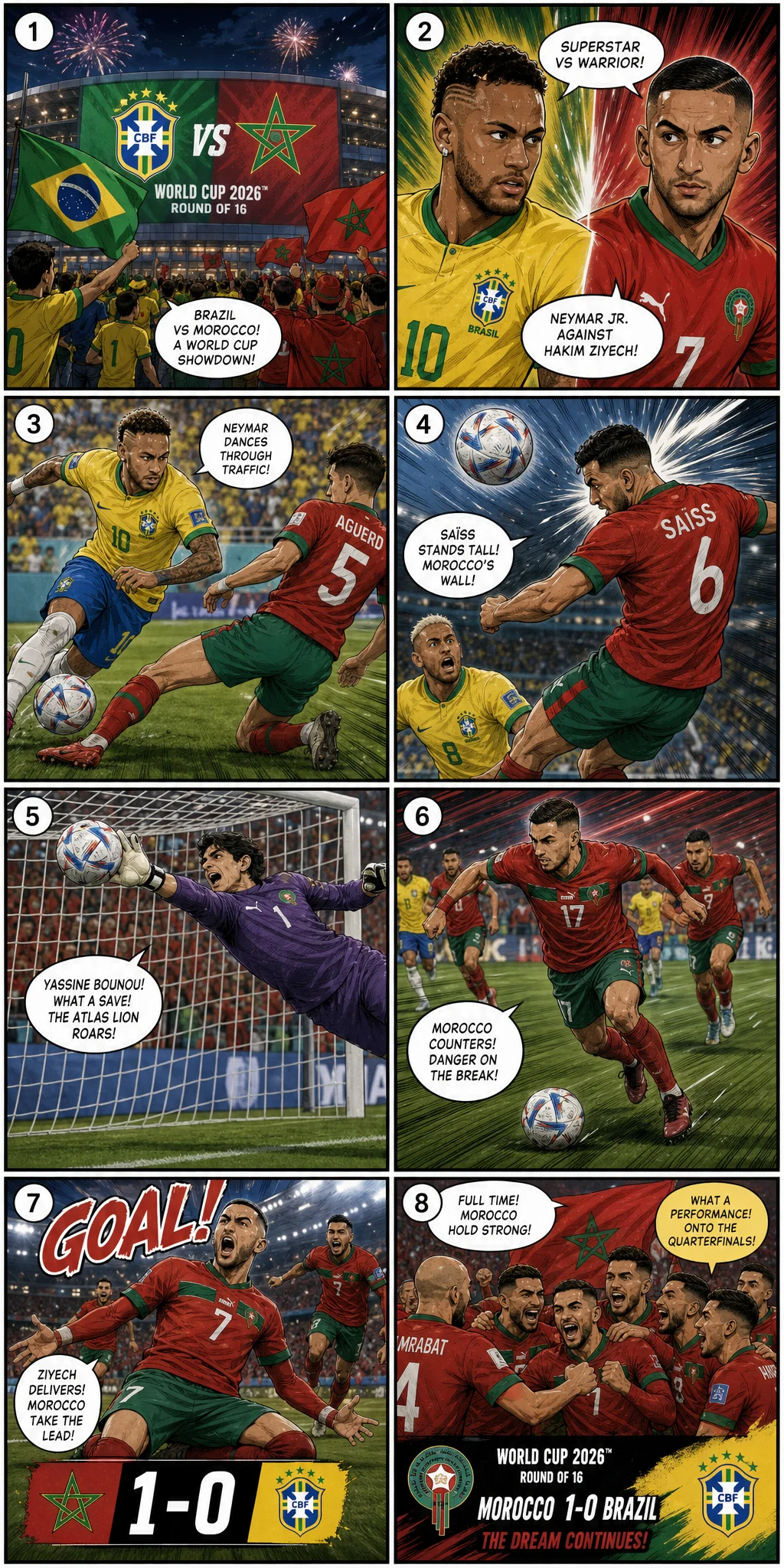
Comic content and match statistics are for entertainment purposes only and may contain inaccuracies. For Accurate Data, please refer to the reference's official website.
# Brazil vs Morocco: Group C Opener — A Rematch of Civilizations at the Azteca
The Estadio Azteca has seen things. It has held its breath for Maradona's Hand of God and the other one, the one that made grown men weep. It has watched Pelé lift a trophy as a teenager and it has absorbed the roar of 114,000 souls during the 1970 final, when Brazil's golden generation stitched together the most beautiful ninety minutes football has ever produced. But on this June evening in 2026, the old concrete giant — the only stadium to host three World Cup openers — is being asked to witness something genuinely new: Brazil, the eternal purveyors of jogo bonito, facing a Morocco side that no longer needs anyone's invitation to football's top table.
I arrived at the Azteca three hours before kick-off and the altitude hit me first. Mexico City sits at 2,250 metres. You climb the stairs to the press box and your lungs remind you that you are not in Rio, not in Casablanca, not anywhere sea-level football makes sense. The players felt it too, though Brazil's preparation camp in Teresópolis deliberately included altitude chambers and Morocco spent ten days acclimatising in Toluca. Nobody is leaving anything to chance. That is the first thing you need to understand about this fixture: the Morocco that stunned Belgium, Spain, and Portugal in Qatar is not the Morocco that arrives hoping. This Morocco arrives expecting.
Brazil under their new manager have been a puzzle wrapped in yellow. The 2022 quarter-final exit to Croatia — that penalty shootout that still haunts Marquinhos in his sleep — forced a reckoning that the Selecao are still navigating. The individual brilliance remains staggering. Vinicius Junior cuts inside from the left like a knife through warm butter, his close control at speed something that cannot be coached, only marvelled at. Rodrygo floats between the lines with the casual elegance of someone who finds professional football mildly amusing, his touches so soft they barely disturb the grass. And Endrick, the boy from Brasilia who kicks a ball as though it owes him money, brings the kind of raw power that makes defenders reconsider their career choices. But the question — and there is always a question with modern Brazil — is whether the system serves the talent or the talent papers over the cracks in the system.
Morocco's coach Walid Regragui has built something different, something that feels permanent rather than miraculous. It is a team that defends not as a last resort but as a first principle, a collective that squeezes space until opponents suffocate. In Qatar, they conceded one goal from open play across five matches before the semi-final — one, against the combined attacking talent of Croatia, Belgium, Spain, and Portugal. The back four, anchored by the indomitable Achraf Hakimi, whose overlapping runs from right-back are powered by what appears to be an internal combustion engine, operates with the synchronicity of a string quartet. They know exactly when to step up, when to drop, when to spring the trap.
The tactical tension writes itself. Brazil want the ball — Brazil always want the ball. Vinicius will drift into that left channel where Hakimi operates, and the duel between those two, Real Madrid teammate against Real Madrid teammate, a training-ground rivalry transplanted onto the World Cup's grandest stage, is worth the admission price alone. Morocco will concede possession, absorb, and then release. Their transitions are not hopeful punts. They are surgical counter-attacks, designed to find the spaces Brazil's marauding full-backs leave behind when the attack has pushed too high and the midfield has not tracked back.
The Azteca crowd complicates the calculus. Mexico City's football public is famously knowledgeable and famously partisan, and there are enough Moroccan flags in the stands to suggest the Atlas Lions have adopted a second home. The Moroccan diaspora in North America has travelled in numbers — buses from Chicago, flights from Montreal, a caravan of supporters who remember watching the 2022 run on television and refused to miss the chance to see it in person. Brazil's support, as always, is global and loud and dressed in variations of yellow that range from canary to mustard to something that might have been white once, thirty years and a thousand washes ago.
What makes this match matter beyond the three points is the narrative arc it extends. Morocco's semi-final in 2022 was treated by some as a miracle. Regragui, with characteristic steel, rejected that framing at every opportunity. Miracles happen once. Systems repeat. A result here — even a draw against Brazil at the Azteca — would be another step in the normalisation of African and Arab football at the highest level, proof that Qatar was not a peak but a plateau. For Brazil, it is about reclaiming a sense of inevitability that the Selecao used to carry like a birthright and that the last two decades have slowly but steadily eroded.
The ball will roll at the Azteca, and two football cultures that have never met at a World Cup will finally collide. One built on individual expression nurtured on beaches and futsal courts, where the ball is treated as a friend rather than a tool. The other forged in the crucible of a coach who told his players that defending is not a sacrifice but an art form, that closing down space is as beautiful as a through-ball. The altitude will burn lungs. The nerves will fray. And somewhere in the old stadium's concrete bones, the ghost of the 1970 final will be watching, wondering if either of these teams can produce something worthy of the memory.