
Haiti vs Scotland - Group C Preview
The history of football is studded with returns — nations emerging from the wilderness to reclaim a place they once occupied — but Haiti's reappearance at a World Cup finals, fifty-two years after their solitary appearance in 1974, belongs to a rarer
Published: June 6, 2026
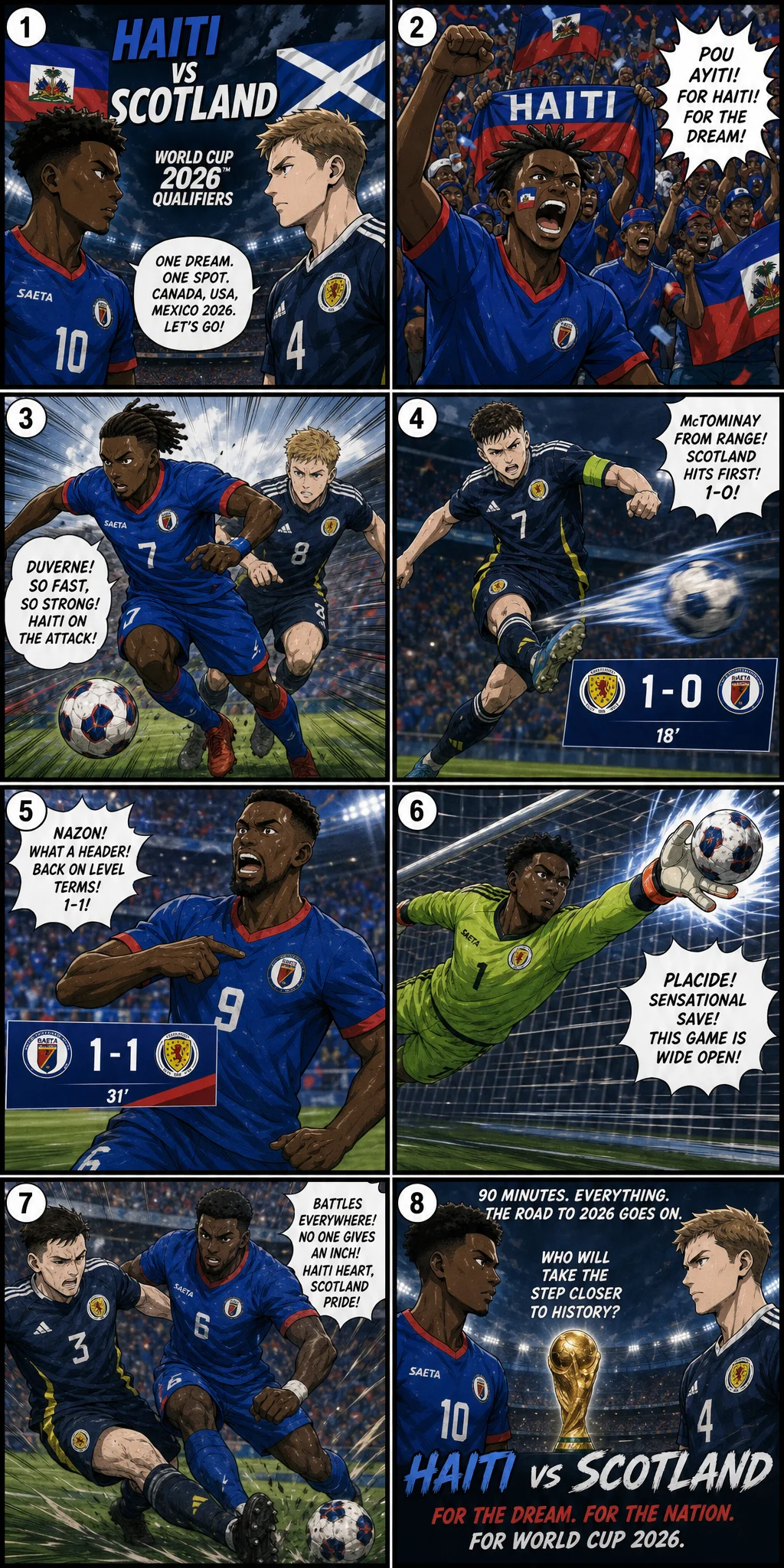
Comic content and match statistics are for entertainment purposes only and may contain inaccuracies. For Accurate Data, please refer to the reference's official website.
# Scotland vs Haiti: 52 Years of Absence Meets 28 Years of Longing — Group C at Gillette Stadium
The history of football is studded with returns — nations emerging from the wilderness to reclaim a place they once occupied — but Haiti's reappearance at a World Cup finals, fifty-two years after their solitary appearance in 1974, belongs to a rarer category. It is not merely a sporting comeback. It is a testament to survival, to the stubborn insistence that a football team can represent a nation even when that nation's institutions are barely functioning, when the players are scattered across continents, and when the coach has never set foot on Haitian soil.
Haiti's 1974 campaign in West Germany ended with three defeats: Italy 3-1, Poland 7-0, Argentina 4-1. The scorelines suggested a team out of its depth, but the scorelines, as they so often do, concealed the context. Emmanuel Sanon's goal against Italy — the first goal Dino Zoff had conceded in 1,142 minutes of international football — was a moment of genuine sporting significance, a Haitian forward breaking the longest clean-sheet streak in the history of the game, in a World Cup match, against the eventual tournament runners-up. The goal did not change the result. It did something more important: it announced that Haitian football had arrived, even if the institutional infrastructure to sustain that arrival did not yet exist.
The fifty-two years since have been a study in institutional fragility. Haiti qualified for the 2026 tournament under conditions that would have broken most football federations. All home qualifiers were played at neutral venues due to the domestic security crisis that has rendered Port-au-Prince ungovernable by any reasonable standard. Coach Sebastien Migne conducted all tactical preparation via video calls — installing a 4-3-3 system, selecting line-ups, managing squad morale, all through the cold mediation of a screen. The players congregate only for international windows, a nomadic tribe gathering for the flag. Captain Johny Placide, the 38-year-old goalkeeper at SC Bastia, has become more than a player. He is a spiritual anchor, a reminder that representing Haiti is an act of defiance against circumstances that make representation nearly impossible.
Scotland's waiting has been different in nature but similar in its psychological weight. Twenty-eight years since France 1998, when Craig Brown's team opened against Brazil at the Stade de France and lost narrowly in a match that felt, at the time, like a beginning rather than an end. The intervening decades have produced a catalogue of near-misses that Scottish football has processed through its characteristic blend of gallows humour and stubborn hope. Steve Clarke changed the trajectory when he arrived in 2019, converting a generation of individually talented players into a collective that performs reliably against opposition of similar quality. The 4-2-3-1 system is neither revolutionary nor particularly expressive, but it functions — and for a nation whose football identity was defined for two decades by heroic failure, "it functions" represents a significant upgrade.
The midfield is where Scotland's quality concentrates. Scott McTominay's reinvention at Napoli — Serie A Footballer of the Year for 2024/25, a midfielder who left Manchester United as a utility player and arrived in Italy as a goal-scoring revelation — is the most dramatic individual transformation in Scottish football since Kenny Dalglish. John McGinn's engine, that deceptive combination of physical sturdiness and off-ball intelligence, provides the defensive cover that enables McTominay's forward runs. Andy Robertson remains, at his best, the most creative full-back Scotland has ever produced, though Liverpool's demanding season has raised questions about the miles on those legs.
Haiti's threat comes through transitions. Jean-Ricner Bellegarde, the lone Premier League regular in the squad, operates as a creative fulcrum whose close control in tight spaces opens passing lanes that more direct approaches would never discover. Duckens Nazon, the all-time leading scorer with 44 international goals, has survived and thrived in Iran's professional league — a destination that tells its own story about the limited pathways available to Haitian footballers. Wilson Isidor's decision to switch allegiance from France, where he was born and developed, to Haiti, where his family's roots lie, mirrors the broader diaspora narrative that defines this squad.
The match at Gillette Stadium pairs two teams for whom presence is itself a victory and for whom the group stage represents an opportunity rather than a ceiling. Scotland should win on talent. Haiti could win on spirit. The gap between should and could, in a tournament that routinely erases such distinctions, is where this match will be decided. Two nations that have waited too long will not yield easily. The waiting has been too long for easy yielding.