
USA vs Paraguay: The Host's Pressure Test
The United States opens its home World Cup against the most reliably awkward opponent in South American football, and the tactical problem presented by Paraguay is more specific than most American analysts have acknowledged. Paraguay's defensive syst
Published: June 6, 2026
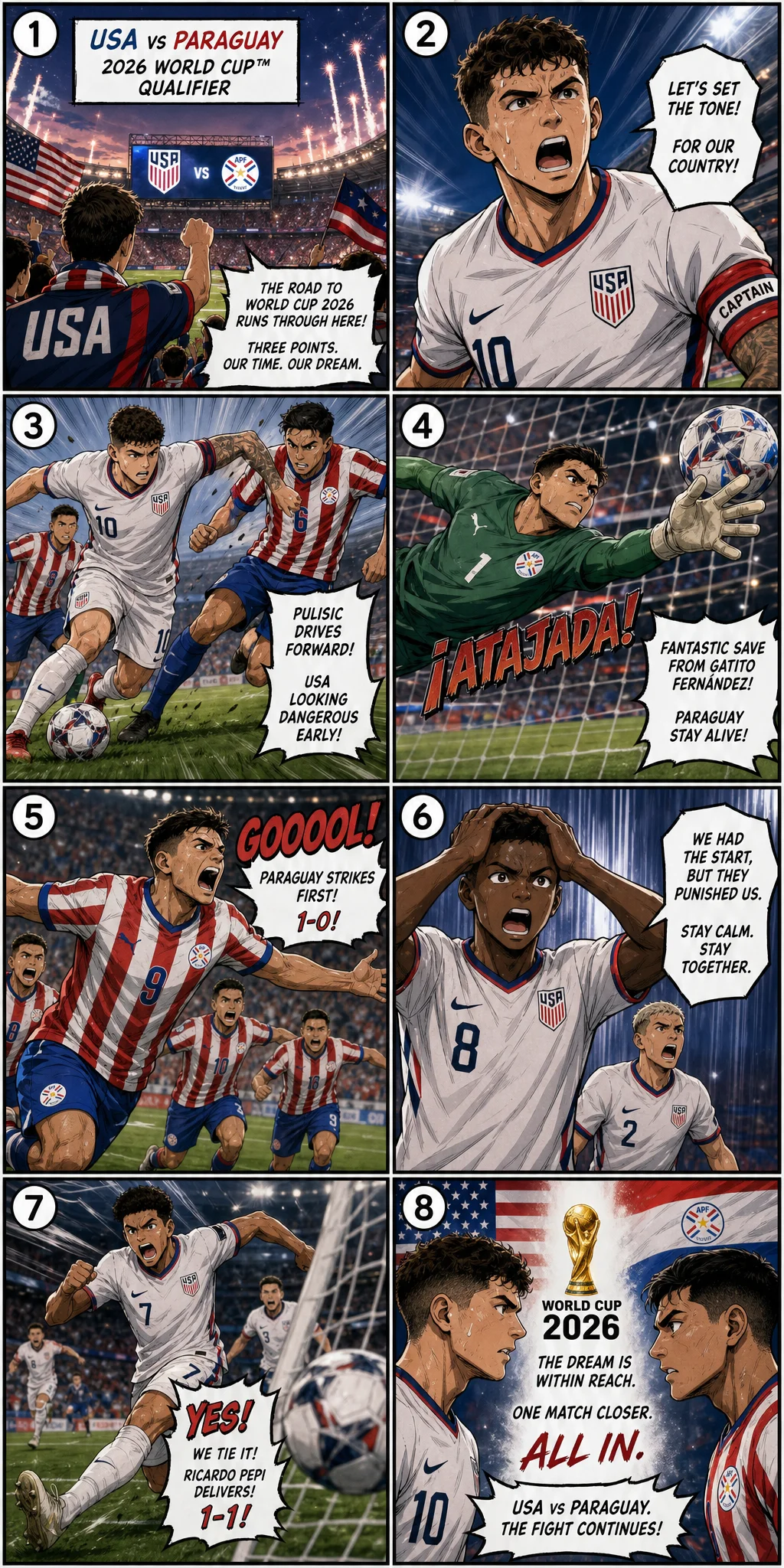
Comic content and match statistics are for entertainment purposes only and may contain inaccuracies. For Accurate Data, please refer to the reference's official website.
# USA vs Paraguay: The Host's First Pressure Test — Group D Opens at SoFi Stadium
The United States opens its home World Cup against the most reliably awkward opponent in South American football, and the tactical problem presented by Paraguay is more specific than most American analysts have acknowledged. Paraguay's defensive system, honed across three decades of tournament football against opponents with superior individual talent, is not merely a low block designed to frustrate. It is a mid-block pressing structure that actively shapes the opponent's buildup, funneling possession into wide areas where the touchline becomes an extra defender and the cross — statistically the lowest-percentage scoring method in modern football — becomes the attacking team's primary output.
Paraguay's 4-4-2 in its defensive phase operates with a discipline that statistical models struggle to capture because it is not primarily a matter of individual defensive actions. The two banks of four maintain a separation of no more than ten metres — a figure that has been remarkably consistent across Paraguay's last three World Cup qualifying campaigns — and the compression eliminates the pocket of space between midfield and defence that creative number tens have exploited since the position was invented. The system concedes possession willingly. Paraguay has averaged forty-two percent possession in competitive fixtures over the last four years and has never, in any competitive match during that period, recorded a higher possession share than its opponent. This is not a flaw. It is a design principle, and it is a principle that has enabled Paraguay to compete with Brazil and Argentina in South American qualifying conditions that are among the most hostile in international football. The Paraguayan approach at SoFi Stadium will be exactly what the American scouting reports expect: compact, patient, dangerous on the counter, and entirely unimpressed by the pageantry of an American home World Cup.
For the United States, the challenge is more psychological than tactical, though the tactical dimension is significant. Playing a World Cup match on home soil, at SoFi Stadium in Los Angeles, with a nation's expectations strapped to shoulders that have never carried comparable weight, against a team that genuinely does not care about American narratives — this is a scenario for which no amount of training-camp preparation can fully prepare a squad. The USMNT's core players have experienced hostile crowds in Champions League knockout ties and Liga MX away fixtures, have played at the highest levels of European club football and understand the specific pressure of representing a nation that expects results. But the specific pressure of being the host nation, of representing not merely a team but a tournament, of carrying the emotional investment of a country that has spent years preparing for this moment — this is a variable that exists outside the standard competitive framework and that cannot be simulated in any training environment.
Christian Pulisic remains the attacking reference point, a wide forward whose best work comes when he receives between the opposition right-back and right-sided centre-back — precisely the channel that Paraguay's compact defensive structure is designed to close. The solution, and it is a solution that requires patience the American sporting public has historically been reluctant to grant, is to overload that channel with the left-back pushing high and a midfielder rotating wide, forcing the Paraguayan shape to stretch horizontally and thereby creating the central spaces the initial defensive structure had eliminated. Weston McKennie's late runs into the box from midfield represent the secondary threat, but they also represent the defensive vulnerability: when McKennie advances, the space behind him must be covered, and Paraguay's transitions through wide areas — Miguel Almiron carrying the ball at speed, Julio Enciso making the diagonal run from left to centre — are specifically designed to exploit exactly this moment of American defensive transition.
The first goal determines everything, and this is not a cliche in this specific tactical context. A Paraguay that concedes first must abandon the defensive shape they have mastered, pushing higher and wider in search of an equaliser — at which point the match becomes a fundamentally different tactical problem, one for which Paraguay's system was not designed. A US that concedes first faces the prospect of breaking down a well-drilled defensive block that will defend its lead with the specific commitment that Paraguay's football culture has refined across decades of tournament competition, while carrying the psychological burden of a nation that will not accept a scoreless opening match as a reasonable outcome. The Americans must manage this match with a patience that tournament openers demand, that American sporting culture has never fully valued, and that Paraguay's system is specifically calibrated to exhaust. SoFi Stadium will be loud. The tactics will be quiet. The outcome will depend on which team imposes its preferred rhythm on the match, and the first twenty minutes — the period when Paraguay's defensive structure is settling and America's attacking patterns are being tested against live competition — will determine the direction of everything that follows. The host nation's tournament begins with ninety minutes against the most uncomfortable opponent the draw could have provided. The Americans asked for a home World Cup. They are about to discover what it actually demands.