

Australia vs Turkiye: The Weight of Absence
Australia versus Turkey at the 2026 World Cup is a match between two football nations that have been defined, across decades of international competition, as much by what they have lost as by what they have achieved. It is a fixture that invites hist
Published: June 6, 2026
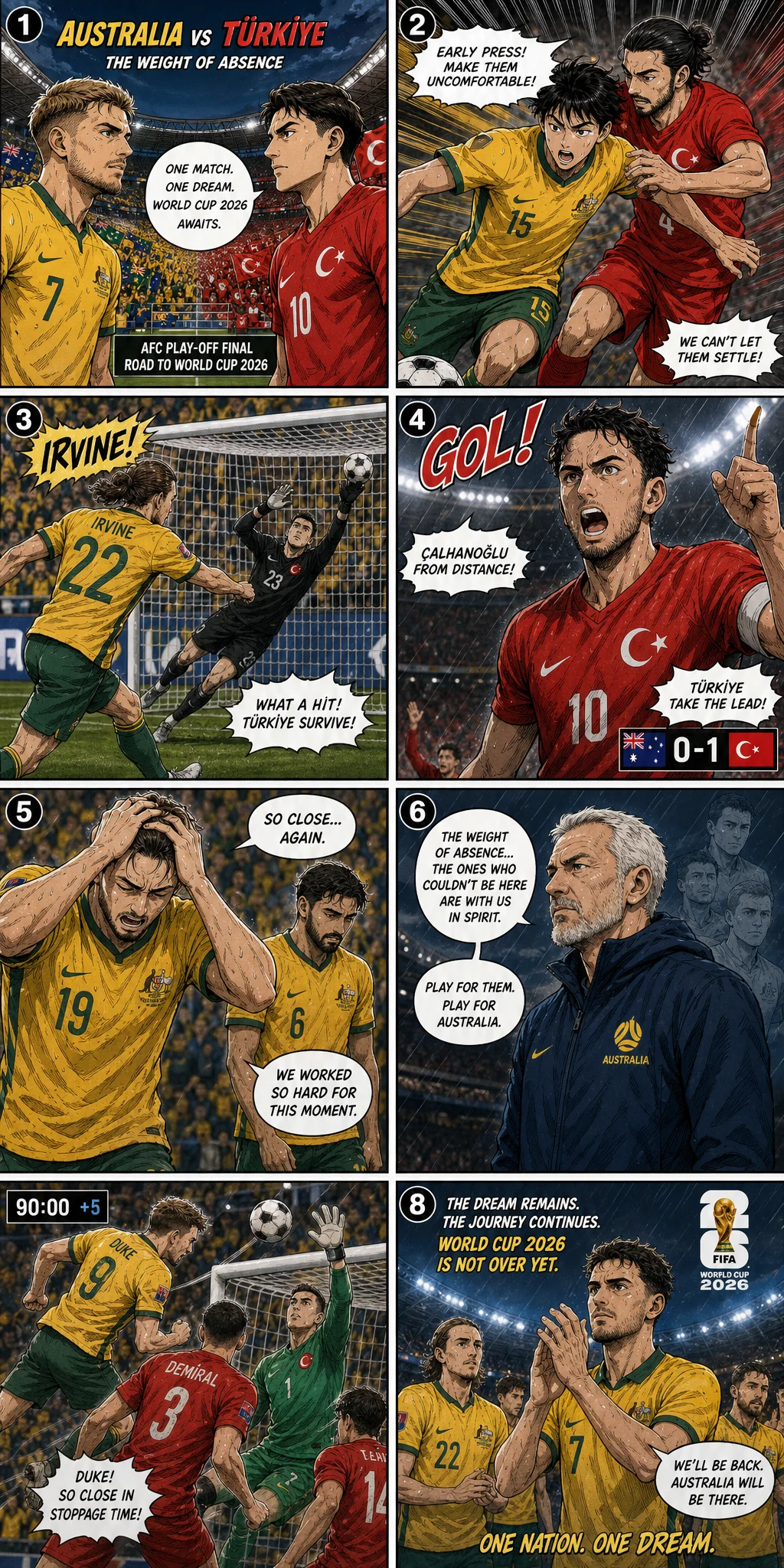
Comic content and match statistics are for entertainment purposes only and may contain inaccuracies. For Accurate Data, please refer to the reference's official website.
# Australia vs Turkey: The Weight of Absence — When Two Nations Chase What They've Lost
Australia versus Turkey at the 2026 World Cup is a match between two football nations that have been defined, across decades of international competition, as much by what they have lost as by what they have achieved. It is a fixture that invites historical reflection because the present conditions of both teams cannot be understood without it — and the history, in both cases, circles around a single luminous tournament that subsequent generations have failed to replicate.
Australia's golden generation was never officially declared as such, which may explain why its ending was processed as disappointment rather than the natural conclusion of an extraordinary cycle. Tim Cahill scored in three consecutive World Cups, a feat achieved by only a handful of players in the tournament's history — his volley against the Netherlands in 2014, struck with the outside of his right foot from a dropping ball delivered from thirty-five yards, belongs in any serious catalogue of great World Cup goals. Mark Schwarzer's reliability in goal, the specific solidity of Lucas Neill at centre-back, the unlikely tournament runs that carried the Socceroos to the 2006 round of sixteen and the 2015 Asian Cup title on home soil — these achievements established a baseline that the current generation has inherited as burden rather than inspiration. Graham Arnold's team does not possess a game-breaker of Cahill's calibre. What it possesses, and what Australian football has always possessed in its most successful iterations, is organisation, physical resilience, and the specific competitive stubbornness that makes Australia difficult to beat and exhausting to play against.
Turkey's relationship with its football history is more volatile, more emotionally charged, in ways that reflect the nation's broader cultural identity. The 2002 World Cup semifinal — a third-place finish secured by Hakan Sukur's goal after eleven seconds against South Korea, still the fastest goal in World Cup history — remains a luminous anomaly in a record characterised by qualification failures, internal turmoil, and the specific frustration of a football culture whose domestic passion far exceeds its international returns. Turkey's football passion is not a cliché. It is a measurable phenomenon: the noise levels recorded at Galatasaray's Rams Park and Fenerbahce's Sukru Saracoglu Stadium consistently rank among the highest in European football, the supporter culture is genuinely distinctive, and the talent production pipeline — the youth academies of the Istanbul giants, the diaspora recruitment system that identified and developed players of Turkish heritage across Germany, the Netherlands, and Austria — has produced a generation that should, on paper, outperform any Turkish squad in history.
Vincenzo Montella's 4-2-3-1 system encapsulates the Turkish football paradox. On its best days — Hakan Calhanoglu dictating tempo from deep midfield with the passing range of a player who sees angles others do not, Arda Guler drifting between the lines with the creative ease of a teenager who has not yet learned that professional football is supposed to be difficult, Kerem Akturkoglu's explosive wide play providing the vertical threat that stretches defences — the system looks genuinely dangerous, capable of troubling any opponent in the tournament. On its worst days, the defensive structure collapses in ways that organised opponents systematically exploit: the full-backs caught high, the central midfielders failing to track runners, the centre-backs isolated against counter-attacks that develop faster than the Turkish defensive transition can reorganise.
The tactical matchup favours Australia's organisation over Turkey's volatility, but volatility is by its nature unpredictable, and that is precisely what makes this fixture so compelling. Australia will attempt to impose a controlled tempo, to defend in a compact 4-4-2 block, to score from set pieces delivered onto Harry Souttar's head — the most reliable Australian attacking weapon since Cahill's aerial dominance. Turkey will attempt to impose chaos, to create the broken-play sequences in which Calhanoglu's vision and Guler's creativity can find the spaces that controlled defensive structures were designed to eliminate. Both teams have identified this match as their most winnable group fixture. Both understand that losing likely means elimination. The result will depend on which team handles the weight of necessity better, and necessity, in tournament football, has a way of revealing truths that qualifying campaigns successfully conceal.