
USA vs Australia: The Host's Identity on Trial
The United States versus Australia is a tactical mirror that reveals more about both teams than either wants to acknowledge. Both nations build football identities around athleticism, organization, and the specific chip of being underestimated by the
Published: June 6, 2026
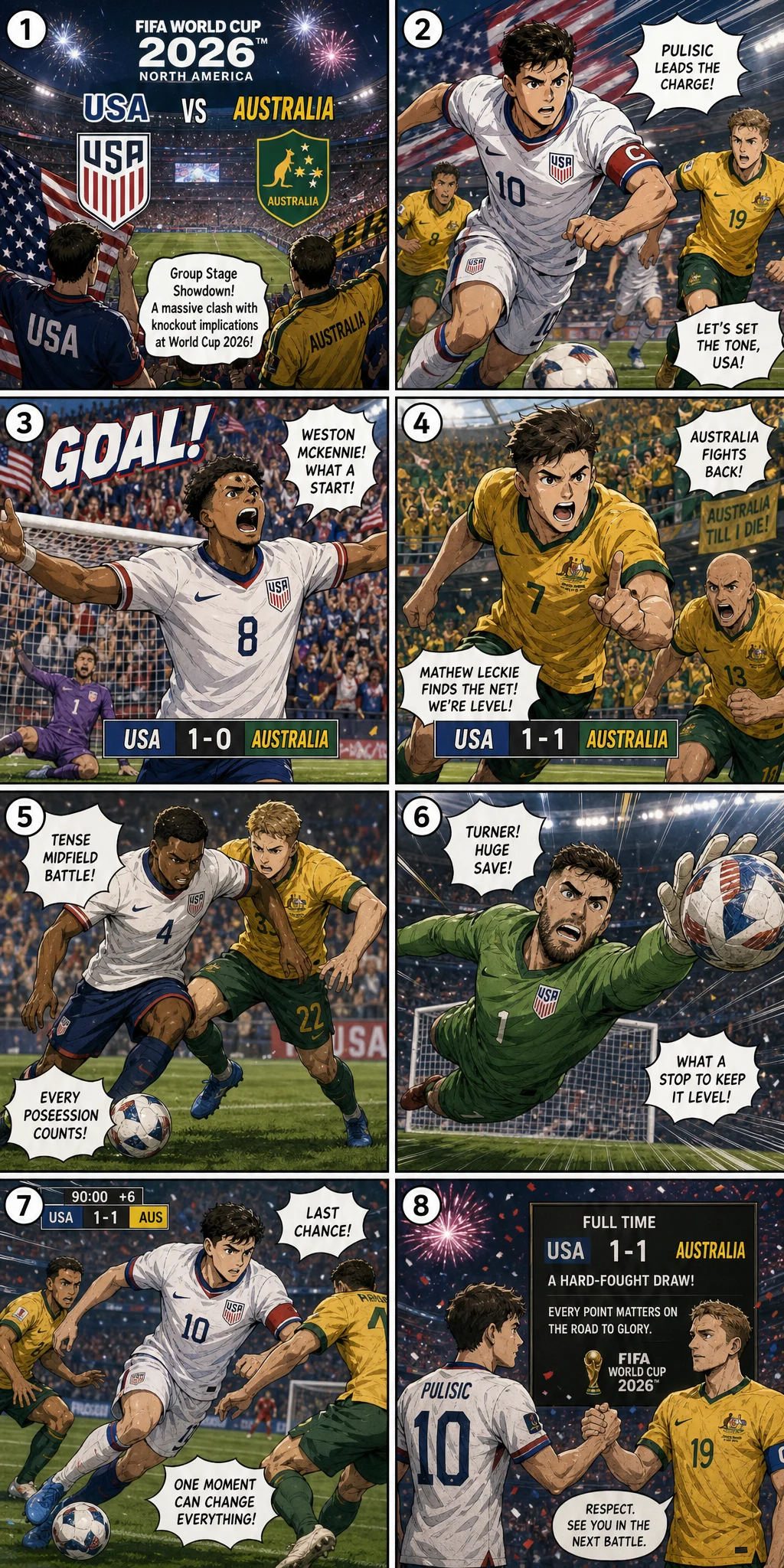
Comic content and match statistics are for entertainment purposes only and may contain inaccuracies. For Accurate Data, please refer to the reference's official website.
# USA vs Australia: The Host's Identity on Trial — Mirror Match in Kansas City
The United States versus Australia is a tactical mirror that reveals more about both teams than either wants to acknowledge. Both nations build football identities around athleticism, organization, and the specific chip of being underestimated by the global football establishment. Both lack the creative genius of a Messi or Mbappé and compensate through collective intensity and physical output. When two teams constructed on identical principles meet, the result measures which team executes its shared identity more effectively.
Australia will not park the bus. Graham Arnold's Socceroos will press higher than Paraguay did in the American opener, testing whether the US midfield can control games against opponents who refuse to be intimidated. Jackson Irvine and Riley McGree in the Australian double pivot will target the space behind Weston McKennie when he pushes forward — the defensive vulnerability that opponents have exploited since the 2022 World Cup. Harry Souttar's aerial presence on set pieces challenges an American backline lacking a dominant header of the ball. For the United States, Christian Pulisic must find space against a defense that will not concede it willingly. McKennie must balance attacking instincts with defensive responsibility. Balogun's finishing — clinical at Monaco, unproven at international level — receives the chances that elite strikers convert and developing strikers miss. Home advantage and marginally superior individual quality tilt the balance toward the United States. Australia's tournament experience tilts it back. The result reveals whether the host nation can compete or merely participate.
The mirror that this match holds up to both nations is uncomfortable because it reflects truths that both football cultures prefer to avoid. The United States has spent three decades building a football infrastructure — the youth academies, the professional league, the coaching education system, the player development pathway that runs from MLS academies through European transfers — designed to produce exactly the kind of technically proficient, tactically intelligent, physically dominant football that the world's elite nations produce as a matter of course. The investment has been enormous. The results have been promising but incomplete. The 2022 World Cup — a round-of-sixteen appearance, a competitive defeat to the Netherlands that demonstrated how far American football had come and how far it still had to travel — was simultaneously the best American men's World Cup performance in a generation and a reminder that the gap between the United States and the world's elite remains significant. The 2026 tournament, on home soil, with a generation of players who have accumulated European experience across the Premier League, Serie A, the Bundesliga, and La Liga, is supposed to be the moment when the investment matures into achievement. The Australia match is not, in competitive terms, the most important fixture of the American tournament — the knockout rounds, if the United States reaches them, will carry higher stakes. But in symbolic terms, the Australia match is exactly the kind of fixture that the American project must win to validate its trajectory: a match against a team built on similar principles, competing with similar resources, pursuing similar ambitions. Lose, and the narrative of American football as perpetually promising and perpetually disappointing gains another chapter. Win, and the narrative begins to shift.
Australia's football identity has been forged through a different path but has arrived at a similar destination. The Socceroos spent decades as the dominant force in Oceania, winning qualification campaigns against opponents whose competitive level did not prepare them for the World Cup opponents they would face. The move to the Asian Football Confederation in 2006 was a competitive decision disguised as a geographic one: Australia recognized that playing competitive qualifiers against Japan, South Korea, Iran, and Saudi Arabia would develop the national team more effectively than another campaign of double-digit victories against Pacific island nations. The decision has been vindicated. Australia has qualified for every World Cup since 2006, has reached the knockout stage twice, and has established a competitive identity that opponents respect even when they expect to win. The 2022 campaign — victories over Tunisia and Denmark, a round-of-sixteen appearance against eventual champions Argentina, a performance against Lionel Messi that was narrowly and heroically insufficient — demonstrated that Arnold's Socceroos had evolved from the physical, direct team of previous generations into a more tactically sophisticated unit without sacrificing the physical qualities that have always defined Australian sport.
The tactical matchup that this mirror produces is fascinating precisely because both teams understand what the other is trying to do. Arnold's Australia will not sit deep and absorb pressure in the manner of a traditional underdog. The 4-3-3 or 4-2-3-1 system that Arnold has developed presses high, contests midfield aggressively, and transitions directly through wide areas where Martin Boyle and Craig Goodwin provide the pace and delivery that the system requires. The central midfield — Irvine and McGree, with Aaron Mooy's retirement creating a creative void that the current generation is still learning to fill — is designed to win physical battles and distribute quickly to the wide attackers. The defensive line, organized around Souttar's aerial dominance and Kye Rowles's recovery pace, is competent rather than exceptional, capable of defending set pieces and crosses but vulnerable to the quick, incisive passing combinations that the American attacking unit is designed to produce. Australia's approach to this match will reflect a team that respects its opponent without fearing it — a team that has competed with Argentina, France, and Denmark at the most recent World Cup and discovered that competing is possible, even when winning proves elusive.
For the United States, the specific tactical question is whether the midfield can control the match against an opponent that will contest every ball, challenge every pass, and refuse to be cowed by the home crowd. McKennie's role is particularly significant because it encapsulates the dilemma that has defined his international career. At his best, McKennie is a box-to-box force — winning possession in defensive areas, carrying the ball through midfield, arriving in the penalty area to finish chances that his forward runs create. At his worst, McKennie's forward runs leave gaps behind him that opponents exploit, his passing lacks the precision that international midfield demands, and his emotional intensity produces the yellow cards and disciplinary issues that have occasionally undermined his performances. Against Australia, McKennie must find the balance between attacking contribution and defensive responsibility — the specific calibration that the best box-to-box midfielders achieve instinctively and that developing midfielders achieve, if they achieve it at all, through painful experience. The Australian double pivot of Irvine and McGree will specifically target the space McKennie vacates when he pushes forward, and the success or failure of the American midfield will depend substantially on whether McKennie's attacking contributions outweigh his defensive vulnerabilities.
Pulisic's performance will be equally decisive and is subject to the specific pressure that accompanies his status as the face of American football. The AC Milan winger — or wherever his club career has deposited him by the summer of 2026 — is the most technically accomplished American player ever produced, a winger whose close control, dribbling ability, and capacity to score from wide positions represent qualities that no previous generation of American footballers possessed. But his international performances have been inconsistent in the specific way that creative players on teams that do not dominate possession are always inconsistent: brilliant in moments, peripheral in stretches, the player who can win a match with a single action and the player who can disappear for twenty minutes while his team struggles to get him the ball. Australia's defensive organization will be designed to deny Pulisic the space in central areas where his dribbling is most dangerous, forcing him wide where his passing options narrow and his shooting angles become more acute. Pulisic has faced this defensive approach throughout his international career. His capacity to overcome it — to find the spaces that defensive organization cannot completely eliminate, to produce the moments that justify his status — will determine whether the United States can generate the goals that home advantage and superior talent should produce.
Balogun's role as the central striker adds another layer of complexity to the American attacking equation. The Monaco forward — or wherever his career has progressed by 2026 — represents the specific quality that American football has historically lacked: a genuine penalty-box finisher, a striker whose movement in the six-yard box and whose capacity to convert the chances that Pulisic and the wide players create transforms American possession into American goals. His club form has been productive in ways that suggest the quality is real. His international form has been promising in ways that require World Cup validation. The chances will come against Australia — the American midfield and wide players will create opportunities, because they are talented enough to create opportunities against any opponent in Group D. The question is whether Balogun converts them, and the answer will determine not simply the result of this match but the trajectory of the American attacking unit for the remainder of the tournament. A striker who scores in his first World Cup match gains the confidence that makes subsequent goals more likely. A striker who misses chances in his first World Cup match carries the psychological burden of those misses into subsequent fixtures, and the burden compounds with each passing opportunity. The psychological dimension of Balogun's performance is as significant as the technical dimension, and the coaching staff's management of that dimension — the specific support that strikers require when the goals do not come immediately — will be tested as severely as the player himself.