
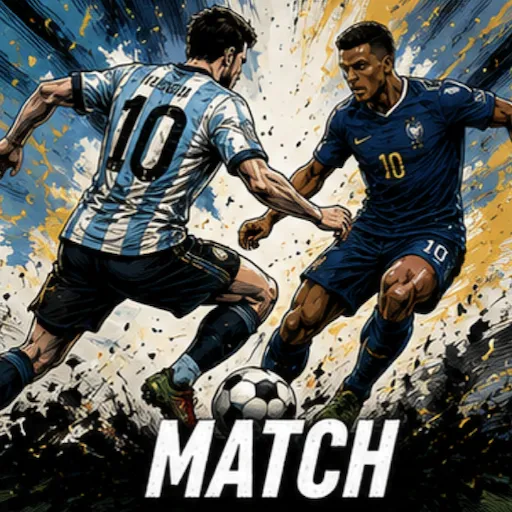
Turkiye vs USA: The Group D Decider
If Group D follows its expected script — and World Cup groups follow their expected scripts with the same reliability that Istanbul traffic follows lane markings — Turkey versus the United States will determine the group winner and, with it, the knoc
Published: June 6, 2026
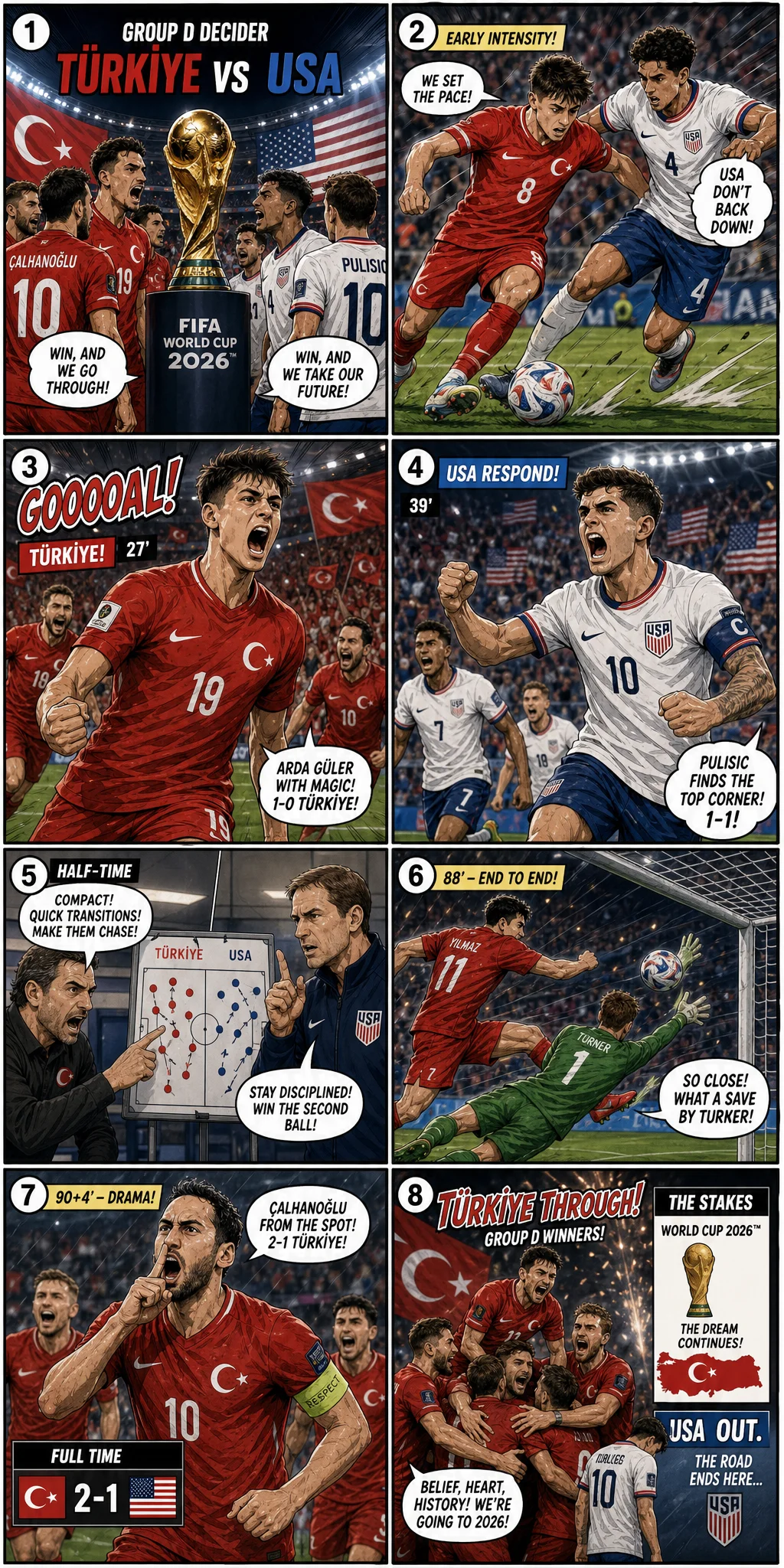
Comic content and match statistics are for entertainment purposes only and may contain inaccuracies. For Accurate Data, please refer to the reference's official website.
# Turkey vs USA: The Group D Decider — Volatility Meets Expectation
If Group D follows its expected script — and World Cup groups follow their expected scripts with the same reliability that Istanbul traffic follows lane markings — Turkey versus the United States will determine the group winner and, with it, the knockout path that shapes each nation's tournament ambitions. The match pairs the most unpredictable team in the tournament against a host nation playing under pressure that no tactical system can fully absorb, in a venue that will be overwhelmingly American, and the specific volatility that Turkey brings to every competitive fixture is the variable that no amount of video analysis can prepare for.
I have watched Turkish football for long enough to understand that analysing Turkey through the standard vocabulary of tactical systems and player profiles is like analysing a thunderstorm through the vocabulary of weather patterns — the description is accurate and entirely insufficient. Turkey under Vincenzo Montella can beat anyone or lose to anyone, often within the same international break, sometimes within the same match. Their 4-2-3-1 system produces attacking sequences of genuine quality — the kind of passing combinations that make you lean forward in your seat, the specific interplay that only football cultures with Turkey's improvisational DNA can generate — and defensive sequences that organised opponents systematically exploit. The tactical gap between Turkey's best and worst performances is the widest in international football. Montella has narrowed it, through the patient imposition of structural discipline on players whose instincts resist structure, but he has not eliminated it, and the question that follows Turkey into every meaningful fixture is whether the Montella version or the chaotic version will take the field.
The talent in this Turkish squad is the deepest the nation has produced since the 2002 generation that reached the World Cup semifinals. Hakan Calhanoglu, the Inter Milan midfielder whose set-piece delivery transforms corners and free kicks into scoring opportunities with a consistency that no other midfielder in Group D can match, provides the creative fulcrum. His passing range — the ability to deliver a ball from any position to any teammate with the specific weight and trajectory that creates goalscoring chances — is the quality that Turkey's attacking system is built around. Arda Guler, the Real Madrid prodigy whose creative movement between lines creates passing angles that organised defences struggle to close, represents the wildcard talent that can unlock a knockout match with a single moment of inspiration. The question, as it always is with Guler, is whether the moment arrives in the match where it is needed — Turkish football history is littered with prodigies whose moments arrived one match too late or one tournament too early.
For the Americans, the challenge is managing Turkish chaos: the unpredictable press triggers, the sudden transitions that emerge from positions that appear harmless, the individual quality of players developed in Europe's elite leagues who are capable of producing moments that no tactical preparation can anticipate. The specific danger is Calhanoglu's set pieces — the deliveries that find heads in crowded penalty areas with a precision that makes defending them a matter of positioning rather than reaction, and positioning against Calhanoglu's delivery is always imperfect because the delivery adapts to the defensive arrangement in real time. The secondary danger is Guler's creativity between lines, the passing angles that emerge from spaces that American defensive structure will have been designed to close but which Guler's movement creates through the specific quality of arriving where defenders are not.
For Turkey, the challenge is simpler and more difficult: produce the controlled, consistent performance against a motivated opponent in a hostile atmosphere that Turkish football history suggests is entirely possible and equally unlikely. The US must approach the match with the patience that tournament group deciders demand — the specific emotional regulation of a team that understands a draw is a good result and a loss is not catastrophic, the tactical discipline of a team that respects its opponent's capacity for chaos without being paralysed by it. The winner controls their knockout path. The loser faces a more difficult route. The pressure will be enormous, the crowd will be partisan, and the match will be decided by which version of Turkey takes the field — the tactically disciplined team that Montella has been building, or the volcanic force of nature that has defined Turkish football since its emergence on the global stage. The difference between those two versions is the difference between a comfortable American victory and the kind of chaotic classic that only Turkey can produce, and no one in the stadium — not the American players, not the Turkish bench, not the eighty thousand spectators — will know which version has arrived until the match is twenty minutes old.
Montella's project with Turkey deserves more attention than it has received, in part because the Italian manager has accomplished something genuinely difficult: he has imposed tactical structure on a team whose identity is built on tactical improvisation, and he has done so without extinguishing the improvisational spark that makes Turkey dangerous even when structure breaks down. His 4-2-3-1 is not, in its fundamentals, dramatically different from the systems deployed by Turkey's previous managers. The difference is in the details: the pressing triggers are more precisely defined, the defensive transitions are more coordinated, the positional rotations in possession are more rehearsed. Montella has not tried to turn Turkey into Italy — the defensive catenaccio that Italian managers have historically exported would be culturally alien to a Turkish squad whose identity is built on attacking expression. Instead, he has built a system that accommodates Turkish chaos within a structural framework that limits its destructive potential — a system where Calhanoglu's creative freedom is protected by a disciplined double pivot behind him, where Guler's improvisational movement is supported by positional rotations that create the space his movement requires, where the defensive vulnerabilities that improvisation creates are covered by tactical organization that previous Turkish teams have simply not possessed. The system works, when it works. When it does not work — when the chaos overwhelms the structure, when the individual errors that Turkish football has never been able to eliminate accumulate into collective collapse — the result is the kind of defeat that makes observers wonder whether the entire project is futile. The oscillation between these two outcomes is the defining characteristic of Turkish football, and Montella has not eliminated the oscillation; he has merely made the good version more frequent and the bad version less catastrophic.
Calhanoglu deserves specific recognition as one of the most underappreciated midfielders of his generation. His career at Bayer Leverkusen, AC Milan, and Inter Milan has established him as a player whose set-piece delivery ranks among the best in world football — a skill that is often dismissed as a niche specialty but that, in tournament football where set pieces decide a disproportionate percentage of knockout matches, is as valuable as any creative attribute. His corner delivery finds the specific trajectory that dips over the near-post defender and lands in the corridor of uncertainty where goalkeepers cannot claim and defenders cannot clear. His free-kick technique generates both power and precision, the combination that makes free kicks from thirty meters genuine scoring opportunities rather than speculative attempts. Against the United States, Calhanoglu's set pieces represent Turkey's most probable path to goal independent of open-play performance — a path that does not require Turkey to control possession, to build through midfield, or to solve the American defensive structure. The delivery is independent of context. The targets — Merih Demiral, Caglar Soyuncu, the physically imposing center-backs who arrive for set pieces with the specific intent that Turkish defenders have always brought to attacking dead balls — are independent of the tactical flow. The threat is permanent, and the American defensive preparation for that threat will be as extensive as any tactical adjustment the coaching staff makes.
Guler is the player who generates the most excitement among Turkish supporters and the most anxiety among Turkish coaches. The Real Madrid prodigy possesses the specific qualities that cannot be taught: the capacity to receive the ball in crowded central areas and emerge into space, the vision to see passing angles that defenders have not yet recognized, the technical execution to deliver the pass once the angle is identified. His development at Real Madrid has been managed with the caution that the world's most demanding club applies to its most promising young players — carefully calibrated minutes, specific tactical instructions, the gradual accumulation of experience against elite opposition. The question, as it always is with creative prodigies, is whether the international stage arrives at the right moment in his development — whether 2026 finds Guler ready to dominate World Cup matches or still developing the physical and tactical maturity that international football demands. The evidence from his club performances suggests readiness. The evidence from his international performances — the specific pressure of representing a football nation whose expectations always exceed its achievements — is less conclusive. The United States match will provide evidence that tilts the assessment in one direction or the other, and the direction will shape both Turkey's tournament and Guler's emerging legacy.
For the United States, the tactical challenge of this match is fundamentally different from the challenges presented by Paraguay and Australia. Paraguay defended deep and dared the Americans to break them down — a challenge that tested American creativity and patience. Australia pressed and contested — a challenge that tested American physicality and midfield control. Turkey presents a challenge that is both simpler and more difficult: an opponent that can be brilliant or dreadful, that can dominate possession or concede it willingly, that can produce moments of individual quality that no tactical preparation can anticipate and moments of collective collapse that no opponent can fail to exploit. Preparing for Turkey means preparing for multiple versions of the same team — the version that beat France in Euro 2024 qualifying, the version that lost to the Faroe Islands, the version that can produce both performances within the same week. The American coaching staff's preparation will include contingencies for every version, but the players who execute that preparation will not know which version they are facing until the match is underway, and the specific challenge of adapting in real time to an opponent whose identity shifts from minute to minute is the challenge that defines this fixture.
The home advantage that the United States enjoys in this match is significant and double-edged. The crowd will be overwhelmingly American — the host nation's supporters, augmented by the casual American sports fans who attend World Cup matches for the event rather than the football, will create an atmosphere that Turkish players have experienced in hostile European away fixtures but never at a World Cup. The energy of the crowd will lift the American players in the specific way that home crowds lift their teams: the extra five percent of running intensity, the fractionally quicker reactions, the psychological boost that transforms competitive contests into dominant performances. But home advantage also generates pressure of a specific kind — the pressure to perform for the fans who have paid premium prices, the pressure to justify the investment that the host nation has made in its football infrastructure, the pressure to deliver the result that the crowd expects. The American players have not experienced this specific pressure at a World Cup because no American player has played a home World Cup match in more than three decades. How the team responds to the pressure — whether it elevates performance or constricts it — will be as decisive as any tactical adjustment.