
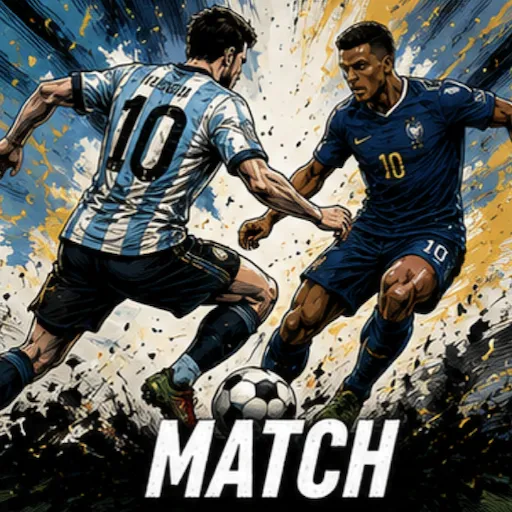
Paraguay vs Australia: The Survival Equation
Paraguay versus Australia is the kind of group-stage match that the expanded format was designed to produce: two nations that arrived with genuine hope of knockout qualification, that view advancement not as expectation but as achievement, meeting in
Published: June 6, 2026
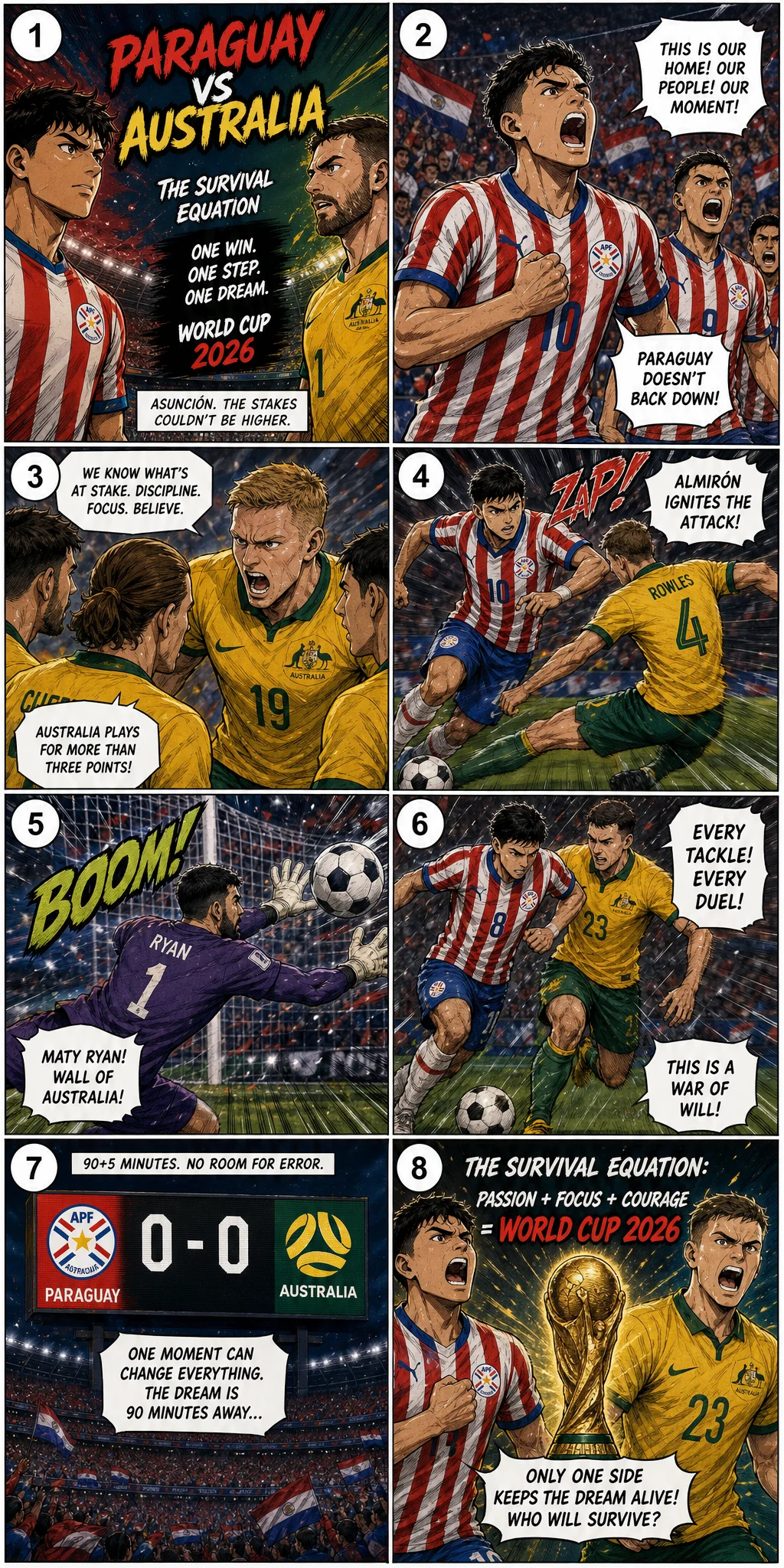
Comic content and match statistics are for entertainment purposes only and may contain inaccuracies. For Accurate Data, please refer to the reference's official website.
# Paraguay vs Australia: The Survival Equation — When Two Underdogs Play for Everything
Paraguay versus Australia is the kind of group-stage match that the expanded format was designed to produce: two nations that arrived with genuine hope of knockout qualification, that view advancement not as expectation but as achievement, meeting in a fixture where defeat means the near-certain end of a World Cup campaign and victory keeps the dream mathematically alive. The pressure is binary and the consequences are absolute. A draw serves neither team. Both will approach the match knowing that three points is the only acceptable outcome, and the tactical question that defines the fixture is which team can impose its preferred rhythm on a match where the stakes make rhythm almost impossible to sustain.
Paraguay's football identity has been remarkably consistent across three decades of international competition: defend, organize, frustrate, and counter. The 4-4-2 mid-block has been the tactical foundation of Paraguayan football since the 1998 World Cup campaign that announced the nation as South America's third competitive force. The system concedes possession willingly — Paraguay has never been interested in the ball, only in what opponents do with it — and transitions through wide areas with a speed that belies the defensive posture. Miguel Almiron, at thirty-two, remains the creative engine, a wide midfielder whose combination of dribbling volume and progressive carrying from deep positions creates the attacking transitions that Paraguay's system depends upon. Julio Enciso provides the vertical threat, the explosive acceleration in the final third that transforms Paraguayan counter-attacks from promising positions into scoring opportunities. The back four presses and retreats in synchronized discipline that has conceded fewer goals in South American qualifying than any team outside Argentina and Brazil — a statistic that captures the specific defensive competence that Paraguayan football has institutionalized across generations.
Australia arrives with a team built on physical resilience and collective organization, the specific qualities that have defined the Socceroos' football identity since their emergence as a regular World Cup participant in 2006. Graham Arnold's 4-4-2 system is designed around reliability rather than sophistication — the understanding that Australia cannot outplay technically superior opponents and must instead outwork them. Jackson Irvine and Riley McGree provide the midfield engine, the box-to-box running that covers the spaces between defense and attack and prevents opponents from establishing the controlled possession that Australian defensive structure is designed to deny. Harry Souttar's aerial presence on set pieces is the primary scoring threat — the towering centre-back whose heading ability transforms corners and free kicks into legitimate goalscoring opportunities against any opponent. The Australian game plan is straightforward: compete physically, defend set pieces with organization, attack set pieces with conviction, and trust that the cumulative pressure of Australian physicality will produce the moment that decides the match.
The tactical contrast is absolute and fascinating. Paraguay does not want the ball — possession invites pressure, and pressure creates the defensive errors that Paraguayan football has spent three decades learning to eliminate. Australia wants the ball in specific situations — set pieces, wide areas, the moments when Souttar's aerial presence can be deployed — but is comfortable conceding possession in the central areas where Paraguayan defensive structure is most effective. The match will be played at a tempo that neither team controls, the rhythm disrupted by fouls, set pieces, and the specific chaos that matches between two defensively organized and offensively limited teams inevitably produce. The first goal, if it arrives, will fundamentally alter the tactical architecture of the match. The team that scores first can retreat into the defensive structure it prefers. The team that concedes first must abandon its defensive comfort and chase the match in ways that expose the very vulnerabilities its system was designed to protect.
The winner keeps knockout qualification hope alive — not merely mathematically but emotionally, the specific momentum of a team that has won a must-win match and carries that confidence into its final group fixture. The loser, barring a mathematical miracle elsewhere, goes home after three matches. Paraguay's experience in tight, low-scoring tournament matches — the specific ability to manage the emotional rhythm of a fixture where a single moment decides everything, developed through decades of competing against Brazil and Argentina in matches where one goal is often enough — gives them a narrow but meaningful edge. Australia has built its tournament identity on winning matches exactly like this — the 2022 victories over Tunisia and Denmark, the playoff victory over Peru on penalties, the specific Socceroo quality of finding ways to win when the football says they should not. One team will be right about itself. The other will be eliminated before the group stage concludes, which is the specific cruelty of World Cup football compressed into ninety minutes of survival arithmetic.
Paraguay's football history at World Cups provides a context that enriches this fixture without determining its outcome. The Albirroja have reached the knockout stage in four of their last seven World Cup appearances — 1998, 2002, 2010, and the quarterfinal run of 2010 that remains the high-water mark of Paraguayan football achievement. The 2010 campaign, under Gerardo Martino, demonstrated the specific tournament formula that Paraguay has institutionalized: defensive organization of almost monastic discipline, counter-attacking efficiency that punishes opponents who commit numbers forward, and the specific goalkeeper quality — Justo Villar in 2010, the current generation's custodians — that transforms defensive organization into clean sheets. Paraguay has not won a World Cup knockout match since 2010, but the institutional memory of how to compete in tournament football — how to manage the emotional rhythms, how to approach a must-win fixture without being consumed by the pressure — remains embedded in the national team culture. The players who take the field against Australia were children when Paraguay was reaching quarterfinals, but the tactical identity they have inherited is the same identity that produced those achievements, and the continuity of approach is itself a competitive advantage.
Australia's tournament experience is different but equally valuable. The Socceroos have qualified for five consecutive World Cups since 2006, accumulating the specific institutional knowledge that repeated tournament participation generates. The 2006 campaign — a round-of-sixteen appearance, a narrow and controversial defeat to eventual champions Italy — established Australia as a competitive force. The 2010, 2014, and 2018 campaigns were less successful — group-stage exits, competitive but ultimately insufficient performances against opponents who possessed marginally more quality at the decisive moments. The 2022 campaign restored the trajectory: victories over Tunisia and Denmark, a round-of-sixteen appearance against Argentina, a performance against the eventual champions that demonstrated Australia's capacity to compete with the world's best without being overwhelmed by the occasion. The specific lesson of 2022 — that Australia can win World Cup matches against opponents from outside the traditional football powers, that the physical and organizational qualities that define the Socceroos translate into competitive results — is the lesson that Arnold's team carries into this fixture against Paraguay.
The midfield battle between Almiron and Irvine encapsulates the tactical contrast in a single individual duel. Almiron is a dribbler, a carrier, a player who receives the ball in deep positions and progresses through the thirds with the ball at his feet — the specific quality that Paraguayan counter-attacks require to transition from defensive organization to attacking threat. Irvine is a runner, a presser, a player who covers ground rather than carrying the ball — the specific quality that Australian midfield requires to deny opponents the time and space that creative players like Almiron need. The duel will not be direct in the sense of two players marking each other; it will be systemic, the Paraguayan transition game against the Australian pressing structure, and whichever system prevails in this specific battle will determine which team can impose its preferred rhythm on the match.
The set-piece dimension is significant and, in a match of such fine tactical margins, potentially decisive. Souttar's aerial threat is Australia's most reliable source of goals — the Stoke City and Leicester City center-back has scored more international goals than many strikers, and his specific combination of height, timing, and heading technique makes him a threat that no defensive organization can completely neutralize. Paraguay's defensive set-piece organization is excellent — the synchronized movement of the back four, the goalkeeper's command of the six-yard box, the specific attention to blocking assignments that prevents opponents from winning the first contact in dangerous areas. But Souttar represents a challenge that exceeds normal defensive parameters — a player whose aerial dominance is so pronounced that even perfect positioning may not prevent him from winning the header, and whose heading accuracy is sufficient that winning the header is frequently followed by scoring the goal. Paraguay's set-piece preparation will allocate specific attention to Souttar — a designated blocker, a zonal defender positioned to attack the ball before Souttar reaches it, perhaps even a second defender assigned to obstruct his run. The preparation is straightforward; the execution, against a player of Souttar's specific quality, is not.
The broader context of this match within the expanded World Cup format is worth considering. Under the thirty-two-team format, Paraguay and Australia might have been in a four-team group where a draw in this fixture could be compensated by results elsewhere — the mathematics allowing for recovery. Under the forty-eight-team format with three-team groups, every point is more precious and every dropped point is more damaging. The match carries elimination stakes that four-team group formats could defer to later fixtures. This is, in competitive terms, a more consequential match than the equivalent fixture would have been in any previous World Cup, and the specific pressure generated by that consequentiality — the knowledge that ninety minutes will determine whether a four-year cycle ends in achievement or disappointment — will be as present as any tactical factor. The players who manage that pressure most effectively will give their team an advantage that no amount of tactical preparation can replicate.