
Germany vs Côte d'Ivoire: Order Meets Chaos
Germany's Nagelsmann rebuild faces its most unpredictable group-stage test against a Côte d'Ivoire side embodying everything the German football machine has historically struggled to process: elite athletic intensity, transitional chaos, and the spec
Published: June 6, 2026
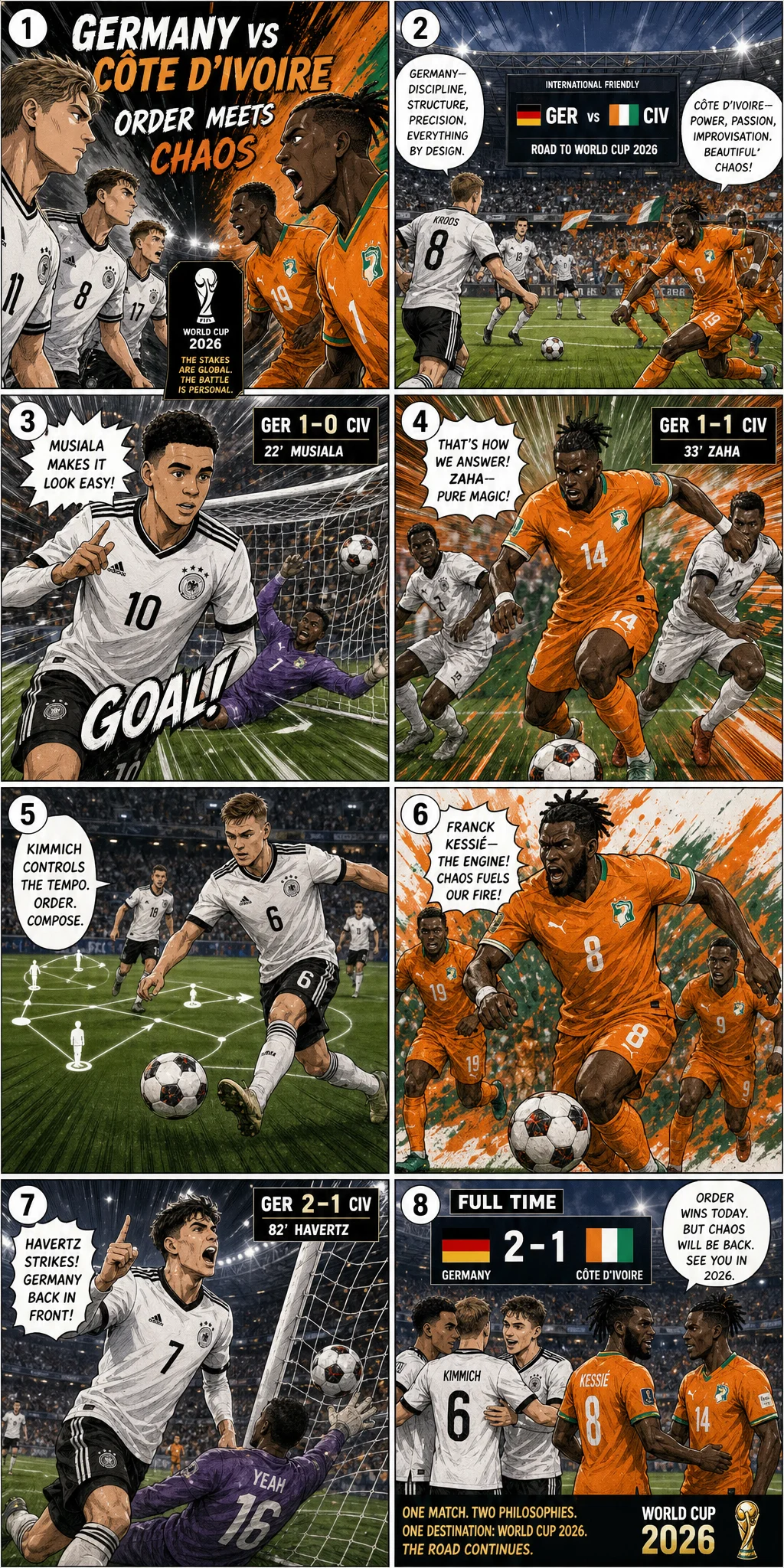
Comic content and match statistics are for entertainment purposes only and may contain inaccuracies. For Accurate Data, please refer to the reference's official website.
# Germany vs Côte d'Ivoire: When Order Meets Chaos — Nagelsmann's Machine Faces the Elephants
Germany's Nagelsmann rebuild faces its most unpredictable group-stage test against a Côte d'Ivoire side embodying everything the German football machine has historically struggled to process: elite athletic intensity, transitional chaos, and the specific confidence of a team that knows it cannot outplay the opposition — only outwork and outlast them. The tactical contrast is the most extreme of any Group E fixture.
Nagelsmann's Germany presses like a Bundesliga side on caffeine — high, chaotic, relentless, designed to force turnovers in the opposition half and punish disorganization instantly. Jamal Musiala operates between the lines with the fluidity of a player who has memorized every space before it opens. Florian Wirtz provides the complementary creative threat on the opposite side — less explosive than Musiala, more precise, the second violinist who knows exactly when to defer and when to take the melody. Kai Havertz, deployed as a false nine, drops deep to create numerical advantage in midfield while pulling center-backs into uncomfortable positions. The attacking system is sophisticated, well-drilled, and when it works, essentially unplayable. Côte d'Ivoire's plan is simpler: disrupt the German buildup through physical pressure in midfield, win the second balls that German positional rotations create, and transition with maximum speed through Sébastien Haller's hold-up play and Wilfried Zaha's direct running. The Ivorian midfield of Franck Kessié and Seko Fofana matches Germany's physical output and exceeds it in certain areas. Kessié's box-to-box coverage provides a defensive shield preventing the central overloads Germany uses to overwhelm opponents. For Germany, the risk is psychological rather than tactical — a loss would revive every fear about the post-2014 decline. The German players remember South Korea. They remember Japan. Côte d'Ivoire, unburdened by history or expectation, will play with the freedom of a team with nothing to lose and a continent's worth of belief to gain.
The German football machine's recent World Cup history is the inescapable context for this fixture and for every German match at this tournament. The 2014 triumph in Brazil — the 7-1 demolition of the hosts in the semifinal, Mario Gotze's extra-time winner against Argentina in the final, the culmination of a sixteen-year project initiated by Jurgen Klinsmann and perfected by Joachim Low — represented the apotheosis of German football's institutional excellence. The subsequent collapse — group-stage elimination in 2018 as defending champions, a defeat to South Korea that felt cosmically improbable and was statistically inevitable given Germany's performance level, another group-stage elimination in 2022 after a defeat to Japan that repeated the humiliation with an almost sadistic precision — represents the most dramatic institutional decline in modern football history. No defending champion had ever been eliminated at the group stage before Germany in 2018. No football superpower had ever missed consecutive knockout stages before Germany repeated the feat in 2022. The psychological weight of this history — the specific fear that the football machine is permanently broken, that the structural excellence that produced four World Cup titles and consistent semifinal appearances has been replaced by something inadequate and unreliable — hangs over every German touch, every German pass, every German defensive action.
Nagelsmann was appointed specifically to break this cycle, and his approach represents a departure from the Low era in ways both tactical and psychological. Low's Germany, in its later iterations, had become possession-obsessed to the point of paralysis — passing for the sake of passing, controlling the ball without creating danger, the specific sterility of a team that had forgotten that possession is a means rather than an end. Nagelsmann's Germany is more direct, more vertical, more willing to risk losing the ball in exchange for the attacking opportunities that risk creates. The high press is more aggressive, the defensive line is higher, the transition from defense to attack is faster. The system demands more from its players physically — the pressing intensity requires elite fitness and the specific willingness to run without the ball that Germany's 2018 and 2022 teams demonstrably lacked — but it also produces more chances, more goals, and the specific attacking momentum that makes opponents feel overwhelmed rather than merely controlled. The question is whether the system can function against an opponent that will not be intimidated by German reputation, that will contest every physical battle as though the outcome matters more than reputation, and that possesses the specific athletic qualities — pace in transition, power in midfield, aerial dominance on set pieces — that can exploit the spaces Nagelsmann's high defensive line inevitably concedes.
Côte d'Ivoire's football identity has evolved significantly since the golden generation of Didier Drogba, Yaya Touré, Kolo Touré, and Gervinho that defined Ivorian football from 2006 through 2014. That generation — physically imposing, technically accomplished, and perpetually disappointing at the tournament level where their talent should have produced more than three group-stage exits and a single Africa Cup of Nations title — established Côte d'Ivoire as Africa's most talent-rich football nation without ever translating that talent into the World Cup achievement that African football has been pursuing for two decades. The current generation is different: less individually brilliant but more collectively coherent, less dependent on a single superstar but more capable of the team performances that World Cup success requires. Haller's recovery from testicular cancer and his subsequent goalscoring form for Borussia Dortmund — the Champions League final appearance, the specific resilience of a player who faced mortality and returned to elite competition — provides an emotional core that transcends football. Zaha's direct running from wide areas, his capacity to beat defenders one-on-one and deliver the crosses and cutbacks that create goalscoring opportunities, provides the attacking threat that Côte d'Ivoire's counter-attacking system requires. Kessié's midfield presence — the box-to-box coverage, the physical authority, the specific capacity to win the ball and immediately transition into attack — provides the platform that enables Haller and Zaha to function. The team is not the sum of its individual parts in the way the Drogba generation was. It is greater than that sum, and the specific quality of a team that exceeds its individual components is exactly what World Cup success requires.
Kessié versus Germany's midfield is the individual matchup that may determine this fixture. The Al-Ahli midfielder — or wherever his post-Barcelona, post-Saudi Arabia career has deposited him — is one of the most physically dominant central midfielders in world football, a player whose combination of strength, stamina, and technical competence allows him to compete with any midfield opponent. Against Germany, Kessié's role is specifically defined: disrupt Musiala's reception between the lines, prevent Wirtz from finding the half-spaces, win the physical battles that German positional rotations are designed to avoid. Kessié cannot cover both Musiala and Wirtz simultaneously — no midfielder can — but his presence in the specific zones where German creativity operates most effectively can force the German attackers wide, where their creative options narrow and their goalscoring threat diminishes. The duel between Kessié and whichever German midfielder attempts to establish control — whether Joshua Kimmich operating from deep, whether Leon Goretzka providing the box-to-box thrust — will be a contest of physical authority against positional intelligence, and the outcome will determine whether Germany can impose its tactical will or whether Côte d'Ivoire can disrupt the German system before it establishes the rhythm that makes it effective.
The psychological dimension of this match is particularly significant for Germany and particularly favorable for Côte d'Ivoire. Germany carries the institutional trauma of 2018 and 2022 into every match at this tournament, the specific awareness that the football world is watching for signs of the old fragility, that another group-stage defeat — or even an unconvincing draw — would trigger the narrative cycle that German football has been trying to escape since the final whistle in Kazan. The players who experienced 2018 and 2022 — Manuel Neuer, Thomas Muller, Kimmich — carry the psychological scars of those tournaments, and the specific challenge of performing under the weight of institutional failure is a challenge that no tactical preparation can address. Côte d'Ivoire carries no such burden. The Elephants arrive at this match as underdogs, expected to lose but not expected to be embarrassed, free to compete without the specific pressure that expectation generates. The freedom of the underdog — the capacity to play without fear because defeat is the predicted outcome — is a genuine competitive advantage that Côte d'Ivoire will deploy against a German team whose every action will be scrutinized for evidence of the old fragility. The psychological asymmetry is as significant as any tactical factor, and the team that manages its emotional state more effectively will have an advantage that no formation or tactical adjustment can provide.
The set-piece dimension adds another layer of complexity to a match already rich with tactical and psychological variables. Côte d'Ivoire's aerial presence — Haller's heading ability, the center-backs arriving for attacking set pieces, the specific physical advantage that West African footballers have historically enjoyed in aerial contests — presents a threat that Germany's defensive set-piece organization must neutralize. German football's historical set-piece defending has been competent rather than exceptional, organized rather than dominant, and against an opponent whose most probable path to goal runs through dead-ball situations, competence may not be sufficient. The specific deliveries from wide areas, the specific movement in the penalty area, the specific physical mismatches that set pieces create — these represent Côte d'Ivoire's most reliable scoring mechanism independent of open-play performance, and Germany's preparation for this dimension of the match will be as extensive as any tactical work the coaching staff undertakes.