
Ecuador vs Curaçao: Steel Against the Waves
Ecuador versus Curacao is the kind of fixture that the forty-eight-team World Cup was designed to create: a collision between a South American nation building its football identity through geography and physical intensity, and a Caribbean island nati
Published: June 6, 2026
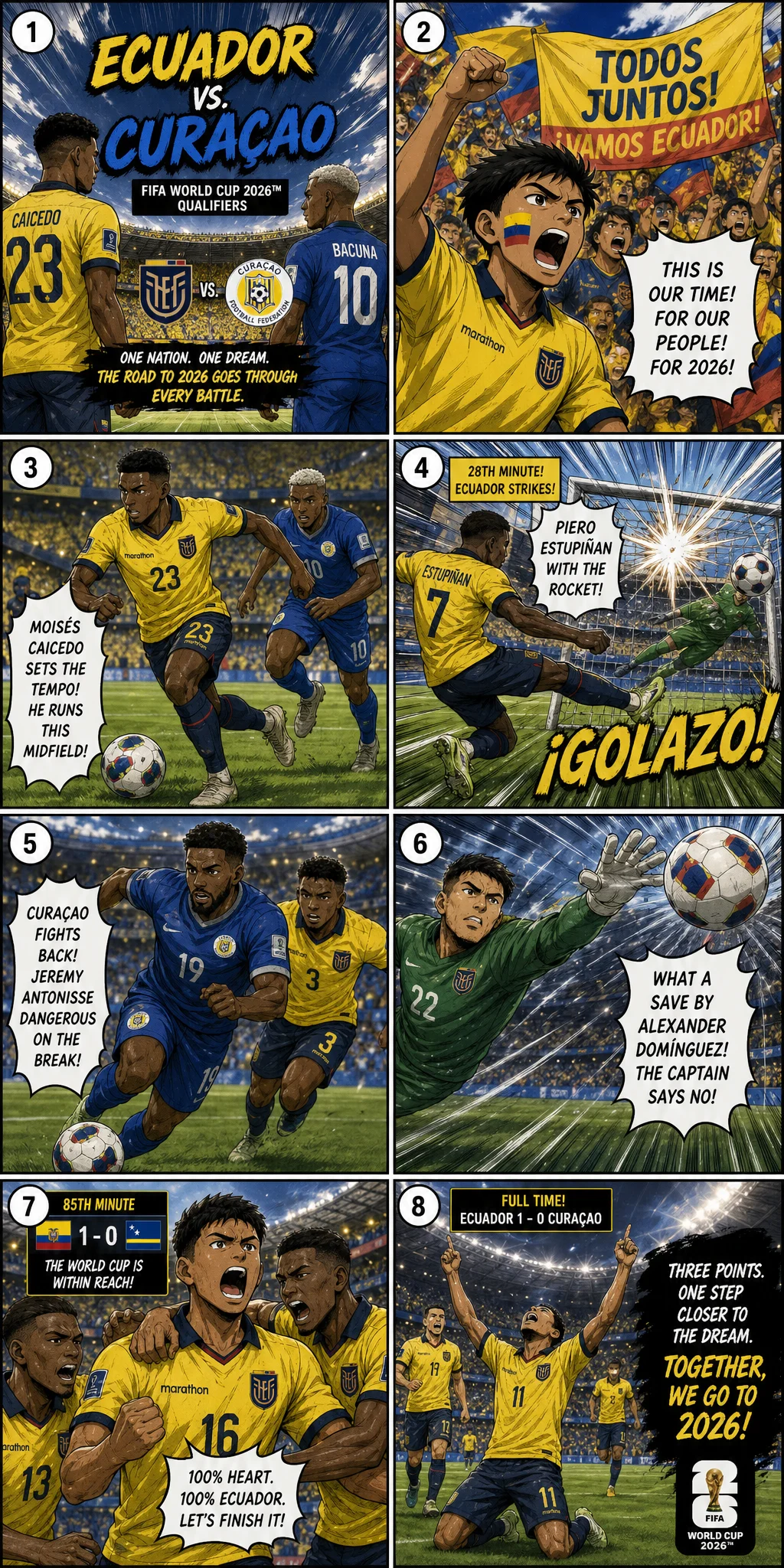
Comic content and match statistics are for entertainment purposes only and may contain inaccuracies. For Accurate Data, please refer to the reference's official website.
# Ecuador vs Curacao: The Match That Pits Continents Against Each Other
Ecuador versus Curacao is the kind of fixture that the forty-eight-team World Cup was designed to create: a collision between a South American nation building its football identity through geography and physical intensity, and a Caribbean island nation of 150,000 people playing a style of football inherited from a colonial power through diaspora and migration. The match is not expected to determine Group E's winner. It may well determine which of these two nations advances to the knockout stage as one of the eight best third-placed finishers, and the stakes of that possibility — a tiny island reaching the World Cup knockout stage — transcend any tactical analysis.
Ecuador arrives as a team constructed around Moises Caicedo's midfield coverage — the Chelsea midfielder who runs as though personally offended by open space, whose capacity to cover the ground between defense and attack enables Ecuador's transition game to function. The altitude advantage that Ecuadorian football has historically deployed at home in Quito — 2,850 metres above sea level, where visiting teams arrive and discover that their lungs have stopped working — does not apply in North American venues, which represents a competitive loss that Ecuadorian football culture has not fully processed. The tactical identity remains: physical intensity, collective pressing, the specific resilience of players who grew up alternating between Quito's altitude and Guayaquil's tropical humidity, developing physiological adaptations that translate into competitive advantages even at sea level. The 4-4-2 mid-block concedes possession in harmless areas and explodes into transitions when the opponent's shape frays — the specific tactical approach that enabled Ecuador to qualify comfortably from South America's grueling qualification process.
Curacao arrives carrying the weight of a different kind of football history. The island nation of 150,000 people — smaller than a medium-sized European town — plays a 4-3-3 system that would be recognizable to any student of Dutch football philosophy. The Dutch colonial relationship transmitted the Cruyffian tradition across the Atlantic through the Caribbean diaspora in Rotterdam and Amsterdam, and Curacao's football identity is an inheritance from that relationship. The players who represent Curacao are predominantly products of the Dutch academy system — born on the island, developed in the Netherlands, carrying the specific tactical vocabulary of positional play that Dutch football has refined across generations. The quality is genuine: Curacao did not qualify through luck or the format's generosity but through a CONCACAF campaign that demonstrated the specific competitive capacity of a tiny nation playing a sophisticated brand of football.
The tactical contrast is stark and compelling. Ecuador does not want extended possession — holding the ball against technically superior opponents leads to turnover goals, a lesson learned through painful World Cup qualifying campaigns against Brazil, Argentina, and Uruguay. Curacao wants possession, positional control, and the specific rhythm of Dutch positional play adapted to Caribbean conditions and Caribbean athletes. The midfield is the battlefield: Curacao wants controlled circulation, the patient buildup that creates passing angles through third-man combinations. Ecuador wants turnover-and-break chaos, the specific disorder of a match where possession changes rapidly and repeatedly, where the physical intensity of transitional moments favors the more athletic team.
The narrative dimension adds texture that no tactical analysis can capture. Curacao's presence at a World Cup is itself remarkable — the smallest nation by population ever to qualify, a country whose entire football history could be documented in a single medium-length book. The players who wear the Curacao shirt are representing not merely a team but an idea: that football's global reach extends to places the sport's institutions have historically ignored, that 150,000 people can produce a World Cup-caliber football team if the institutional infrastructure and diaspora connections align. For Curacao, merely competing at a World Cup is a victory that will be celebrated on an island where football is the primary cultural passion. But this team did not qualify to participate. They qualified to compete, and the Dutch football philosophy they carry — transmitted across the Atlantic through decades of migration and cultural exchange — does not recognize moral victories. Ecuador is the favorite on paper. The gap between paper and grass is where both of these nations have built their football identities. The match will determine whose identity proves more durable under tournament pressure.
Ecuador's football development model deserves examination because it explains how a nation of eighteen million people — smaller than the metropolitan area of Buenos Aires, smaller than the state of São Paulo — has established itself as South America's fourth competitive force behind the traditional powers of Brazil, Argentina, and Uruguay. The foundation is geography: Quito's altitude forces physiological adaptations that translate into competitive advantages at any elevation. The infrastructure is the domestic league: Liga Pro, for all its structural challenges and financial limitations, has produced a consistent pipeline of players who develop at home before exporting to European and North American markets. The specific names — Antonio Valencia, Felipe Caicedo, Enner Valencia, Piero Hincapie, Moises Caicedo — tell the story of a development system that produces one or two elite players per generation and supplements them with a supporting cast of competent professionals developed in the same system. The current Ecuadorian generation is arguably the deepest in the nation's football history: Caicedo at Chelsea, Hincapie at Bayer Leverkusen, Pervis Estupinan at Brighton, Gonzalo Plata and Enner Valencia providing the attacking threat. The team that takes the field against Curacao is not a collection of overachievers defying the odds. It is a genuinely talented generation from a football nation that has earned its World Cup place through the most grueling qualification process in world football.
Curacao's football story is fundamentally different and, in its own way, equally remarkable. The island's population of 150,000 makes it smaller than many European towns with professional football clubs — smaller than Eindhoven, smaller than Leverkusen, smaller than Bergamo — and yet it has produced a national team that qualified for a forty-eight-team World Cup through a CONCACAF qualification process that, while less grueling than South America's, still required consistent performance against nations with dramatically greater resources. The mechanism that made this possible is the Dutch diaspora connection. Curacaoan players are predominantly developed in the Netherlands — born on the island, identified by Dutch scouts in their early teens, transported to the academy systems of Ajax, Feyenoord, PSV, and the constellation of smaller Dutch clubs that feed the European football ecosystem. The players who return to represent Curacao at international level are products of the most sophisticated youth development system in European football, carrying the specific tactical intelligence and technical quality that Dutch academies have institutionalized across generations. The result is a national team that plays a brand of football entirely disproportionate to the nation's population — a team that attempts to control possession, build through positional rotations, and create chances through the coordinated movement patterns that define Dutch football philosophy. Whether this approach can succeed against Ecuador's physical intensity and defensive organization is the specific question that this match will answer.
Caicedo's individual role in this fixture deserves detailed attention because he is the player who most embodies Ecuador's competitive identity. His trajectory — from Independiente del Valle, the Ecuadorian club whose academy has become one of South America's most productive talent factories, through Brighton's data-driven recruitment system, to Chelsea's midfield in a transfer that exceeded one hundred million pounds — is the trajectory that Ecuadorian football aspires to replicate. His playing style is defined by coverage: the capacity to defend enormous spaces, to win the ball in positions that appear lost, to transition from defensive action to attacking pass in the time it takes opponents to recognize that possession has changed. Against Curacao, Caicedo's role is to disrupt the Dutch positional patterns that the Curacaoan midfield will attempt to establish — to win the ball in the specific moments when Curacao's passing sequences expose the ball to pressure, to release the transition that Ecuador's counter-attacking system requires, to provide the defensive platform that allows Ecuador's more attacking players to commit forward without exposing the backline. Caicedo is the most talented player on the pitch, and the specific quality that elite talent brings to World Cup matches — the capacity to produce moments that transcend tactical systems — will be tested against a Curacaoan midfield that will have studied his tendencies and prepared specifically to neutralize them.
The significance of this match extends beyond Group E and beyond the 2026 tournament itself. It is a test case for the forty-eight-team format's central promise: that expanding the World Cup to include nations from outside the traditional football powers produces competitive fixtures rather than mismatches, compelling narratives rather than foregone conclusions. Ecuador versus Curacao is not a fixture that the thirty-two-team format would have produced. It exists because the expanded format created the space for Curacao to qualify and for Ecuador to face an opponent from outside the familiar constellation of South American and European opponents. Whether the match justifies the format's expansion — whether it produces the competitive drama and the narrative richness that expansion's advocates promised and expansion's critics doubted — will be determined not by the scoreline alone but by the quality of the football, the competitiveness of the contest, and the specific sense that both teams belong on this stage. The forty-eight-team World Cup is an experiment. Matches like Ecuador versus Curacao are the data points that will determine whether the experiment succeeds.