
Curaçao vs Côte d'Ivoire: Last Dance in Philadelphia
The expanded forty-eight-team World Cup manufactures a specific type of match that no previous format could deliver: a nation with essentially no football infrastructure facing a continental powerhouse that has produced Champions League winners, Ball
Published: June 6, 2026
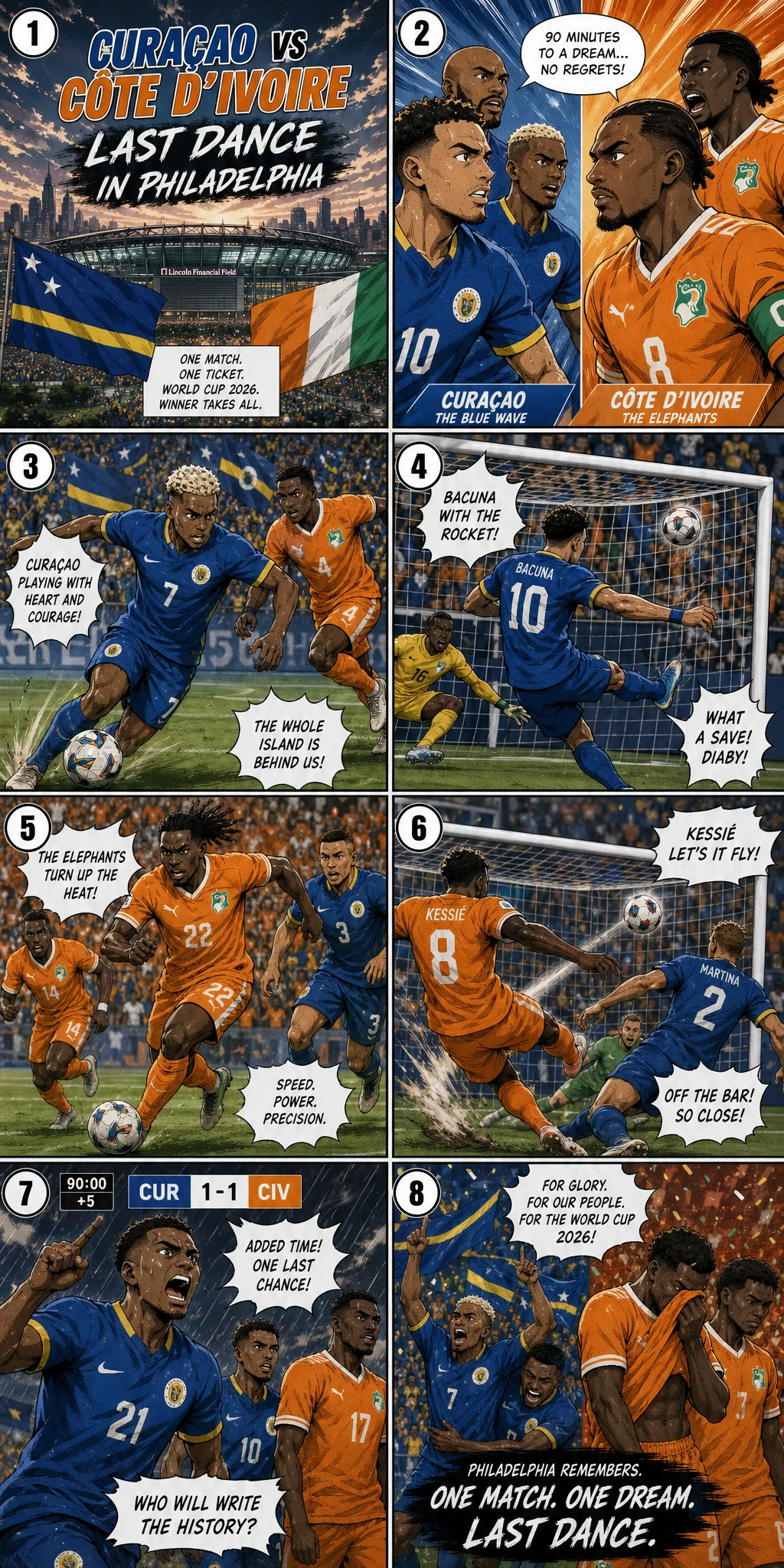
Comic content and match statistics are for entertainment purposes only and may contain inaccuracies. For Accurate Data, please refer to the reference's official website.
# Curaçao vs Côte d'Ivoire: When a Caribbean Island of 150,000 Faces a Continental Powerhouse
The expanded forty-eight-team World Cup manufactures a specific type of match that no previous format could deliver: a nation with essentially no football infrastructure facing a continental powerhouse that has produced Champions League winners, Ballon d'Or nominees, and Premier League title-deciders for a generation. Curaçao versus Côte d'Ivoire, in Philadelphia, in the final round of Group E, is precisely that match — and it matters more, in the peculiar arithmetic of the expanded World Cup, than any of the tournament's traditional powers would care to admit. A Caribbean island whose population of 150,000 would fit comfortably inside most large European football stadiums, against a West African nation of twenty-eight million whose talent pipeline has been feeding Europe's richest leagues for three decades uninterrupted.
To understand what Curaçao represents, you must understand what Curaçao is — not merely as a football team, which a scouting report can capture in two hundred words and a formation diagram, but as a political and cultural entity whose footballing identity is inseparable from the colonial history that produced it. The island is a constituent country within the Kingdom of the Netherlands, a status held since the dissolution of the Netherlands Antilles in 2010. Before that constitutional moment, Curaçao was part of a federation of Caribbean islands that had been Dutch colonial possessions since 1634, when the Dutch West India Company established a trading post and began transforming a small Caribbean landmass into a node in the global network of Dutch commerce. Four centuries is a long time for a colonial relationship to persist — long enough that the Dutch language, Dutch educational institutions, and Dutch football feel less like colonial impositions than like inherited traditions that have been remade in the Caribbean context. Curaçao's players did not learn to play football on Caribbean beaches in the romantic sense that European football writing has traditionally deployed to describe the origins of South American and African footballers. They were refined, systematized, transformed from gifted children into professional footballers in the academies of Rotterdam, Amsterdam, and Eindhoven, cities where the Caribbean diaspora has been producing footballers for three generations.
The Dutch colonial legacy is simultaneously Curaçao's greatest advantage and its deepest limitation — a duality the players experience as the background condition of their footballing existence rather than as a topic for conscious reflection. The advantage is obvious and has been documented extensively: access to Europe's most sophisticated youth development system, a pipeline producing players capable of competing in the Eredivisie and occasionally in Europe's top five leagues. Curaçao's squad is not composed of amateurs who train in the evenings after working construction. It is composed of players who have trained at professional academies since childhood, who understand positional play at a level recognizable to any Dutch coach, who approach the game with the Cruyffian conviction that possession is not merely a tactical preference but a philosophical position. The limitation is equally significant and far less discussed: the Dutch system produces technically proficient footballers who understand positional play but does not, as a general rule, produce the physically dominant specimens that West African development systems, with their emphasis on athletic dominance as the foundation upon which technical quality is built, have specialized in developing. Against Côte d'Ivoire, physical dominance is the central organizing principle around which the Ivorian footballing identity has been constructed.
Côte d'Ivoire's footballing history is, in many respects, the history of African football's integration into the global game. The golden generation — Didier Drogba, Kolo and Yaya Toure, Gervinho, Salomon Kalou — represented the moment when African footballers ceased to be exotic imports into European leagues and became the players around whom clubs constructed their competitive identities. Drogba, in particular, transformed the perception of the African striker more decisively than any player since George Weah: no longer raw talent to be polished by European coaching, no longer a physical specimen whose technical limitations would be exposed at the highest level, but a complete footballer whose physical dominance was complemented by technical refinement and tactical intelligence. The image of Drogba in full flight — chest puffed, arms pumping, the Stamford Bridge crowd rising to meet his intensity — became the image of Ivorian football exported to the world: powerful, direct, emotionally overwhelming.
This golden generation carried Côte d'Ivoire to three consecutive World Cups — 2006, 2010, 2014 — without ever escaping the group stage. The record speaks simultaneously to the nation's quality and to the structural challenges African teams face: infrastructure gaps that limit preparation, administrative dysfunction that periodically disrupts squad cohesion, the specific difficulty of building a tournament-ready team from players dispersed across a dozen European leagues who assemble weeks rather than months before the competition begins. The post-Drogba generation has inherited the physical template while adding tactical sophistication. The contemporary Ivorian midfield overwhelms through athleticism. Wingers stretch defenses vertically, pinning full-backs deep and creating spaces through which central runners arrive late. The signature is the explosive transition that converts a defensive action into an attacking one before the opponent has mentally registered the change in possession.
The tactical contrast between these teams is a contrast between two models of football development that have emerged from European colonialism — and the historical irony is structurally significant. Curaçao represents the Dutch colonial model: a small territory shaped by the colonizing power's philosophy, players developed in Dutch academies, tactical approach essentially an export of the colonizer's football culture. Côte d'Ivoire represents the French colonial pipeline: players shaped by French developmental infrastructure even as their style has diverged from French tactical traditions. Two colonial legacies, two footballing philosophies, two very different relationships to the European infrastructure that has simultaneously developed and exploited African and Caribbean talent — meeting in Philadelphia, birthplace of American independence, before a crowd including both the Caribbean and West African diasporas whose presence in the United States is itself a product of migrations set in motion by empire centuries ago.
The stakes are enormous but asymmetrical and differently shaped. For Curaçao, every match at this tournament is, by definition, the most significant football match in the nation's history, a designation that transfers forward with each fixture, creating a chain of historically significant moments. Victory would be validation of the entire project of the expanded World Cup — proof that including smaller nations enriches the competition beyond commercial calculation. For Côte d'Ivoire, the stakes involve carrying a continent's accumulated expectations. Morocco's semifinal appearance in 2022 changed the calculus — the psychological barrier Cameroon first approached in 1990 has been broken. Now the logic is inescapable: if Morocco can reach a semifinal, why not Côte d'Ivoire? Every World Cup that passes without an African champion reinforces the structural inequalities of global football. The broader significance extends beyond Group E. The expanded format has been criticized as dilution, as a commercial decision masquerading as developmental. Curaçao versus Côte d'Ivoire is simultaneously an argument for expansion and against it — and the fact both arguments have merit is precisely what makes the match, and the format that produced it, so difficult to evaluate in simplistic terms. For ninety minutes in Philadelphia, the ball will be struck by footballers from a tiny Caribbean island and a West African continental power, both products of colonial empires whose populations have spent decades reclaiming and redefining the identities those empires imposed. It will be the strangest match of the tournament — and precisely for that reason, the most World Cup match of the tournament.