
Ecuador vs Germany: Bielsa Meets Nagelsmann
Ecuador versus Germany is the Group E fixture that presents Julian Nagelsmann's ambitious tactical rebuild with its most uncomfortable examination — and potentially the match that determines whether the German football machine has genuinely recovered
Published: June 6, 2026
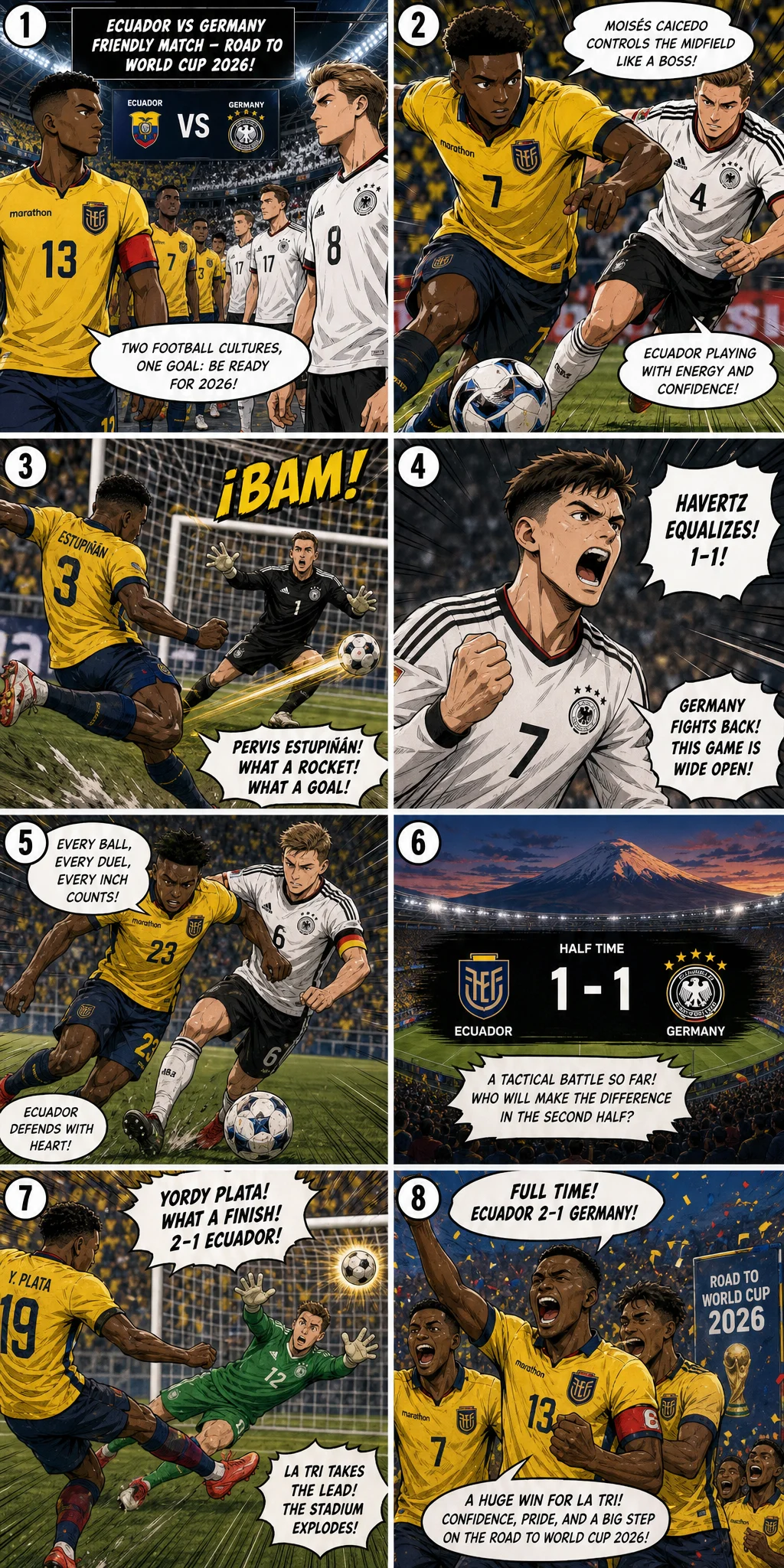
Comic content and match statistics are for entertainment purposes only and may contain inaccuracies. For Accurate Data, please refer to the reference's official website.
# Ecuador vs Germany: Nagelsmann's Machine Faces the Altitude Army — Group E Decider
Ecuador versus Germany is the Group E fixture that presents Julian Nagelsmann's ambitious tactical rebuild with its most uncomfortable examination — and potentially the match that determines whether the German football machine has genuinely recovered from the institutional trauma of consecutive group-stage exits in 2018 and 2022. Ecuador's identity — physical intensity, collective pressing, the specific confidence of a generation that believes this tournament represents their moment — poses precisely the kind of challenge that undid German football in Russia and Qatar: an organized opponent playing without fear against a European power whose system demands risk and whose psychology cannot tolerate the possibility of failure.
Nagelsmann's Germany presses high and presses systematically. The defensive line is stationed near the halfway line, the coordinated triggers designed to force turnovers in the opposition half where the transition to goalscoring opportunity is shortest. Jamal Musiala operates between lines with the fluidity of a player who perceives space before it opens — the specific spatial intelligence that makes him the most effective ball-carrier in the Bundesliga, the quality of receiving possession in congested areas and emerging into open space through a combination of close control and body positioning that defenders cannot legally counter. Florian Wirtz provides the complementary creative threat — less explosive than Musiala, more precise in his final-third decision-making, the player whose passing range creates the chances that Musiala's dribbling generates. The system is sophisticated, coherent, and, when the press functions as designed, essentially unplayable — the specific defensive nightmare of an opponent that wins the ball in your half and attacks before your defensive shape has reorganized.
The vulnerability is the space behind the high defensive line. Opponents who can bypass the German press — through direct balls into the channels, through target-man hold-up play that allows supporting runners to break beyond the defensive line, through the specific counter-attacking patterns that Ecuador's system is designed to execute — can access the spaces that Nagelsmann's system concedes as a structural feature of its ambition. This is not a tactical flaw in the conventional sense. It is a calculated risk, the specific trade-off that high-pressing systems accept in exchange for the territorial dominance and turnover generation that the high press produces. Germany under Nagelsmann has decided that the benefits of territorial control outweigh the risks of counter-attacking exposure. Ecuador under Felix Sanchez has built a team specifically designed to test whether that calculation is correct.
Ecuador's plan is simpler than Germany's and, in its simplicity, potentially more effective against the specific opponent it faces. Absorb German possession — Ecuador will concede sixty-five percent or more of the ball, and this is not a problem but a premise. Compress the spaces that Musiala and Wirtz seek to occupy — the half-spaces between opposition midfield and defense, the specific channels where German creativity operates most effectively. And transition with maximum speed through Moises Caicedo's progressive passing — the Chelsea midfielder whose capacity to win the ball and immediately release a forward pass transforms defensive actions into attacking transitions. The Ecuadorian counter-attack is not the speculative long ball of a team hoping for fortune. It is the structured transition of a team that has designed its attacking patterns around the specific defensive actions that precede them — win the ball here, release the pass there, arrive in the box now.
The psychological dimension adds weight that transcends tactics. For Germany, dropping points in this fixture revives ghosts — the 2018 defeat to South Korea that eliminated the defending champions at the group stage, the 2022 defeat to Japan that repeated the humiliation, the specific institutional trauma of a football machine that stopped functioning at the moments when functioning mattered most. Nagelsmann's tenure has been defined by the project of restoring German football's institutional confidence, the specific swagger that characterized German tournament performances from 2006 through 2014 and that evaporated in the years after the 7-1. A draw against Ecuador would not eliminate Germany from the tournament — the format's expanded knockout stage makes group-stage elimination mathematically less likely. It would, however, trigger a psychological crisis that extends far beyond the mathematics of Group E, reviving questions about German football's tournament mentality that Nagelsmann's project was specifically designed to answer. Ecuador arrives without historical baggage — a team that has never carried the weight of being tournament favorites, that approaches matches against European superpowers as opportunities rather than obligations. The psychological asymmetry is as significant as the tactical one, and the team that manages its emotional state more effectively will have an advantage that no tactical system can provide.
Ecuador's approach to this match deserves deeper examination because it represents a specific tactical philosophy that has been refined across multiple World Cup cycles against South American opposition. Felix Sanchez, the Spanish coach who previously led Qatar's national team project and who brings the specific tactical education of La Masia to the Ecuadorian national team, has constructed a system organized around defensive solidity and counter-attacking precision. The 4-4-2 defensive shape compresses into a narrow block when Germany has possession in the middle third, denying the central spaces that Musiala and Wirtz target while conceding wide areas where German crosses must contend with Ecuadorian aerial presence. The transition game is built around Caicedo's ball-winning and progressive passing, with Enner Valencia's experience providing the attacking reference point and Gonzalo Plata's pace providing the vertical threat. The system is not beautiful and does not attempt to be. It is designed for a specific purpose — to survive against technically superior opponents and to punish the moments when those opponents' ambition creates space — and that purpose aligns precisely with the challenge that Germany presents.
The specific matchup between Caicedo and Germany's midfield is the tactical axis around which the entire match rotates. Caicedo's Chelsea development has refined the raw physical qualities that first attracted European attention — the coverage, the tackling, the specific capacity to win the ball in positions that appear unwinnable — into the more complete midfield package that elite Premier League football demands. His passing range has improved; his positional discipline has sharpened; his decision-making under pressure has matured. Against Germany, Caicedo will face a midfield designed to overwhelm opponents through numerical superiority and positional rotation — Musiala dropping deep to receive, Wirtz drifting inside from wide positions, Havertz dropping from the false nine position to create the central overload that German attacking patterns require. Caicedo cannot cover all of these movements simultaneously, but his specific quality — the ability to read the play before it develops, to position himself where the danger will be rather than where it currently is — allows him to disrupt the German attacking rhythm by arriving at the right place at the right moment. The duel between Caicedo's anticipation and Germany's positional rotation will determine whether Ecuador can defend with the organization that its game plan requires or whether German creativity overwhelms Ecuadorian structure.
The historical context of Germany's struggles against organized, counter-attacking opponents provides a framework for understanding this fixture. The 2018 defeat to Mexico — a 1-0 loss in the opening group match where Mexico's counter-attacks exposed the space behind Germany's advanced full-backs — established the template that South Korea and Japan subsequently exploited. The 2022 defeat to Japan — another counter-attacking exhibition, another German defensive collapse, another tournament exit that felt simultaneously shocking and predictable — reinforced the pattern. Germany's problem is not that it cannot break down organized defenses. Germany's problem is that the specific tactical approach required to break down organized defenses — committing numbers forward, maintaining a high defensive line, accepting the risk of counter-attacking exposure — creates the specific vulnerability that counter-attacking opponents are designed to exploit. Nagelsmann's system does not solve this problem. It leans into it — accepting the risk, trusting that German attacking quality will produce more goals than German defensive vulnerability will concede. Against Ecuador, a team specifically constructed to test this equation, the result will provide evidence for or against Nagelsmann's tactical philosophy that no amount of Bundesliga analysis could generate.
The broader significance of this match for Group E is substantial. A German victory, particularly a convincing one, establishes the narrative of recovery — the football machine functioning as designed, the institutional trauma of 2018 and 2022 consigned to history, the path toward the deep tournament run that German football expects. An Ecuadorian result — a draw, an improbable victory — transforms Group E into the kind of chaotic narrative that the expanded format was designed to amplify: the South American outsider challenging the European establishment, the group dynamics shifting in ways that no pre-tournament prediction anticipated, the specific drama of a World Cup group where the expected order refuses to materialize. The stakes of the match extend beyond the Group E standings. They extend into the psychological territory that defines tournament football — the specific confidence or fragility that a result in the group stage generates, that compounds through the knockout rounds, that determines whether a team believes it can win the World Cup or merely hopes to survive. Germany enters this match needing to believe. Ecuador enters this match needing to prove that belief, in German football, is currently unfounded. The collision of these psychological imperatives will produce either the German reassertion that Nagelsmann was hired to deliver or the Ecuadorian statement that the expanded World Cup was created to enable.