
France vs Iraq: Asymmetric Warfare — Star Power Meets the Ultimate Low Block
France takes on Iraq in an encounter spanning football's complete spectrum — the talent factory that produced Mbappe against the Lions of Mesopotamia writing an improbable story. This preview examines the tactical mismatch, Iraq's defensive discipline strategy, the moments of individual Iraqi quality forged in adversity, and the World Cup's unique capacity to create fixtures where champion meets underdog.
Published: June 6, 2026
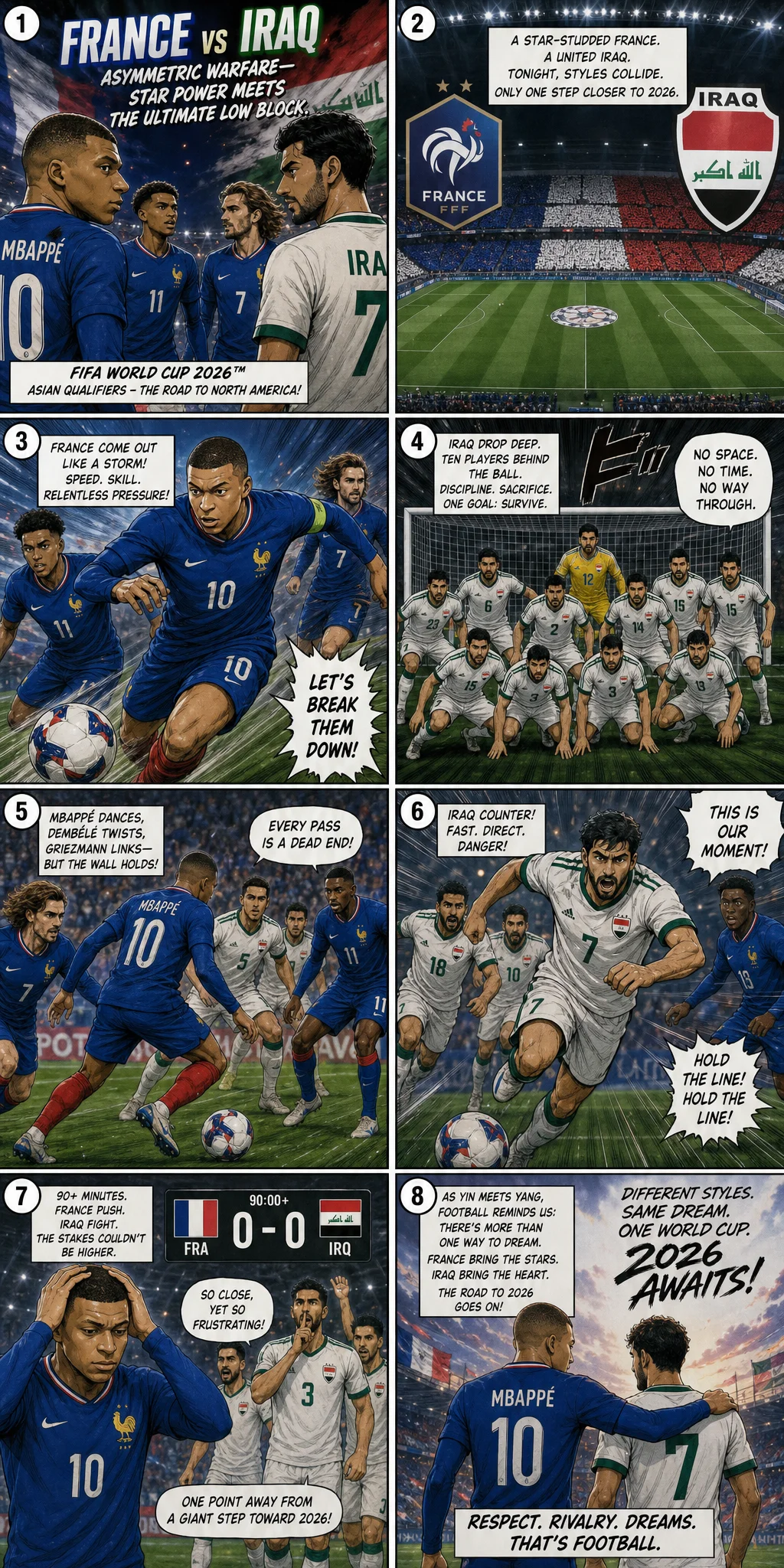
Comic content and match statistics are for entertainment purposes only and may contain inaccuracies. For Accurate Data, please refer to the reference's official website.
France vs Iraq: Asymmetric Football and the Art of Breaking a Block
The tactical distance between France and Iraq is, by any measure, the widest gulf in the 2026 World Cup group stage. France fields a squad of players who start for Real Madrid, Bayern Munich, Paris Saint-Germain, and Arsenal — the elite of the European elite. Iraq fields a squad drawn predominantly from the Iraqi Stars League and lower-tier European competitions. The footballing resources are not comparable. The tactical objective, however, is identical: find a way to score. For France, the challenge is breaking down a defensive block that will concede possession, surrender territory, and place eleven men in positions designed to deny the specific spaces where France's most dangerous players operate. For Iraq, the challenge is surviving long enough for the scoreline to remain credible.
France's attacking system against a deep block follows patterns that Deschamps has refined across a decade of facing inferior opposition in qualifying campaigns. The 4-3-3 formation stretches the pitch through wide forwards — Kylian Mbappe on the left, Ousmane Dembele on the right — while the full-backs underlap or overlap depending on the positioning of the opposing wingers. Mbappe's movement is the key variable. Against a compact defensive block, he starts wide and drifts inside, receiving the ball in the left half-space with his body positioned to shoot across goal. The pass into that pocket — typically from Griezmann or Camavinga — must be weighted to arrive as Mbappe completes his inward movement, catching the defensive block in the process of shifting. Timing matters more than power, placement more than pace.
Iraq's defensive structure under Jesus Casas is a 5-4-1 that becomes, in its most compressed form, a 5-5-0. The wingers drop alongside the midfield line, the lone forward retreats to the halfway line, and the entire structure shifts laterally with the ball. The objective is not to win possession but to deny space — to make the penalty area so congested that any pass into it is intercepted, any shot from outside it is blocked. This is defensive football stripped to its essence, and its effectiveness depends on a single variable: concentration. One defender losing focus, one passing lane left open, one moment of hesitation against Mbappe's movement — the entire structure collapses. The system holds until the human beings operating it make an error.
The specific matchup that defines this match is Mbappe against Iraq's right side — the right-back, the right-sided center-back, and the right-sided central midfielder who must slide across to provide additional coverage. Iraq will double-mark Mbappe, positioning one defender to engage and another to cover the space behind. The risk of double-marking anywhere on the pitch is that it creates numerical advantages elsewhere; if Iraq commits two players to Mbappe, France has a free player in the zone those defenders have vacated. Griezmann's role is to identify and exploit that free player — to receive the ball in space and deliver the pass that breaks the defensive line before the block can adjust. This is Griezmann's best skill, the tactical intelligence that makes him the most important player in Deschamps' system even when Mbappe scores the goals.
N'Golo Kante's role in this match is counter-intuitively crucial. Against a team that will not have the ball, Kante's defensive contributions are theoretically unnecessary. But Kante's value against deep blocks is not defensive — it is his capacity to recover possession immediately when an attacking move breaks down, preventing the counter-attack that represents Iraq's only route to goal. France's most vulnerable moments occur in the three seconds after losing possession in the final third, when the full-backs are advanced and the center-backs are isolated. Kante's positioning during French attacks is designed to anticipate exactly these moments — he is the player who is already running toward the clearance before Iraq's forward has controlled it.
For Iraq, the set-piece represents the equalizing mechanism that talent disparity cannot erase. A corner, a wide free-kick, a long throw-in — these moments bypass France's superior technical quality and reduce the contest to aerial duels, timing, and physical presence. Iraq's center-back, Rebin Sulaka, stands at 193cm and has scored from set-pieces throughout Iraq's qualifying campaign. France's zonal marking system, while statistically effective, creates gaps at the edge of the box where late-arriving midfielders can find unmarked shooting opportunities. Iraq's best — perhaps only — chance of scoring comes from a dead ball situation that France's defense treats as routine.
Deschamps faces a selection question that is less about this match than about the tournament structure. Does he rotate the squad, resting key players for the tougher fixtures against Norway and Senegal? Or does he field the strongest XI to establish the attacking rhythm that knockout-stage matches will demand? The evidence from the 2018 and 2022 tournaments suggests Deschamps prefers continuity — he starts his best team, secures the result early, and then substitutes to manage minutes. Expect France's strongest available lineup, playing with intensity for the opening hour before the substitutions change both the personnel and the tempo.
The tactical reality is that France should win comfortably. The deeper tactical reality is that World Cup history contains enough examples of favorites struggling against deep blocks — France against Tunisia in 2022, Argentina against Saudi Arabia in the same tournament — to make assumptions dangerous. Iraq's defensive organization will be tested by the best attacking talent in the world. Whether the structure holds will determine whether the final scoreline is a formality or a contest. The chessboard is arranged for a mismatch. The pieces are in position. The system must now demonstrate that talent translates to goals against an opponent whose only tactic is to deny the space those goals require.