
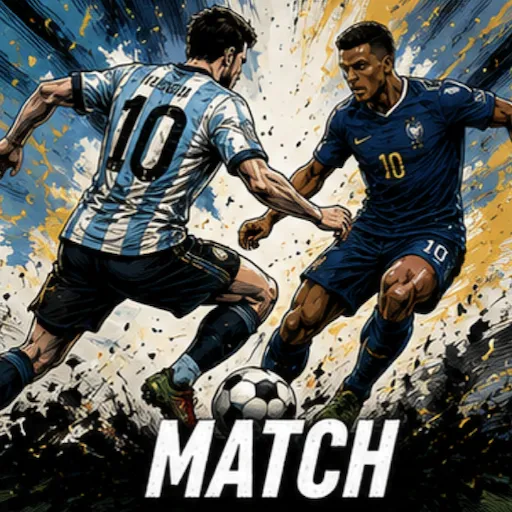
Norway vs Senegal: The Group Decider — Haaland Meets Koulibaly Under the New Jersey Lights
Norway and Senegal face off between two of football's most physically imposing and technically gifted squads — Haaland versus the Lions of Teranga's formidable defense, Odegaard against Senegal's midfield power. This analysis breaks down the individual duels, contrasting European and African philosophies, and this fixture's decisive role in determining which ambitious nation advances.
Published: June 6, 2026
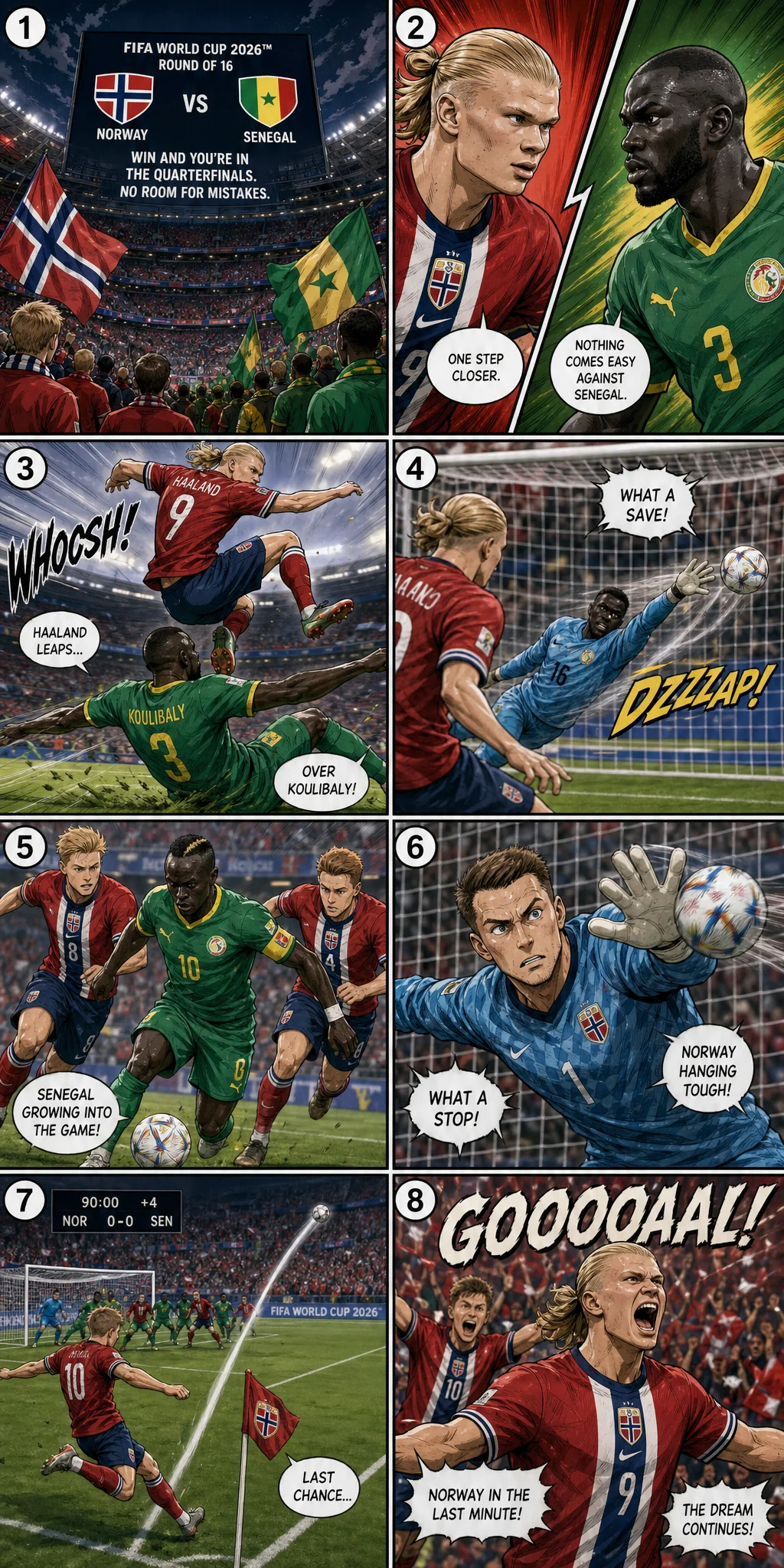
Comic content and match statistics are for entertainment purposes only and may contain inaccuracies. For Accurate Data, please refer to the reference's official website.
Norway vs Senegal: Group I's Decisive Collision Between Generations
The group-stage fixture that carries the most significant knockout implications in Group I pits Norway's golden generation against Senegal's tournament-hardened veterans in a match where the tactical patterns are well-established and the individual matchups are irresistible. Erling Haaland versus Kalidou Koulibaly — the most efficient finisher in world football against one of the most decorated center-backs in African football history — is the duel that will determine which team advances and which team boards a flight home with four years of what-ifs. The tactical frameworks around these two players are sophisticated. The outcome may still come down to whether Haaland can do what Haaland does against a defender who has spent his career neutralizing exactly this type of threat.
Norway's system under Stale Solbakken has been designed with a clarity of purpose that borders on philosophical purity: everything serves the Haaland-Odegaard axis. Martin Odegaard operates as the creative hub in the right half-space, receiving possession between the lines and scanning forward for Haaland's movement. His passing range — capable of playing the ball over the top, into the channel, or threaded through a defensive gap — is the mechanism that makes Norway's possession threatening rather than sterile. The full-backs, Julian Ryerson and Fredrik Bjorkan, advance to provide width, stretching the opponent's defensive block horizontally and creating the passing lanes that Odegaard exploits. The midfield three behind Odegaard — typically Sander Berge, Patrick Berg, and Kristian Thorstvedt — provides the defensive platform that allows the creative players to operate with reduced defensive responsibility.
Senegal's system represents the counter-argument: defensive organization as the foundation for everything else. The 4-3-3 becomes a 4-5-1 without the ball, with the wingers dropping to form a compact midfield line and the central striker pressing alone. Koulibaly, at 35, remains the organizing intelligence at the center of Senegal's defense — his positioning, his aerial dominance, his capacity to read the game one pass ahead of the opponent. He has faced every type of striker in European football: the quick, the powerful, the technical, the combination. Haaland is a category unto himself. The question is whether Koulibaly's experience and positional intelligence can compensate for the physical decline that comes at 35 against a forward whose athletic peak has barely begun to plateau.
The specific matchup between Haaland and Koulibaly will be decided in the space between the center-back and the goal. Haaland's movement in the box is not about direction — he does not drift wide, does not drop deep — but about timing. He arrives in scoring positions at the exact moment the cross is delivered, when the defender is flat-footed and the goalkeeper's positioning is uncertain. Koulibaly's defensive response will be physical: making contact before the ball arrives, establishing body position that denies Haaland the space to accelerate, using his frame to block the runs that Haaland times with scientific precision. This is a duel that will be won or lost in fractions of a second, in the half-meter of space that determines whether a cross becomes a goal or a clearance.
Senegal's attacking threat runs through the wide areas, where Ismaila Sarr and Sadio Mane operate against Norway's advanced full-backs. Solbakken's system demands that the full-backs push high, which creates the space behind them that Senegal's wide players are specifically designed to exploit. Sarr's pace in transition, combined with Mane's dribbling ability and Nicolas Jackson's movement in the box, gives Senegal a counter-attacking dimension that Norway's midfield must screen against. The Norwegian double pivot must be positioned to prevent the ball from reaching Senegal's wide players in transition — if Sarr receives with space to run into, the Norwegian center-backs are exposed in a way that their club experience at top European sides may not prepare them for.
The midfield battle will be defined by physicality rather than creativity. Senegal's Pape Gueye and Idrissa Gueye provide the ball-winning intensity that disrupts opposition rhythm; Norway's Berge and Berg provide the composed possession that establishes control. The team that wins the second-ball battle — that recovers possession after a clearance or a tackle — will control the tempo. In matches where both teams are defensively organized, possession is less important than the location of possession. Senegal wants the ball in wide areas, where Sarr and Mane can isolate against defenders. Norway wants the ball in the half-spaces, where Odegaard can find Haaland. The midfield's job is to direct possession to the areas where the attacking talent can operate.
The set-piece dimension favors Senegal. Koulibaly's aerial threat from corners and free-kicks is well-established; Norway's zonal marking system has shown vulnerability against teams that attack the ball in clusters rather than from static positions. If Koulibaly can attack a delivery with momentum — arriving at the ball rather than waiting for it — the timing advantage against a zone marker who is stationary creates the kind of chance that Senegal's open-play patterns may struggle to produce against organized Norwegian defending.
The tactical calculus slightly favors Norway's controlled possession against Senegal's transitions. The experience calculus decisively favors Senegal — two World Cup appearances, an Africa Cup of Nations title, a generation of players who have competed at the highest level of European club football. The individual matchups are evenly balanced: Haaland-Koulibaly, Odegaard-Gueye, Mane-Ryerson. The match will be decided by the one matchup where the balance tips decisively in one direction, and identifying which matchup that will be before it tips is the tactical exercise that makes this the most analytically compelling fixture of Group I. The winner advances. The loser goes home. The system that holds under pressure will be the one still standing in the knockout stage.