
Norway vs France: Battle for Group Supremacy — Solbakken Tests Deschamps in Boston
Norway versus France is a group-stage heavyweight showdown between Mbappe's defending runners-up and a Haaland-led Nordic force two decades in the making. This blockbuster preview dissects the battle between two devastating attacking arsenals, the midfield chess match, and a fixture with genuine claim to being the group stage's most anticipated match of the entire 2026 tournament.
Published: June 6, 2026
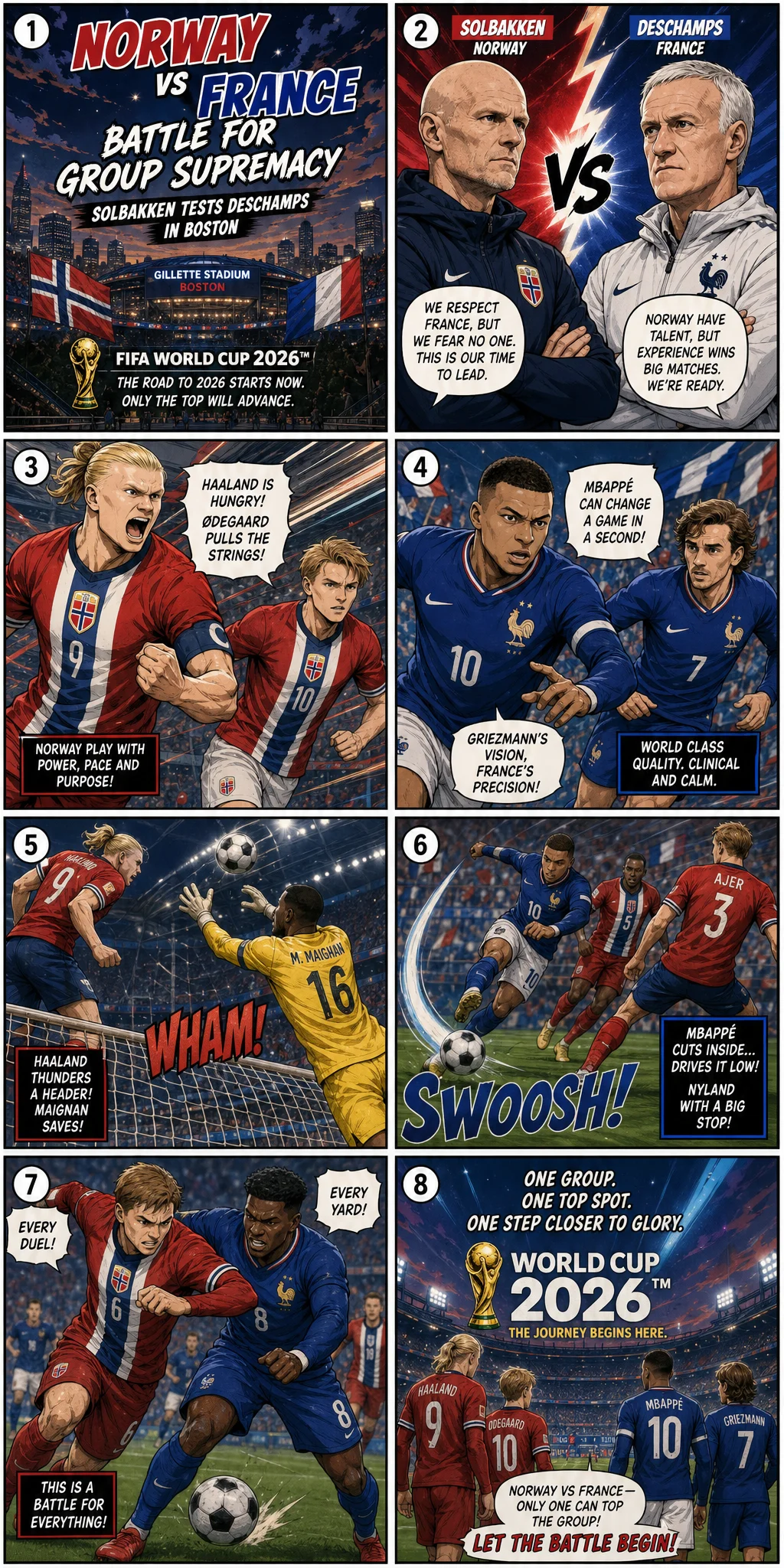
Comic content and match statistics are for entertainment purposes only and may contain inaccuracies. For Accurate Data, please refer to the reference's official website.
Norway vs France: The Group I Summit Between the World's Two Best Strikers
The fixture that Group I has been building toward delivers the matchup that global football has anticipated since the tournament draw was made: Erling Haaland versus Kylian Mbappe, the two defining forwards of their generation, on the same pitch with group supremacy at stake. The tactical subtext, however, is more layered than the individual duel suggests. This is a match between two systems that operate from fundamentally different premises — Norway's reactive counter-attacking structure against France's possession-dominant control machine — and the outcome will be determined by which system imposes its terms on the other.
France under Didier Deschamps has evolved into the most complete team in international football, a side capable of controlling possession against inferior opponents and transitioning at devastating speed against equals. The 4-3-3 base formation provides structural balance: Tchouameni and Camavinga as the midfield base, Griezmann linking midfield to attack, Mbappe and Dembele providing width and penetration. The French system's defining characteristic is its adaptability — the shape shifts according to opponent and game state, becoming a 4-2-3-1 when chasing a result and a 4-4-2 defensive block when protecting one. This tactical flexibility makes France uniquely difficult to prepare for; the system you plan to face may not be the system you encounter.
Norway's approach will be shaped by the specific threat that France presents. Solbakken's Norway has historically performed better against teams that dominate possession — the reactive counter-attacking mode suits a team whose primary weapons are Odegaard's passing from deep positions and Haaland's finishing in transition. Against France, Norway will concede possession willingly, set their defensive block in a 4-5-1 shape, and wait for the moments when France's advanced full-backs leave space behind them. This is the template that Switzerland used to eliminate France from Euro 2020, the template that teams facing superior possession opponents have followed for decades. The question is whether Norway's defenders, drawn from clubs like Borussia Dortmund and Brentford, can execute the template against the best attacking talent in the world.
The Haaland-Mbappe comparison is inevitable but analytically misleading. They are not the same type of player; they do not occupy the same spaces or perform the same functions. Haaland is a penalty-box finisher whose movement is about timing — arriving at the ball at the exact moment it arrives at him. Mbappe is a wide forward whose movement is about space — receiving possession in areas where he can accelerate past a defender and create shooting angles. The comparison is valid only in the sense that both convert chances at rates that statistical models consider unsustainable, suggesting that both possess finishing ability that transcends the quality of the chances they receive. France's defensive plan for Haaland involves denying the service — pressure Odegaard on the ball, cut the passing lanes, force Norway to build through players who lack Odegaard's creative range. Norway's defensive plan for Mbappe is simpler and less likely to succeed: double-team him, funnel him wide, deny the cut inside onto his right foot.
Odegaard's role is the tactical variable that could decide the match. The Arsenal captain has spent his Premier League career facing mid-block defensive structures designed to deny him time on the ball. France's midfield press, while aggressive, leaves space behind the first line of pressure — the zone where Odegaard operates most effectively. If Odegaard can receive possession between France's midfield and defensive lines, turn, and locate Haaland's run before Tchouameni or Camavinga closes him down, Norway creates the transition moments that their system is designed to produce. If France's midfield press denies Odegaard the time to turn — if he receives facing his own goal, with a French midfielder in close attendance — Norway's attacking threat diminishes to set-pieces and hopeful balls over the top.
France's attacking patterns against Norway's defensive block will follow the principles that Deschamps has installed across a decade of tournament football. Width through the full-backs — Theo Hernandez on the left, Jules Kounde on the right — stretches Norway's defensive shape and creates passing lanes into the half-spaces. Griezmann operates as the connector between midfield and attack, receiving between the lines and releasing Mbappe or Dembele into the channels. The speed of France's wide forwards in one-on-one situations forces Norway's full-backs to defend without the support of their wingers — the wingers must drop to form the defensive block, leaving the full-backs isolated against France's most dangerous players.
The tactical chess match extends to the benches. France's squad depth — the capacity to introduce Ousmane Dembele, Bradley Barcola, or Randal Kolo Muani against tiring defenders — gives Deschamps options that Solbakken cannot match. Norway's substitutes, while competent, do not change the tactical equation in the way that France's can. The match may be decided not by the starting systems but by the adjustments that become possible as fatigue erodes the defensive organization on both sides.
The broader narrative — Haaland versus Mbappe, the two players who will define the post-Messi/Ronaldo era — will dominate the pre-match coverage. The tactical reality is that this match will be decided by the supporting systems, by the midfielders who deliver passes and the defenders who prevent them, by the tactical adjustments that Deschamps and Solbakken make in response to the patterns that emerge in the opening exchanges. The stars will have their moments. The system will determine whether those moments matter. Group I's summit meeting is a clash of individuals only in the headlines. On the pitch, it is a clash of structures, and the structure that bends least under pressure will determine which team enters the knockout stage as group winner.