

Eleven Billion Dollars and a Bill You Will Never See
The numbers, when you sit with them for a moment, are almost too large to mean anything. Eleven billion dollars. That is the projected revenue FIFA expects the 2026 World Cup to generate -- a figure that would make it not merely the most lucrative fo
Published: June 6, 2026
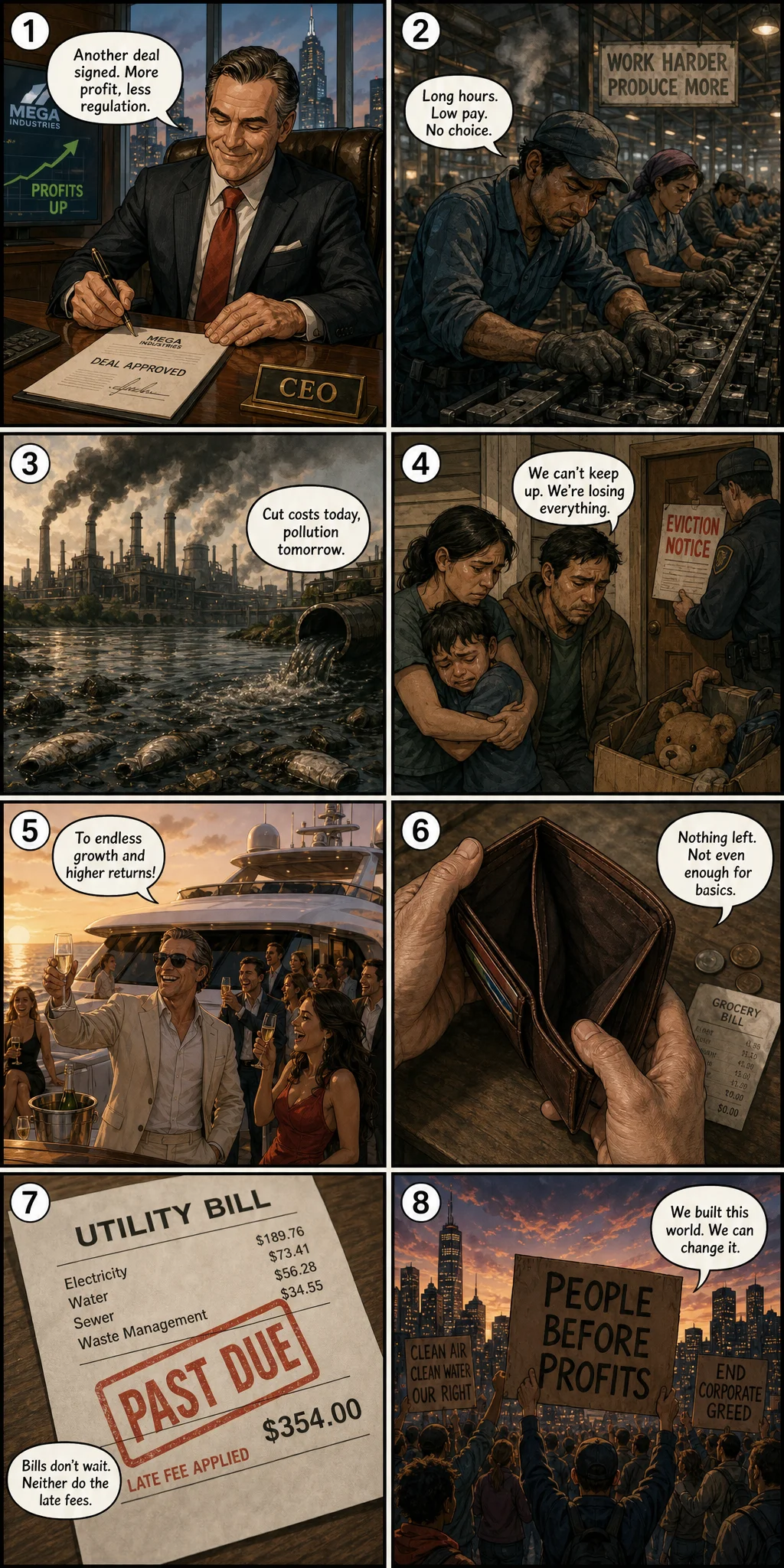
Comic content and match statistics are for entertainment purposes only and may contain inaccuracies. For Accurate Data, please refer to the reference's official website.
# The $11 Billion Question: Who Actually Pays for the World Cup?
The numbers, when you sit with them for a moment, are almost too large to mean anything. Eleven billion dollars. That is the projected revenue FIFA expects the 2026 World Cup to generate -- a figure that would make it not merely the most lucrative football tournament in history but one of the most profitable recurring events human beings have ever organized, surpassing even the Olympic Games in its ability to extract wealth from attention. And yet, as with all numbers of this magnitude, the figure conceals as much as it reveals. Someone pays. Someones, really: broadcasters, sponsors, ticketing agencies, and, in ways less visible but no less real, you and I.
To understand how FIFA arrived at $11 billion -- a figure that would have seemed fantastical even a decade ago, when the 2014 Brazil World Cup generated roughly $4.8 billion -- one must first understand the three-legged stool upon which the tournament's finances rest. The first and most muscular leg is broadcasting rights. Television money has been the engine of football's commercial expansion since the 1990s, when Rupert Murdoch's Sky Sports demonstrated to a skeptical industry that people would pay handsomely for the privilege of watching live football in their living rooms. The lesson was not lost on FIFA, which has since structured its entire media rights strategy around the principle of scarcity: a World Cup comes only once every four years, making it the most precious commodity in sports broadcasting.
For 2026, FIFA has already secured approximately $4.5 billion in broadcast deals, with the largest contributions coming from European networks whose audiences remain captive to the sport in ways that American audiences -- despite decades of predictions to the contrary -- have never quite matched. Fox Sports paid roughly $425 million for the English-language U.S. rights for the 2026 and 2030 tournaments combined, a figure that reflects both the tournament's co-hosting on American soil and the stubborn reality that World Cup viewership in the United States, while growing, remains a fraction of what a semifinal involving England, Brazil, or Argentina commands in their home markets. The European Broadcasting Union, by contrast, has committed well over $1 billion, recognizing that even in an age of fragmented media consumption, the World Cup remains one of the few events capable of assembling a truly mass audience.
But broadcasting is only the beginning. Sponsorship -- the second leg -- is where FIFA's commercial machinery achieves its most remarkable alchemy, transforming brand visibility into revenue at margins that would embarrass most Fortune 500 companies. The organization operates a tiered partnership structure that is, in its own way, as hierarchical as the tournament's group stage: a small circle of "FIFA Partners" at the top (Coca-Cola, Adidas, Visa, Hyundai-Kia, Qatar Airways, and Aramco), a larger ring of "FIFA World Cup Sponsors," and an even broader constellation of regional supporters. The top-tier partners alone contribute an estimated $1.5 billion per four-year cycle, a figure that has grown steadily even as questions about sportswashing and the ethics of certain state-linked sponsorships have grown louder in the background.
What is striking about the 2026 sponsorship landscape is not simply its scale but its shifting geography. Where once the sponsorship portfolio was dominated by European and American brands -- the Coca-Colas and McDonaldses of the world -- the 2026 tournament reflects a more multipolar commercial reality. Chinese brands such as Vivo and Hisense have emerged as major sponsors, while Middle Eastern interests, particularly from Saudi Arabia through Aramco, represent an increasingly assertive presence. This is not merely a commercial phenomenon; it is a reflection of the broader geopolitical reordering that has made the World Cup a stage not just for football but for national branding campaigns of immense ambition.
The third leg -- ticketing and hospitality -- is in some ways the most revealing, because it is here that the tension between the World Cup as a popular festival and the World Cup as a luxury product becomes most acute. FIFA has not yet released its full ticketing revenue projections for 2026, but extrapolating from Qatar 2022, where ticket sales generated approximately $500 million despite a tournament capacity of roughly 3.4 million, the expanded 48-team format with its 104 matches and projected attendance of over 5 million suggests ticketing revenue alone could approach $1 billion. The mathematics are brutal and straightforward: more matches, larger stadiums, and -- crucially -- a hospitality pricing strategy that treats proximity to the pitch as a luxury good whose price should reflect its scarcity.
Hospitality packages for 2026 are, by all available indicators, priced in a different stratosphere altogether. The "FIFA Hospitality Programme," operated by MATCH Hospitality, has structured its offerings into tiers that range from the merely expensive to the genuinely eye-watering. A single match ticket in the highest hospitality category for a semifinal at AT&T Stadium in Texas, which seats over 90,000, could easily command several thousand dollars when food, beverage, and the intangible aura of exclusivity are factored in. Multiply that across 104 matches and the revenue becomes substantial enough to reshape the economics of the entire tournament.
But the question that lurks beneath these revenue figures -- the question that the press releases and annual reports tend not to answer directly -- is who bears the cost. The answer, as is often the case with events of this scale, is more complicated than a balance sheet can capture. Broadcasting revenue ultimately comes from viewers, whether through subscription fees or through the advertising that fills the commercial breaks. Sponsorship revenue is embedded in the price of every soda can and credit card transaction. Ticket revenue comes directly from the pockets of fans, many of whom will travel across continents, pay inflated accommodation prices, and rearrange their lives around a tournament that is, in the final accounting, a discretionary entertainment expense.
And then there are the costs that do not appear in FIFA's revenue ledger at all: the public expenditure by host nations on infrastructure, security, and the various inducements required to secure hosting rights in the first place. The United States, Canada, and Mexico are spending billions -- billions with a "b" -- on stadium upgrades, transportation improvements, and security preparations that FIFA is not required to reimburse. These are costs borne by taxpayers, distributed across populations that may or may not care about football at all, and they represent a subsidy from the public purse to a private organization whose reserves exceed $4 billion.
There is, too, the question of distribution -- because revenue, however enormous, only matters if we ask where it goes. FIFA's own financial structure channels the vast majority of tournament revenue back to its member associations through the Forward Programme, which disburses funds for development projects, infrastructure, and operational costs. In theory, this is the virtuous cycle: the wealth generated by the World Cup's global audience is reinvested in the sport's growth, particularly in nations where football lacks the commercial infrastructure to sustain itself. In practice, the distribution has been plagued by allegations of mismanagement, corruption, and the simple gravitational truth that money, once concentrated, tends to stay concentrated. The 211 member associations do not receive equal shares, and the gap between what flows to a major European federation and what reaches a small island nation's football association can be measured in orders of magnitude.
The $11 billion figure, then, is not simply a measure of commercial success. It is a measure of the World Cup's singular position in the global attention economy -- its ability to concentrate the gaze of billions of people on a single event and to monetize that concentration with an efficiency that has no parallel in sport or perhaps in any other domain of human culture. Whether that concentration is worth eleven billion dollars is a question that accounting cannot answer. But someone is paying for it. The broadcast viewer who pays a monthly subscription they barely use except during tournaments, the fan who saves for years to buy a Category 1 ticket, the taxpayer in Guadalajara or Kansas City whose road is repaved for a tournament she may never attend -- all of them are patrons of this eleven-billion-dollar production, whether they realize it or not.
The World Cup has always been, in part, a financial enterprise. The difference in 2026 is not the fact of money's presence but the scale of its ambition. Eleven billion dollars is not merely a record; it is a statement of intent, a declaration that football's quadrennial festival has become one of the world's most formidable commercial machines. And like all machines, it requires fuel. The question of who pays is, ultimately, a question about who we are willing to be.