

Eight and a Half Tickets. One Continent's Turnaround.
There is a map, reproduced in countless football histories, of the 1930 World Cup participants. Thirteen nations, clustered almost entirely in the Americas and Western Europe, with a lone Egyptian delegation providing the sole representation from the
Published: June 6, 2026
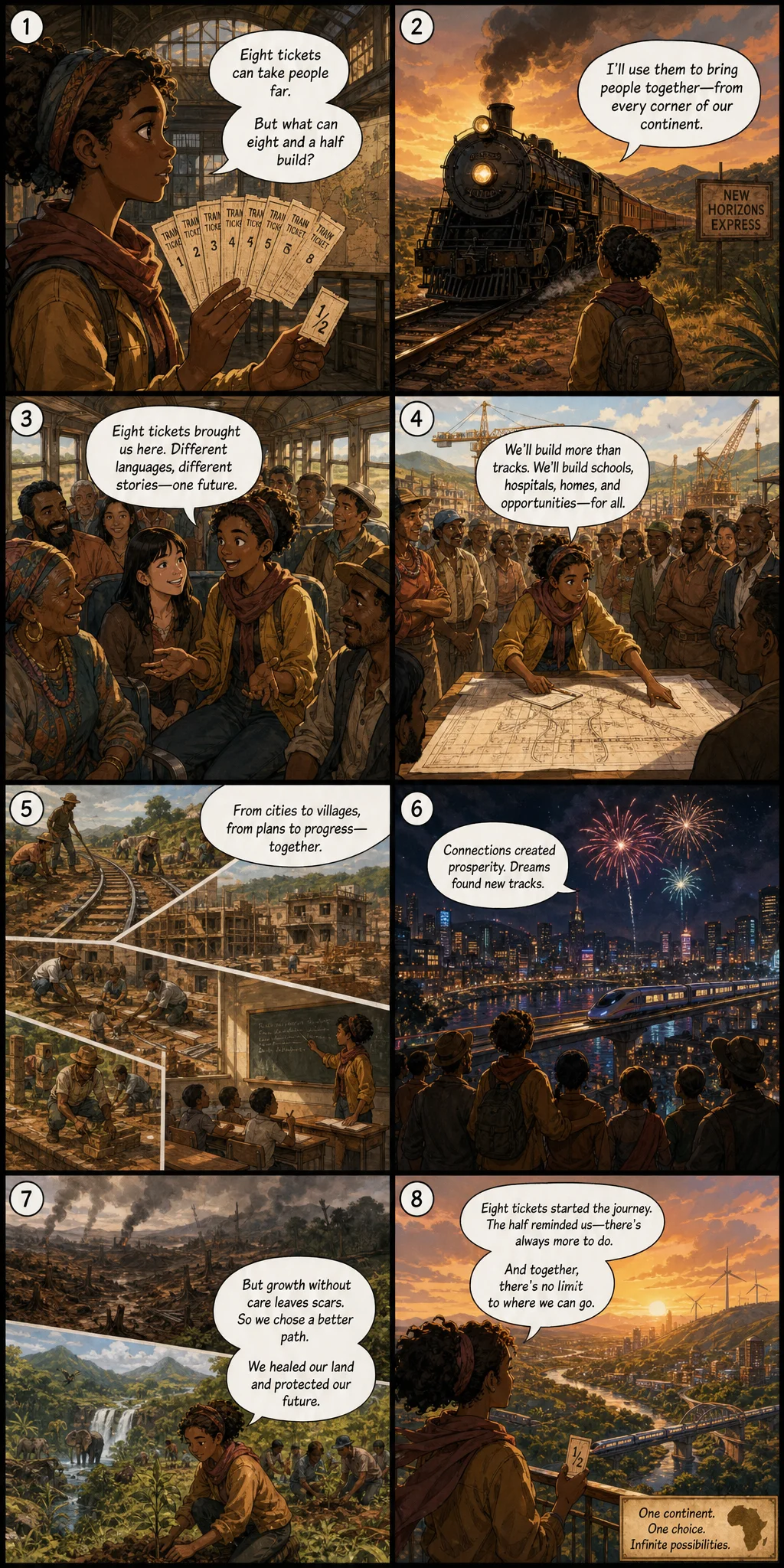
Comic content and match statistics are for entertainment purposes only and may contain inaccuracies. For Accurate Data, please refer to the reference's official website.
# The Asian Century Arrives at the World Cup: 8.5 Spots and a Continent Transformed
There is a map, reproduced in countless football histories, of the 1930 World Cup participants. Thirteen nations, clustered almost entirely in the Americas and Western Europe, with a lone Egyptian delegation providing the sole representation from the vast landmass of Africa and Asia combined. It would be another 36 years before an Asian team -- North Korea, improbably, memorably -- won a match at the World Cup finals, defeating Italy at Ayresome Park in 1966 in a result that still registers as one of the tournament's genuine shocks. The map of world football was, for most of the twentieth century, a map of European and South American dominance, with the rest of the globe consigned to the role of willing -- and sometimes unwilling -- supporting cast.
That map is about to be redrawn. When the 2026 World Cup kicks off across the United States, Canada, and Mexico, Asia will send as many as nine teams to the tournament, thanks to FIFA's expansion of the confederation's allocation from 4.5 spots to 8.5. It is, by any measure, the most significant recalibration of World Cup representation since the tournament expanded from 24 to 32 teams in 1998, and it reflects a calculation that is simultaneously sporting, political, and commercial: Asia, home to roughly 60 percent of the world's population, has long been underrepresented in football's quadrennial showcase, and FIFA's leadership has decided that the time for correction has arrived.
To understand the magnitude of this shift, one must appreciate what 4.5 spots meant in practice. For decades, Asia's World Cup qualification pathway was a brutal funnel: dozens of nations, spanning from Japan in the east to Saudi Arabia in the west, compressed into a qualifying system that produced, at most, five participants. The mathematics were unforgiving. South Korea and Japan became near-automatic qualifiers, their domestic leagues and youth development systems having matured to a point where qualification was an expectation rather than an aspiration. Iran and Saudi Arabia occupied the next tier, perennial qualifiers whose occasional absences were treated as national crises. Australia, upon switching from Oceania to the Asian Football Confederation in 2006, immediately claimed one of the spots, its professional infrastructure giving it an advantage that smaller AFC members could not match.
But beyond these five or six nations, the bottleneck was severe. Nations with populations in the tens or hundreds of millions -- Uzbekistan, with its rich footballing culture inherited from the Soviet era; the United Arab Emirates and Qatar, with their immense financial resources; Syria, whose national team became a symbol of resilience during years of civil war; Vietnam, where football is followed with an intensity that rivals any country in the world -- were forced into a zero-sum competition for a handful of intercontinental playoff spots that rarely produced qualification. The 4.5 allocation was, in effect, a structural ceiling on Asian football's ambition.
The expansion to 8.5 spots changes this calculation fundamentally. The top tier of Asian football -- Japan, South Korea, Iran, Saudi Arabia, and Australia -- will now qualify with relative comfort, their professional structures and deep talent pools making the expanded format a safety net rather than a genuine test. But it is the nations that occupy the next rung that stand to benefit most profoundly. Uzbekistan, a nation of 35 million people that has never qualified for a World Cup despite producing technically gifted players for decades, suddenly finds itself with a realistic pathway. The UAE and Qatar, the latter having hosted the tournament in 2022 but never qualified on sporting merit, can now target direct qualification rather than hoping for continental playoff miracles.
Even further down the pyramid, the expansion changes the psychology of entire football associations. Iraq, whose golden generation won the 2007 Asian Cup against a backdrop of war and displacement, can now build toward World Cup qualification as a plausible medium-term goal rather than a distant dream. Jordan, Lebanon, Oman, Bahrain -- nations whose footballing histories have been written in the margins of Asian qualification campaigns -- can now construct multi-year development plans around the realistic prospect of a World Cup appearance. This is not merely a sporting calculation; it is a transformation in what football means to these societies, a recalibration of the possible.
The commercial implications are, inevitably, a significant part of FIFA's calculus. Asia is not merely the world's most populous continent; it is its most dynamic consumer market, with a growing middle class whose appetite for global sports entertainment has been demonstrated by the enormous television rights deals struck by the Premier League, La Liga, and the NBA across the region. Nine Asian teams at a World Cup -- particularly one hosted in time zones that are accessible to Asian viewers -- represents an unprecedented opportunity to deepen football's commercial penetration in markets that have historically viewed the sport as a foreign passion rather than a domestic one. China, even if its national team continues to struggle, will watch with a different intensity if its continental neighbors are participating in meaningful numbers.
But the sporting question -- the question that will ultimately determine whether this expansion is remembered as a triumph of inclusivity or a dilution of quality -- is whether the additional Asian participants can compete. The evidence from previous expansions is mixed. When the World Cup grew from 16 to 24 teams in 1982, the additional participants included several nations that proved competitive (Algeria, Cameroon, Honduras) alongside others that were overwhelmed. The 1998 expansion to 32 teams produced a similar pattern: Croatia reached the semifinals in its first tournament as an independent nation, while other debutants struggled to win a point.
Asia's recent World Cup record provides cautious grounds for optimism. Japan has reached the round of 16 four times since 2002, consistently competing with -- and occasionally beating -- European and South American opposition. South Korea's semifinal run in 2002, while aided by home advantage and controversial refereeing, demonstrated that Asian teams could reach heights previously thought impossible. Saudi Arabia's victory over eventual champions Argentina in the opening match of Qatar 2022 was a reminder that, on any given day, the gap between Asia's best and the world's best is narrower than the historical record suggests.
What is less certain is how deep Asia's competitive quality runs. The seventh, eighth, or ninth Asian qualifier will enter a tournament populated by the world's elite, and the risk of heavy defeats -- the kind that prompt debates about whether expansion has gone too far -- is genuine. But this argument, while reasonable on its face, misunderstands the purpose of the World Cup. The tournament has never been a pure meritocracy; it is, and always has been, a balance between sporting excellence and global representation, a tension embedded in its very structure. The 8.5 spots for Asia are not a guarantee of competitive parity. They are a recognition that a continent of 4.7 billion people deserves more than a token presence at the sport's defining event.
The expanded allocation will also, over time, accelerate the development of Asian football in ways that transcend the tournament itself. World Cup qualification is not merely a reward; it is a catalyst. It attracts investment, inspires youth participation, and creates a generation of players and coaches whose exposure to the highest level of competition transforms domestic football culture. The effects of Japan's co-hosting of the 2002 World Cup are still visible in the J. League's technical standards and the steady stream of Japanese players moving to European clubs. South Korea's football infrastructure is, in part, a legacy of its 2002 experience. The 2026 expansion offers a similar inflection point for a broader range of Asian nations, and the returns may not be fully visible for a generation.
The 8.5 spots are, in the end, more than a number. They are an acknowledgment that the football map has changed -- that a tournament calling itself a World Cup must reflect the world as it is, not as it was in 1930. Asia, with its billions of people, its growing economies, and its deepening football culture, has waited long enough for its seat at the table. The expansion does not guarantee success. But it guarantees opportunity. And in a sport that has spent too much of its history guarding the gates, opportunity is its own kind of victory.