
The 7-1 That Haunted Germany
Belo Horizonte, July 8, 2014. I was in a bar in Berlin — a cavernous place near Hermannplatz, the kind of bar where the tables are sticky and the beer costs three euros and nobody cares who you are. The room was tense at kickoff. By the 29th minute,
Published: June 6, 2026
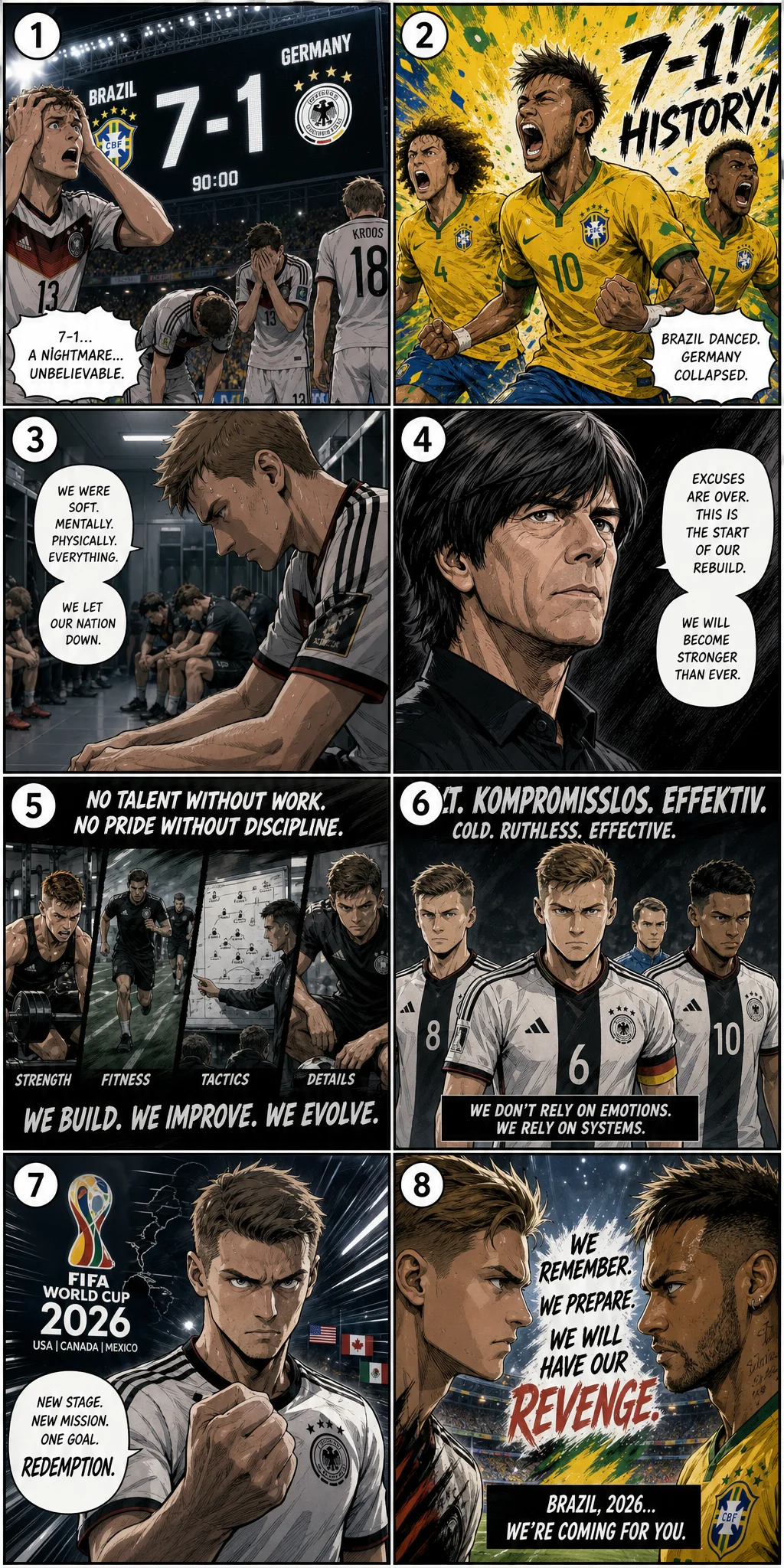
Comic content and match statistics are for entertainment purposes only and may contain inaccuracies. For Accurate Data, please refer to the reference's official website.
# The 7-1 That Haunted Germany — And Why It Might Save Them
Belo Horizonte, July 8, 2014. I was in a bar in Berlin — a cavernous place near Hermannplatz, the kind of bar where the tables are sticky and the beer costs three euros and nobody cares who you are. The room was tense at kickoff. By the 29th minute, it was euphoric. Five-zero. Five goals in eighteen minutes. The bartender, a man named Klaus who had been serving beer since West Germany won in 1990, stopped serving and just stared at the screen. "This isn't football," he said to no one. "This is a crime scene."
He wasn't wrong. Germany didn't beat Brazil that night — they dismantled them, clinically, in front of 200 million Brazilians watching at home, on the stage their nation had built for its own coronation. 7-1. The most devastating scoreline in World Cup semi-final history. A week later, Götze's chest-and-volley at the Maracanã — that impossibly delicate touch in the 113th minute — made Germany world champions. For the first time since 1990, the trophy belonged to the machine. A decade-long youth development revolution, begun after the Euro 2000 humiliation, had paid its ultimate dividend. German football stood atop the world.
I think about that night in Berlin sometimes. Not because of the goals. Because of what Klaus said as I was leaving, around 2am, the streets already filling with honking cars and singing strangers. "This team," he said, wiping down the bar, "will win everything for ten years." He was so certain. We all were.
Then they stopped. Completely. Catastrophically.
Nobody saw it coming, which is the thing about decline — it announces itself only in retrospect. The 2018 group exit was called a fluke: South Korea 2-0, the defending champions eliminated before the knockout stage for the first time since 1938. Löw stayed. The federation insisted the machine simply needed maintenance. 2022: Japan 2-1, Spain 1-1, another group exit. The machine hadn't needed maintenance. The machine had rusted through, and nobody wanted to admit it.
Bierhoff was fired on the plane home from Qatar. Not in an office, not at a press conference — on the plane, somewhere over the Mediterranean, the man who had been Germany's team manager since 2004 was told his services were no longer required. He didn't even reach the terminal. The symbolism was brutal and unintentionally poetic: German football's old guard, discarded mid-flight, unable to land.
What had gone wrong? The autopsy took eighteen months. The conclusion was uncomfortable. The 2014 victory had become a cage. The youth development system — the decade-long project that had produced Lahm, Schweinsteiger, Müller, Kroos, Götze, Neuer, Özil, Khedira — had been so successful that it became orthodox. Germany stopped experimenting because they'd found what worked. What works in 2014, unexamined for eight years, becomes what fails in 2022. The machine that won the World Cup forgot to build its replacement.
Enter Julian Nagelsmann. Thirty-six years old, hired in late 2023 as the youngest Germany coach since the Reich. Radical, unrepentant, a manager whose entire career has been a rejection of orthodoxy. His Hoffenheim played a back three when back threes weren't fashionable. His Leipzig pressed with an intensity that made opponents dizzy. His Bayern — well, his Bayern was complicated, but the ideas were never the problem. Nagelsmann was hired precisely because he wouldn't follow the old German script. The old German script had produced two consecutive group exits.
I met a Bundesliga scout in Leipzig last spring who had worked with Nagelsmann at Hoffenheim. "He thinks about football the way engineers think about bridges," he told me over coffee. "There's a load-bearing principle. If you design the structure correctly, the weight distributes itself. The players don't need to be geniuses. They need to understand the structure." He paused. "Löw's Germany forgot to update the structure. Nagelsmann is rebuilding from the foundations."
The new Germany presses like a Bundesliga side on caffeine: high, chaotic, relentless. The centerpiece is Jamal Musiala, twenty-one years old — half Bavarian accent, half South London swagger, a player who moves through defensive lines like he's read a different physics textbook than everyone else. There is a training clip, viral now, 23 million views: Musiala gliding through a slalom of cones, the ball seemingly tethered to his feet, his body moving in directions that don't appear to have been invented yet. Germans watched it on repeat during the long winter before the tournament, looking for a reason to believe. The clip provided one. Clips are not trophies. But trophies always start somewhere.
Florian Wirtz, the Bayer Leverkusen creator, operates alongside Musiala with the complementary precision of a second violinist who knows exactly when to let the first chair take the melody. Kai Havertz, deployed as a false nine, provides the vertical threat that neither Musiala nor Wirtz naturally generates. Behind them, a double pivot of Joshua Kimmich and Pascal Groß — not the most physically imposing midfield in the tournament, but possibly the most positionally intelligent.
The weakness is the same one that undid Germany in 2018 and 2022: defensive midfield. Against elite counter-attacking sides — France, Spain, Brazil — Germany's high press leaves spaces that Kanté or Rodri or Bruno Guimarães would simply not allow. The second weakness is squad depth at the margins: positions 18 through 23, the players who won't start a knockout game but might be called upon after an injury or suspension or the simple accumulated fatigue of five knockout rounds. These are the margins that separate semifinalists from champions. Germany's first fourteen is good enough. The question is 15 through 26.
The 7-1, in retrospect, was not a victory. It was an inheritance — and Germany spent eight years living off the interest. The 7-1 blinded them to their own decline. The 7-1 made them believe they had solved football. Football, as it turns out, does not stay solved.
Nagelsmann's Germany faces Group E: Curaçao, Côte d'Ivoire, Ecuador. On paper, straightforward. But the group stage is not where Germany's tournament will be decided. Three wins would be expected; anything less revives the ghosts. The knockout stage is where Nagelsmann's rebuilt machine will be tested — against an opponent that presses back, that punishes the spaces behind Kimmich, that asks questions the group stage never allowed.
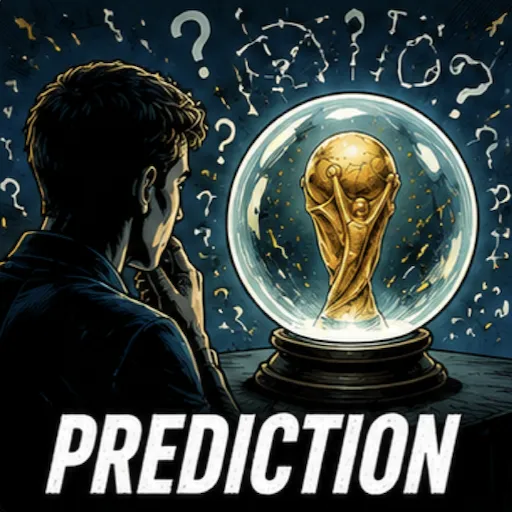
Prediction: quarterfinals, with a genuine path to the semifinal. The talent is real. The hunger — finally, after eight years of self-satisfaction — is back. Germany won't win 2026. But they'll go further than anyone expects. A proud football nation, humiliated twice and finally done admiring its trophies — that's not your safest bet. That's the team you don't want in your knockout bracket.
And somewhere in Berlin, I hope Klaus is still behind that bar, still wiping down the tables, still waiting to believe again. This might be the summer he does.