
Pass Until They Fall Asleep
I was in Las Rozas last March, standing at the edge of Spain's training pitch in the thin winter sunlight, watching a rondo. Not a normal rondo — those are everywhere, the universal warm-up ritual, the circle of players keeping the ball from two chas
Published: June 6, 2026
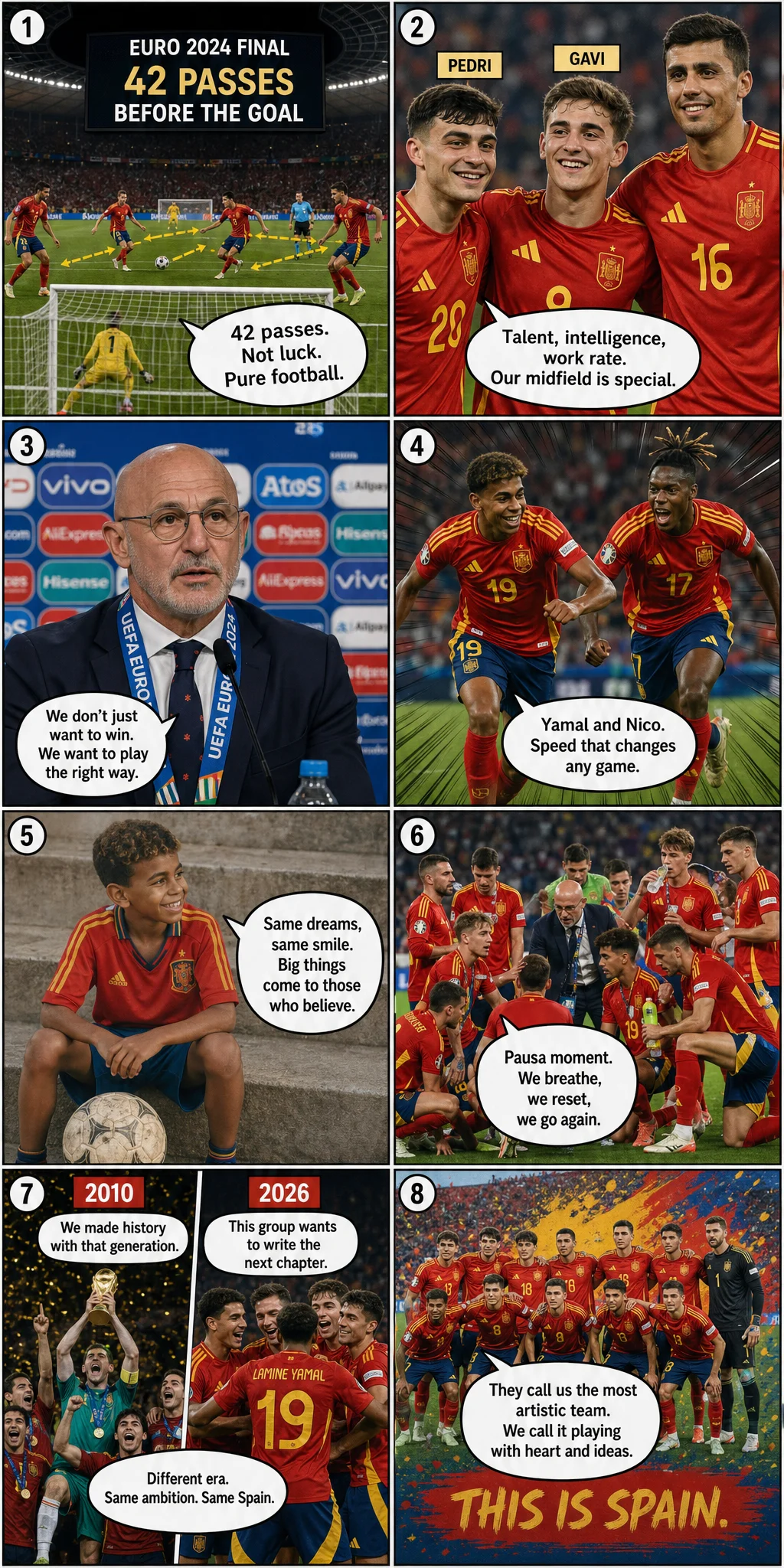
Comic content and match statistics are for entertainment purposes only and may contain inaccuracies. For Accurate Data, please refer to the reference's official website.
# Pass Until They Fall Asleep, Then Kill Them: How Spain Built the Most Complete Machine in World Football
I was in Las Rozas last March, standing at the edge of Spain's training pitch in the thin winter sunlight, watching a rondo. Not a normal rondo — those are everywhere, the universal warm-up ritual, the circle of players keeping the ball from two chasers in the middle. This was different. The circle was smaller. The tempo was faster. And when a player lost the ball, the reaction was immediate and synchronized — three players converging on the ball-carrier from different angles, the press triggered not by a coach's whistle but by the specific moment possession changed hands. De la Fuente was standing twenty yards away, not saying anything. He didn't need to. The drill was self-regulating. The press was instinctive. I had watched Barcelona train under Guardiola in 2011, and I recognized the quality I was seeing. It was the quality of a team that had internalized its identity so completely that the coach no longer needed to coach.
What de la Fuente has built with this Spain team is not a revival of the 2010 champions. It is something more interesting — and, for opponents, significantly more dangerous. The tiki-taka of Del Bosque's era was a philosophy of control: keep the ball, exhaust the opponent, wait for the opening. It was beautiful and it was dominant, but it had a specific vulnerability that the 2014 group-stage exit exposed. When the possession failed — when the opponent refused to cooperate, when Chile and the Netherlands pressed Spain's buildup with an intensity the system couldn't process — the philosophy had no backup plan. The 2010 team won because it could keep the ball better than anyone. The 2026 team can keep the ball better than anyone, and when it loses the ball, it becomes a pack of animals hunting in coordinated fury for exactly five seconds. If the ball isn't recovered in five seconds, the team drops into a compact mid-block and resets. The fury is temporary. The discipline is permanent.
The transformation has been driven by personnel as much as philosophy. Pedri is 23 now and has played more professional matches than most midfielders play in entire careers. Rodri, the metronome, the human safety net, the man who has somehow made the defensive midfield position look like the most creative role on the pitch at Manchester City and who brings that impossible combination of destruction and distribution to the national team. Gavi runs like he's still trying to prove something to someone — and maybe he is, because the Barcelona midfielder has been proving things since he was seventeen and hasn't stopped. The midfield is the best in the tournament. Not arguably. Not probably. The midfield is the best, and the way Spain's midfield functions — the way Pedri and Gavi rotate positions, the way Rodri covers the spaces they vacate, the way Fabián Ruiz arrives late in the box like a secret that only Spain knows — is a system so coherent it approaches the structural elegance of a cathedral.
But the midfield is not what makes this Spain terrifying. What makes this Spain terrifying lives on the wings. Lamine Yamal, nineteen years old, Barcelona's most important attacking player before he was old enough to vote, carrying the creative weight of a football nation the way Messi once carried Argentina — except Yamal seems to enjoy the weight. I watched him in that training session at Las Rozas, and the thing you notice first is not the speed or the dribbling or the close control, though all of those are exceptional. It's the decisions. He receives the ball and he already knows what he's going to do with it — not because he's planned it but because he sees the game at a different frame rate than everyone else. Pedri described him to me, after the session, in the parking lot outside the training center, as "a player who doesn't think — he just knows." I asked Pedri if that made sense, and he laughed and said, "No. But it's true."
The hamstring injury that kept Yamal out of Barcelona's final six league matches has been the most scrutinized muscle fiber in Spanish sports since — honestly, I can't remember an injury receiving this much attention. The Spanish medical staff released daily bulletins. Barcelona's medical staff released competing bulletins. The Spanish football federation and the club engaged in a public negotiation over his recovery timeline that occasionally resembled hostage diplomacy. Yamal stayed back at Spain's U.S. training base rather than travelling for the pre-tournament friendly against Peru, continuing his recovery under the supervision of both national team and Barcelona physiotherapists. The reports from the camp are encouraging — "getting better fast," de la Fuente said, and you believed him because de la Fuente doesn't say things he doesn't mean — but the question of whether Yamal's hamstring can survive five knockout matches in five weeks is the single most important physiological variable in the 2026 World Cup.
Nico Williams is the other half of the equation. The Athletic Club winger, who was magnificent at Euro 2024 alongside Yamal, has been nursing his own hamstring concern — a minor strain suffered in April that the Spanish medical staff has managed with the extreme caution normally reserved for nuclear materials. If both are fit — if, the most important word in tournament football — Spain's wing pairing is the most dangerous in the tournament. Better than France's collection of Ballon d'Or candidates. Better than Brazil's. The combination of Yamal's creative improvisation and Williams's direct explosiveness presents a tactical problem without an obvious solution. Double-team Yamal and Williams gets isolated against a single defender. Shift coverage to Williams and Yamal drifts inside to find the spaces only he can see. Play them straight up and both of your full-backs are in hell for ninety minutes.
The squad selection controversy — no Real Madrid players, the first time in Spanish World Cup history — was the boldest statement any 2026 manager has made. De la Fuente didn't frame it as a statement. He framed it as a selection decision based on form, fitness, and tactical fit. But the statement was unavoidable: the coach of Spain had built his squad around Barcelona's academy graduates, Athletic Club's Basque intensity, and a collection of Premier League and La Liga professionals, and had excluded the most decorated club in Spanish football history because their players did not fit his system. The Madrid sports press, predictably, treated it as a declaration of war. De la Fuente, equally predictably, treated it as a personnel decision and refused to engage. The Basque pragmatism that has defined his management style — results over rhetoric, function over form — was never more visible than in the moment he declined to justify a decision he considered self-evidently correct.
The group stage should be straightforward: Uruguay, Saudi Arabia, Cabo Verde. Spain should win all three matches, should top the group, should enter the knockout stage with momentum. Should. The 2014 trauma — the defending champions eliminated in the second group game, the possession empire collapsing under the weight of its own assumptions — lingers in the institutional memory of every Spanish player who was old enough to watch that tournament. This team carries that memory differently than its predecessors. Not as fear. As scar tissue, which is a different thing entirely. Scar tissue doesn't paralyze you. It reminds you what failure feels like, and why you never want to feel it again.
Prediction: semifinal minimum. If Yamal's hamstring holds — final. If everything clicks — champions. I think about the rondo at Las Rozas, the synchronized press, the way Pedri laughed when he couldn't explain Yamal's genius. I think about de la Fuente standing silently at the edge of the training pitch, watching his machine run itself. The players won't say it, because footballers are superstitious and never say it. But they know. This Spain team isn't just good enough to win the World Cup. It's good enough to make you wonder why anyone thought they wouldn't.